

The difference between healthy fats and unhealthy fats is not simply whether a fat is liquid or solid, or whether it comes from a plant or animal. What matters more is the type of fat, the food it comes from, how much you eat, and what it replaces in your diet.
Dietary fats can be broadly divided into unsaturated ones (monounsaturated and polyunsaturated) and saturated. Saturated fats should generally be limited, while industrially produced trans fats should be avoided.
It is wrong to dichotomize “good” and “bad” fats when, in fact, most foods contain a mixture of different types and proportions of fatty acids. Secondly, the way food is prepared or eaten, the portion size, and the overall composition of the diet also affect the relationship.
Understanding the types of dietary fat will help in choosing the right foods and creating a balanced diet.
Table of Contents
- Quick Answer: Healthy Fats vs Unhealthy Fats
- What Are the Different Types of Dietary Fat?
- Monounsaturated Fats
- Polyunsaturated Fats
- Saturated Fats
- Trans Fats
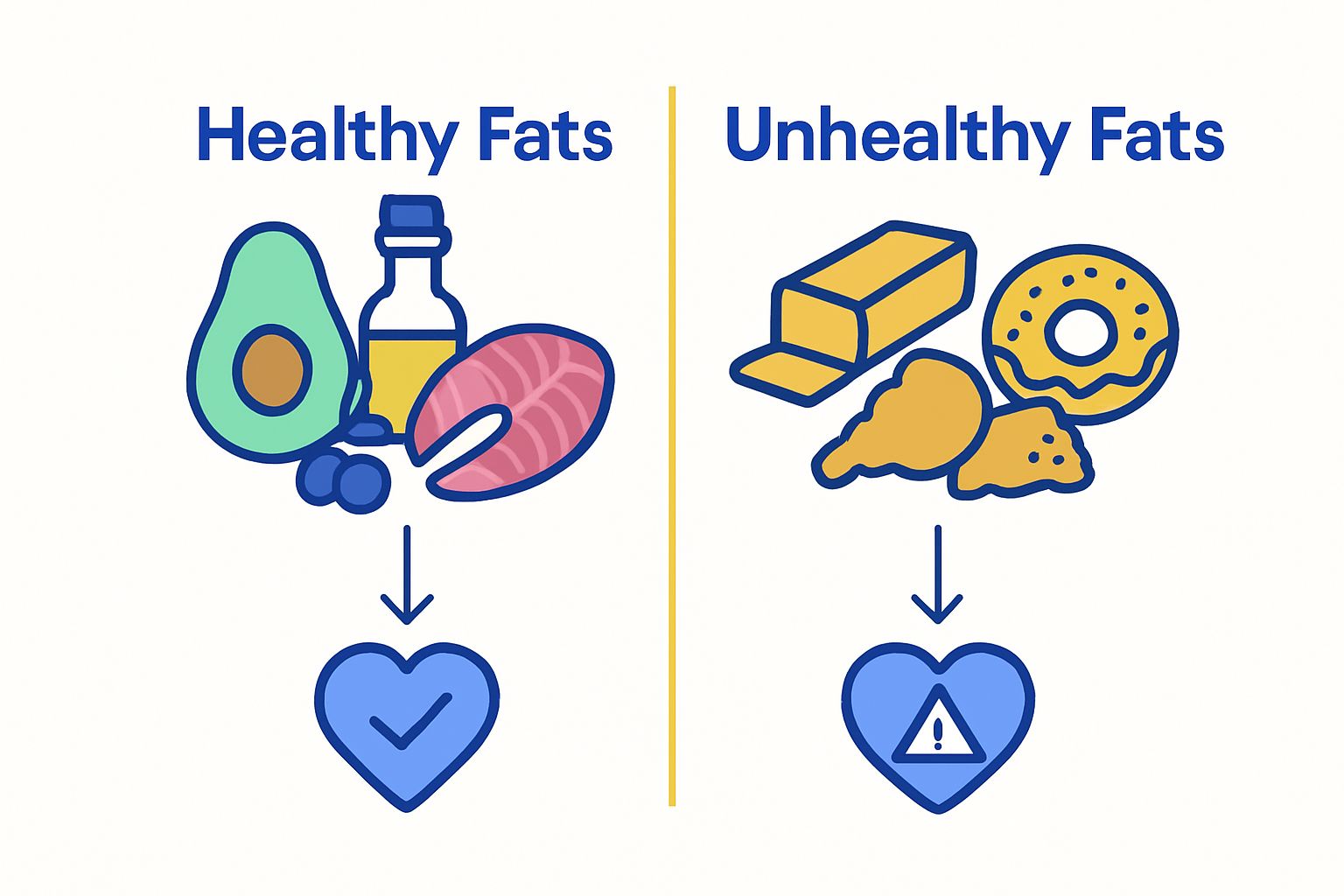
- Healthy Fats vs Unhealthy Fats: What’s the Difference?
- What Foods Are High in Healthy Fats?
- What Foods Are High in Saturated Fat?
- Why Are Trans Fats Considered Unhealthy?
- Why Does the Type of Fat Matter for Heart Health?
- Do Healthy Fats Help With Weight Loss?
- How to Choose Healthier Fats in Everyday Meals
- How to Read a Food Label for Fat
- Common Mistakes When Choosing Dietary Fats
- Frequently Asked Questions
- Key Takeaways
- Conclusion
- References
Quick Answer: Healthy Fats vs Unhealthy Fats
| Type of fat | General guidance | Common sources |
|---|---|---|
| Monounsaturated fats | Emphasize | Olive oil, avocado, peanuts, nuts |
| Polyunsaturated fats | Emphasize | Fatty fish, walnuts, seeds, soybean/sunflower oils |
| Saturated fats | Limit | Butter, ghee, fatty meats, cheese, full-fat dairy, coconut/palm oils |
| Industrial trans fats | Avoid | Foods containing partially hydrogenated oils |
The best approach to remember the difference is as follows:
Prioritize foods rich in unsaturated fats and limit those high in saturated fats. Also, eliminate industrially produced trans fats from the diet.
But it does not mean that all foods with saturated fats are bad, and all foods with unsaturated fats are good. The overall dietary pattern is of utmost importance.
What Are the Different Types of Dietary Fat?
Dietary fat forms a concentrated source of energy and fulfills several vital functions in the body. Fat is also involved in cell structure and facilitates the absorption of the fat-soluble vitamins A, D, E and K.
The dietary fats are divided into the following groups:
- Monounsaturated fat.
- Polyunsaturated fat.
- Saturated fat.
- Trans fat.
The division is based on the chemical composition of the fatty acids, but it also has practical significance since different types of fat affect blood cholesterol levels and cardiovascular health to varying degrees.
Monounsaturated Fats
Monounsaturated fats are unsaturated fats that contain one double bond in their fatty acid chain.
They are present in:
- Oils such as olive oil
- Avocados
- Peanuts and peanut butter
- Nuts such as almonds and cashews
- Some seeds
Substituting saturated-fat foods with monounsaturated-fat foods improves the overall quality of the diet. Monounsaturated fats are also often present in minimally processed foods (such as nuts and avocados) that also contain other nutrients.
Polyunsaturated Fats
Polyunsaturated fats have more than one double bond.
Two groups of polyunsaturated fats include omega-3 and omega-6 fatty acids.
Some polyunsaturated fatty acids are considered essential because they cannot be produced by the body in adequate amounts and must be obtained in the diet.
Food sources include:
- Fatty fish
- Walnuts
- Flaxseeds
- Chia seeds
- Soybeans
- Sunflower seeds
- Soybean oil
- Sunflower oil
- Some other vegetable oils
Including a variety of these foods can help provide essential fatty acids as part of a balanced eating pattern.
Saturated Fats
Saturated fats do not have any double bonds in their fatty acid chain.
Saturated fats are found naturally in a wide range of foods, including:
- Butter
- Ghee
- Cheese
- Full-fat dairy
- Fatty cuts of meat
- Sausages and processed meats
- Coconut oil
- Palm oil and palm kernel oil
Saturated fat should not be confused with trans-fat – they are distinctly different types of fat and guidance on their intake differs.
Current guidance from major health authorities is to limit saturated fat and replace it with unsaturated fats
The key to remember is that it is the replacement of saturated fat with unsaturated fats, rather than with more refined carbohydrates, that is associated with lower risk of chronic disease.
Trans Fats
Trans fats are unsaturated fats with a particular chemical arrangement.
Industrial trans fats were once created by a process called partial hydrogenation, which turned some liquid oils into more solid fats.
Partially hydrogenated oils were commonly used in the food industry because they helped to give certain foods their desirable mouthfeel, stability and longevity.
The FDA determined that partially hydrogenated oils were no longer generally recognized as safe and took regulatory action that substantially removed them from the U.S. food supply.
Small amounts of naturally occurring trans fats can still be found in some meat and dairy products.
For consumers, the practical message is straightforward: Avoid industrial trans fats whenever possible.
Healthy Fats vs Unhealthy Fats: What’s the Difference?
The phrase “healthy fats vs unhealthy fats” can be confusing when it comes to grasping the intricacies of the dietary domain.
A more accurate framework is:
Unsaturated fats: generally emphasize
Monounsaturated and polyunsaturated fats are generally the types of fat to emphasize in a healthy dietary pattern.
Common sources include:
- Nuts
- Seeds
- Avocados
- Fish
- Olive oil
- Other liquid plant oils
Saturated fats: generally limit
Saturated fat can be found naturally in various foods; however, diets that are high in this type of fat are usually improved by the replacement of some saturated-fat foods with unsaturated-fat-rich ones.
Industrial trans fats: avoid
Industrial trans fats are particularly undesirable because of the effect they have on blood cholesterol levels and cardiovascular health.
This is why the goal should not be to eliminate all dietary fats.
Instead, work on enhancing the overall quality of the fats in your diet.
What Foods Are High in Healthy Fats?
Many nutritious foods provide predominantly unsaturated fats along with other beneficial nutrients.
Olive Oil and Other Liquid Plant Oils
Olive oil is high in monounsaturated fat.
Other liquid plant oils, like canola, soybean, sunflower, and others, also contain unsaturated fats.
The type of oil that is most appropriate depends on the food being cooked, the method of cooking, your taste preferences, and the overall diet.
Nuts
Nuts contain unsaturated fats besides proteins, dietary fibers, vitamins, minerals, and other nutrients.
Some of the nuts include:
- Almonds
- Walnuts
- Pistachios
- Peanuts
- Cashews
- Pecans
Since nuts are caloric, one should consider the portion size when including them in the diet, especially when trying to lose weight.
Seeds
Seeds can offer unsaturated fats as well as other nutrients.
Examples of beneficial seeds are:
- Chia seeds
- Flaxseeds
- Pumpkin seeds
- Sunflower seeds
- Sesame seeds
These can be used in oatmeal, yogurt, salads or other dishes.
Avocados
Avocados are a good source of monounsaturated fat and also contain fiber and other nutrients.
They can be used to make salad, sandwiches, bowls and more.
Fatty Fish
Fatty fish are good sources of protein and long-chain omega-3 fatty acids.
Examples include:
- Salmon
- Sardines
- Mackerel
- Herring
- Trout
Incorporating these foods into a balanced diet can help increase your intake of healthy unsaturated fats.
Choosing foods that provide healthy fats along with other nutrients can improve overall diet quality. Learn more about building meals around nutrient-dense foods.
If you want a more detailed food-by-food list, see our guide to healthy fat examples.
What Foods Are High in Saturated Fat?
Saturated fat occurs naturally in many foods, so eliminating it entirely from the diet is generally not necessary is generally not necessary.
The more desirable approach is to focus on foods that are high in saturated fat and limit how much you eat of them.
Common sources include:
- Butter
- Ghee
- Cream
- Full-fat cheese
- Full-fat dairy products
- Fatty cuts of meat
- Sausage
- Bacon
- Some desserts
- Coconut oil
- Palm oil
The goal is not to demonize every food that happens to contain saturated fats.
Consider the overall pattern.
For example, if you’re using mostly butter as your added fat, you could benefit from partially replacing it with an unsaturated-fat-rich plant oil.
Why Are Trans Fats Considered Unhealthy?
Trans fats need special consideration due to the especially harmful effect of industrially produced trans fats on cardiovascular health.
The FDA warns that consumption of trans fats leads to an increase in bad cholesterol LDL, which is a significant risk factor for cardiovascular diseases.
Industrially produced trans fatty acids were mainly produced using partially hydrogenated oils.
Although partially hydrogenated oils have been largely phased out of the US food supply, consumers still need to be mindful of the possibility of encountering them in imported or ultra-processed foods.
Check the ingredient list for:
Partially hydrogenated oil
Avoid such products if possible, choosing alternatives.
It is also important to distinguish between partially and fully hydrogenated oils. They are not chemically equivalent.
Why Does the Type of Fat Matter for Heart Health?
One of the most evident issues that connect dietary fat and health is the association of cholesterol and cardiovascular disease with fat in the diet.
Saturated and trans fats can raise LDL cholesterol. Replacing saturated-fat sources with unsaturated-fat sources can improve the overall dietary fat profile and is part of a heart-healthy eating pattern.
The recommended practice of the current dietary instructions from the American Heart Association focuses on the replacement of saturated fat with unsaturated, which is part of a heart-healthy eating pattern.
This means the question is not simply:
“How much fat am I eating?”
A more useful question is:
“What types of fat am I eating, and what foods are they replacing?”
For example, replacing butter with an unsaturated plant oil is nutritionally different from replacing butter with a refined carbohydrate food.
This concept of nutrient replacement is important when evaluating dietary fat.
Do Healthy Fats Help With Weight Loss?
Healthy fats can contribute to a weight-loss diet, but they should not be considered fat-burning foods.
Dietary fat provides 9 calories per gram, compared to 4 calories per gram for protein or carbohydrate.
This means that nutritious foods such as:
- Nuts
- Seeds
- Avocado
- Olive oil
- Nut butters
can add up to calories, even in small amounts.
At the same time, their value as nutrient-dense foods means they can still be part of a healthy eating pattern.
Fiber is another important component of a filling, nutrient-dense eating pattern. Learn more about how to use fiber for weight loss without treating it as a shortcut to fat loss.
For weight management, it is essential to focus on:
- The amount of food
- The overall energy content
- Dietary quality
- Protein intake
- Fiber
- Fruit and vegetable intake
- And physical activity
Thus, unsaturated-fat-rich foods can be valuable parts of a healthy diet, but increasing fat intake without considering total calories and overall dietary quality will not automatically lead to weight loss.
Dietary fat is only one of the three macronutrients, so understanding how protein, carbohydrates and fat fit together can provide useful context when planning macronutrients for weight loss.
How to Choose Healthier Fats in Everyday Meals
You may not need to make wholesale changes to your diet to improve the types of fat you’re eating.
Some simple substitutions are worth considering.
Use Unsaturated Oils More Often
Depending on the recipe and how you’re cooking, you’re likely to get more heart-healthy fats if you choose an appropriate liquid plant oil over solid fats like butter.
Add Nuts and Seeds
Add small amounts of nuts or seeds to your meals and snacks.
They’ll give you unsaturated fats, plus protein, fiber and other nutrients.
Include Fish
Including fatty fish in your diet can provide omega-3 fatty acids as well as protein.
Use Avocado
Avocado can be used to make healthy sandwiches, salads and other dishes.
Reduce Frequent Highly Processed Foods
Many highly processed foods tend to pack in a lot of saturated fat, refined carbohydrates, added sugars or sodium.
Limiting them can go a long way toward improving your overall diet without needing to make a huge effort to focus on just one type of food.
Once you understand which fat sources to emphasize and which to limit, meal planning for weight loss can make these choices easier to apply consistently.
How to Read a Food Label for Fat
Nutrition labels may help you choose between packaged foods.
Check the Serving Size
You should always start with the serving size.
A food may look low in fat per serving, but eating several servings could add up to too much fat.
Check Total Fat
The “Total Fat” line tells you how much fat is in the serving size, but it doesn’t tell you whether the fat is unsaturated, saturated, or trans-fat.
Check Saturated Fat
Compare the amount of saturated fat in similar products.
In general, you should aim to eat less saturated fat.
Check Trans Fat
Also check the ingredient list for partially hydrogenated oil. In the U.S., a product can list 0 grams of trans fat per serving while still containing a small amount when the amount is below the labeling threshold.
Look at the Ingredient List
The ingredient list can give you more information about the type of fat in the food.
Partially hydrogenated oil is an ingredient that you should watch out for because it contains trans fat.
Look Beyond the Fat Number
Just because a food has less fat, doesn’t mean it’s healthier.
You should also look at:
- added sugars,
- sodium,
- fiber,
- protein,
- how processed the food is,
- the overall nutritional value.
A food should be looked at as a whole not just a number on a nutrition facts label.
Common Mistakes When Choosing Dietary Fats
Let us discuss the top 7 mistakes:
Mistake 1: Avoiding All Dietary Fat
Fat is an essential nutrient and the key is to improve the types and sources of fat in one’s diet.
Mistake 2: Assuming Healthy Fats Can Be Eaten Without Portion Awareness
Although olive oil, nuts, seeds and avocado are regarded as healthy, they are energy-dense foods and should be eaten in moderation.
Mistake 3: Treating Saturated Fat and Trans Fat as the Same
Saturated and trans fats are different types of fat, and they should not be treated as interchangeable. Saturated fat should generally be limited, while industrial trans fats should be avoided.
Mistake 4: Replacing Saturated Fat With Refined Carbohydrates
It is true that simply substituting refined carbs for saturated fat does not automatically make one healthier. The food used for substitution is also important.
Mistake 5: Assuming Solid Fat Is Always Unhealthy
A fat’s physical state – liquid or solid – does not determine its healthfulness. Different fats have varying degrees of saturation, and most foods contain fats of mixed saturation.
Mistake 6: Assuming “Natural” Automatically Means Healthy
A food being natural does not automatically make it a healthier choice. Some natural foods are high in saturated fat or calories, so the overall food and dietary pattern still matter.
Mistake 7: Focusing Only on Individual Nutrients
A healthy diet consists of more than fats, so even if someone has a good type of dietary fat, it does not mean that they are eating healthily in other areas. Vegetables, fruits, whole grains, legumes, nuts, seeds, fish and appropriate protein sources should all be consumed as part of a balanced diet.
For a broader look at sustainable weight management, see our guide to evidence-based weight loss.

Saturated vs Unsaturated Fats: What’s the Difference?
Saturated and unsaturated fats differ in their molecular structure, the food sources in which they are commonly found, and the approach to dietary instruction. This knowledge can be helpful in selecting the best fats for one’s diet without completely limiting them.
Chemical Structure
The main structural difference is the number of double bonds in the fatty acid chain.
Saturated fats have no double bonds between their carbon atoms. These fats are common in animal products and some tropical oils.
Unsaturated fats have one or more double bonds. They are divided into monounsaturated fats, which have one double bond, and polyunsaturated fats, which have two or more.
This difference in structure makes them different in terms of the impact on blood cholesterol levels and, consequently, on the functioning of the cardiovascular system.
Common Food Sources
Saturated fats are commonly found in:
- Butter and ghee
- Full-fat dairy products and cheese
- Fatty cuts of meat
- Sausages and other processed meats
- Coconut oil
- Palm and palm kernel oils
Unsaturated fats are commonly found in:
- Olive and other liquid plant oils
- Avocados
- Nuts and peanuts
- Seeds
- Fatty fish
- Foods containing omega-3 and omega-6 fatty acids
Many foods contain a mixture of different types of fat, so it is not always useful to classify an entire food as simply “good” or “bad.”
General Dietary Guidance
Currently, dietary guidelines generally recommend limiting the intake of saturated fats, while favoring unsaturated fats, especially when the replacement choices are unsaturated- over saturated-fatty foods.
Industrial trans fats are considered to be treated differently and should be avoided as much as possible.
Thus, the point is not to avoid fats in the diet, but to improve the overall quality and sources of the ones consumed.
Why Does Replacement Matter?
One of the most important considerations in comparing saturated with unsaturated fats is what is being used to replace the former.
The replacement of saturated fat by unsaturated fat may be more beneficial than the replacement by refined carbohydrates or highly processed foods.
For example, replacement of butter by an unsaturated, plant oil is qualitatively different from replacing butter by a refined carbohydrate food, and the overall quality of the replacement diet still is important.
Examples of Healthier Substitutions
Small substitutions can make it easier to increase unsaturated fats while reducing saturated fat.
For example:
- Use olive or another liquid plant oil instead of butter when appropriate.
- Choose nuts or seeds instead of highly processed snack foods.
- Choose fatty fish instead of fatty processed meats more often.
- Use avocado in place of some butter or other saturated-fat-rich spreads.
- When choosing dairy products, compare options based on their overall nutritional profile rather than focusing on fat alone.
When picking dairy products, it is essential to choose the ones that have a better nutrient profile instead of comparing solely based on fat content. These substitutions allow people to reduce the amount of saturated fats without limiting foods with healthy fats in their diet.
Frequently Asked Questions:
Are all fats unhealthy?
No. Dietary fat is an essential nutrient and unsaturated fats can be an important part of a healthy eating pattern.
The general approach is to emphasize unsaturated fats, limit saturated fats and avoid industrial trans fats.
What are the healthiest types of fat?
Monounsaturated and polyunsaturated fats are generally the types of dietary fat to emphasize.
Good food sources include olive oil, other liquid plant oils, nuts, seeds, avocados and fish.
Which fats should I limit?
Saturated fats should generally be limited, particularly when they can be replaced with unsaturated fats.
For example, the American Heart Association recommends limiting saturated fat to less than 6% of total calories, which is about 13 grams per day on a 2,000-calorie diet.
Industrial trans fats should be avoided whenever possible.
Are saturated fats always unhealthy?
Saturated fats occur naturally in many foods and are different from trans fats.
However, major health organizations recommend limiting saturated fat and replacing some saturated-fat sources with unsaturated fats.
The overall food and dietary pattern also matter.
What is the difference between saturated and unsaturated fats?
Saturated fatty acids are those that lack double bonds in the molecule, and unsaturated ones have at least one double bond. Saturated fats are present in butter, ghee, fatty meats, and whole dairy products; unsaturated ones are usually found in olive oil, nuts, seeds, avocado, and fish. It is claimed that it is healthier to eat fewer amounts of the former and more of the latter.
Is olive oil healthier than butter?
Olive oil is usually healthy because it contains monounsaturated fats, whereas butter has more saturated fats; thus, replacing some of the latter with olive oil in one’s diet would lead to a better ratio of fats. However, it should be remembered that olive oil is still high in calories, so it should be taken in moderation.
Are healthy fats good for weight loss?
Healthy fats can be part of a weight loss diet, but they don’t actually burn fat. Such foods as nuts, seeds, avocado, and olive oil are healthy but high in calories. The portions, overall calories consumed, the quality of the foods eaten, protein, fiber, and exercise are all important factors in losing weight.
Can I eat healthy fats while trying to lose weight?
Yes.
Healthy fats can fit into a weight-loss diet.
However, dietary fat is calorie-dense, so portion size and total energy intake remain important.
Is olive oil a healthy fat?
Olive oil is rich in monounsaturated fat and can be part of a healthy dietary pattern.
However, it is still calorie-dense, so reasonable portions are appropriate.
Are nuts and seeds healthy sources of fat?
Yes.
Nuts and seeds provide predominantly unsaturated fats along with protein, fiber, vitamins, minerals and other dietary components.
Because they are energy-dense, portion awareness remains useful.
Are coconut oil and palm oil healthy fats?
Coconut and palm oils are plant-derived, but they are relatively high in saturated fat.
For that reason, they should not automatically be treated as equivalent to unsaturated-fat-rich oils such as olive or canola oil.
How can I identify trans fats on a food label?
Check the Nutrition Facts label for trans fat and review the ingredient list for partially hydrogenated oil.
Industrial trans fats have been substantially reduced in many food supplies, but checking labels can still be useful, particularly for highly processed or imported products.
Do healthy fats reduce belly fat?
No specific dietary fat should be described as a targeted belly-fat treatment.
Body-fat distribution changes as part of broader changes in energy balance, diet, activity and other factors.
Healthy fats can be part of a nutritious eating pattern, but they do not selectively burn abdominal fat.
Key Takeaways:
- Dietary fat is an essential nutrient and does not need to be eliminated.
- Monounsaturated and polyunsaturated fats are generally the types of fat to emphasize.
- Saturated fat should generally be limited.
- Industrial trans fats should be avoided whenever possible.
- Most foods contain a mixture of different fatty acids.
- The food source and what replaces a particular fat are important.
- Nuts, seeds, avocados, fish and liquid plant oils are useful sources of unsaturated fats.
- Healthy fats are still calorie-dense, so portion size matters.
- Food labels can help you compare saturated and trans fat content.
- A lower-fat food is not automatically a healthier food.
- Overall dietary pattern matters more than classifying every food as simply “good” or “bad.”
Choosing healthier fat sources works best as part of a broader pattern of sustainable healthy eating habits, rather than as a stand-alone dietary rule.
Conclusion
Understanding the difference between healthy and less healthy fats does not necessarily mean cutting out all fats from the diet.
It is rather important to focus on the type of fat, the food it comes with, the amount and what it is replacing in one’s diet.
Prioritize foods that contain unsaturated fats, such as nuts, seeds, avocado, fish, and some oils, over those that are high in saturated fat, and limit industrial trans fats when possible.
Remember also that if one is focusing on maintaining or achieving a healthy weight, fats, even the “good” ones, are still energy-dense, meaning that portion size and overall calories should also be taken into consideration.
The bottom line is not to look for forbidden foods or nutrients, but rather to choose a varied and balanced diet, in which healthier fats have a more prominent role compared to less healthy ones.
Medical Disclaimer:
This article is for general educational and informational purposes only and is not intended to offer or recommend medical advice, diagnosis, or therapy. Dietary requirements may change according to one’s state of health, drugs, medical conditions, age, and other factors. Before making significant dietary changes, consult your physician if you have cardiovascular disease, diabetes, high cholesterol, or other medical conditions.
References:
- American Heart Association — Fats in Foods
American Heart Association — Fats in Foods - Harvard T.H. Chan School of Public Health — Types of Fat
Harvard Nutrition Source — Types of Fat - Harvard T.H. Chan School of Public Health — Fats and Cholesterol
Harvard Nutrition Source — Fats and Cholesterol - FDA — Trans Fat
FDA — Trans Fat - FDA — Final Determination Regarding Partially Hydrogenated Oils
FDA — Partially Hydrogenated Oils - Harvard Nutrition Source — How to Choose Healthy Fats
Harvard Nutrition Source — How to Choose Healthy Fats - Why Trust Us?
- For Educational Purpose Only