

Fiber is frequently heralded as an essential component of a healthy diet, but its connection to weight loss is far more complicated than many people realize.
Increasing your intake of fiber can help promote satiety and make it easier to build nutrient-dense, high-volume meals with relatively fewer calories per bite. Certain forms of fiber may also have an effect on digestion, satiety and nutrient absorption.
However, fiber itself is not a magic bullet for weight loss, and simply eating more of it will not necessarily cause you to lose weight if your overall diet continues to provide more energy than your body needs.
Learning about the effects of fiber and how to incorporate it into your diet can help you make it a part of a long-term weight loss and healthy living strategy.
The most important thing to remember is that the point is not to consume as much fiber as possible, but rather to eat enough fiber to reap the physiological and satiety benefits while avoiding adverse effects by introducing it slowly and getting it from a variety of sources.
Fiber can be a useful part of a sustainable approach, but it is only one piece of the bigger picture. Understanding the principles behind evidence-based weight loss can help put fiber into the proper context.
Table of Contents
- What Is Dietary Fiber?
- How Does Fiber Help With Weight Loss?
- Fiber and Satiety
- Fiber and Food Volume
- Fiber and Calorie Intake
- Fiber and Overall Diet Quality
- Does Fiber Actually Help You Lose Weight?
- How Much Fiber Do You Need Per Day?
- Best High-Fiber Foods for Weight Loss
- Soluble vs. Insoluble Fiber: Which Is Better for Weight Loss?
- Fiber, Appetite and Fullness
- Fiber, Gut Health and Weight Management
- How to Increase Fiber Without Getting Bloated
- Should You Use a Fiber Supplement for Weight Loss?
- How to Build a High-Fiber Diet for Weight Loss
- Common Mistakes When Increasing Fiber
- Frequently Asked Questions
- Key Takeaways
- Conclusion
Quick Answer: Is Fiber Good for Weight Loss?
| Goal | What fiber can do |
|---|---|
| Lose body fat | Help make a calorie-controlled diet more filling and nutrient-dense |
| Control hunger | Some fiber types may improve fullness and satiety |
| Eat more food for fewer calories | Many fiber-rich foods are high in water and relatively low in energy density |
| Improve diet quality | Fruits, vegetables, legumes and whole grains provide fiber plus other nutrients |
| Support digestion | Fiber contributes to normal bowel function and supports gut microorganisms |
| Increase fiber intake | Add fiber gradually and maintain adequate fluid intake |
| Use supplements | Certain fibers may have specific benefits, but supplements aren’t necessary for everyone |
The key point is that fiber can make a healthy weight-loss diet easier to follow, but it does not replace appropriate overall energy intake, physical activity and sustainable eating habits.
What Is Dietary Fiber?
Dietary fiber refers to a group of carbohydrates that are not fully digested and absorbed in the small intestine.
Unlike digestible carbohydrates, fibers are largely resistant to digestion and pass through the gastrointestinal tract, although some can be fermented by intestinal microbes in the large intestine.
Fibers are naturally present in a variety of foods, including:
- Vegetables
- Fruits
- Legumes such as beans and lentils
- Chickpeas
- Whole grains
- Nuts
- Seeds
- Isolated or added forms of dietary fiber may also be present in foods or supplements.
The term dietary fiber encompasses a variety of materials with different physical and physiological properties. This is one reason why it is too simplistic to believe that all fibers will have similar beneficial effects on satiety, digestion or body weight.
In addition to the familiar distinction between soluble and insoluble fiber, a variety of factors, including viscosity and fermentability, can influence the physiological effects of fiber.
Soluble Fiber
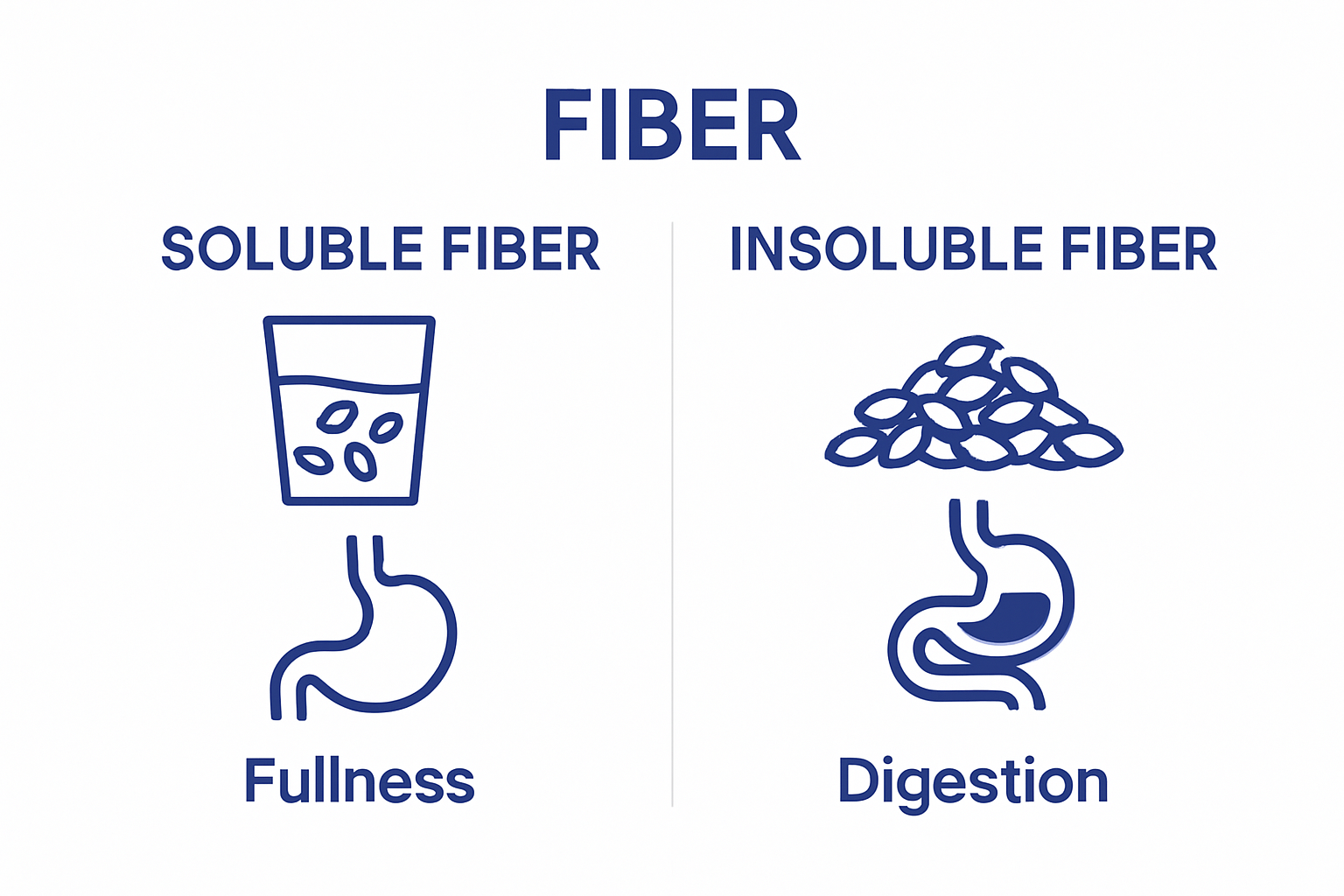
Some soluble fibers can dissolve in water and, depending on their properties, form viscous or gel-like substances.
Examples of foods that contain soluble fibers include:
- Oats
- Barley
- Legumes such as beans and lentils
- Some fruits
- Psyllium
A number of different soluble and viscous fibers have been studied in relation to effects on satiety, digestion, blood glucose and other health outcomes.
Insoluble Fiber
Insoluble fiber tends to be poorly soluble in water, contributing to increased fecal volume and promoting normal intestinal motility.
Sources of insoluble fiber include:
- Many vegetables
- Whole grains
- Wheat bran
- Nuts
- Seeds
- The skins of fruit
In practice, a variety of different dietary fibers are present in most plant-based foods and there is little point in distinguishing between soluble and insoluble fiber in an attempt to obtain an optimal ratio of one to the other.
How Does Fiber Help With Weight Loss?
Fiber does not directly “burn fat.” It may play an indirect role in weight management due to its effects on satiety, food volume, food and diet quality, and eating behaviors.
Fiber and Satiety
Eating foods that are high in fiber tends to be more satiating than eating less fibrous foods.
Fibers that are viscous can physically alter the properties of the digestive tract and slow gastric emptying or nutrient absorption. Some fibers appear to increase satiety, but the effects are variable depending on the type of fiber.
A review of 44 studies found that only about a third of acute interventions that increased fiber intake significantly reduced hunger or food and energy intake. In other words, fiber can help, but it is not a silver bullet.
More recent work looking at cereal fibers also found mostly beneficial effects on satiety measures (with some oat and rye fibers performing better than others), but more mixed results when it came to actual ad-libitum energy intake.
That being said, it is probably best to think about fiber’s role in satiety as part of a balanced diet.
Fiber and Food Volume
Many fiber-rich foods, particularly fruits, vegetables and legumes, also contain substantial water and have relatively low energy density.
Many whole foods that are naturally high in fiber also contain substantial water, which can give them relatively low energy density.
This has the benefit of allowing you to eat more food with fewer calories, which is useful if you’re trying to lose fat.
Fiber and Calories
By altering satiety and food volume, fiber can affect total energy intake.
A meal that is rich in vegetables, legumes, whole grains, and whole fruits will likely be more filling than a meal of highly-processed refined-carb products and will include more micronutrients and macronutrients. However, this does not mean that fiber “burns calories.” Fiber can alter the digestion and absorption of nutrients, but it does not directly reduce the caloric content of food.
Eating more fiber while continuing to eat more calories than you expend will not cause you to lose fat.
Fiber and Diet Quality
Eating foods that are high in fiber tends to improve diet quality.
The main benefit of emphasizing fiber-rich foods is that they tend to come with other essential nutrients.
Legumes, whole fruits and vegetables, whole grains, nuts, and seeds provide fiber along with a range of vitamins, minerals and other beneficial dietary components. That makes them excellent choices if you’re trying to lose fat while maintaining a healthy diet.
Fiber is one component of a balanced eating pattern, alongside protein, carbohydrates and dietary fat. If you want to understand how these nutrients fit together, see our guide to macronutrients for weight loss.
Does Fiber Actually Help You Lose Weight?
Yes, fiber can contribute to a diet that promotes weight loss, but the degree of benefit depends upon the type, food source, quantity consumed, and the overall diet.
This is an important distinction.
It would not be correct to say:
“The more fiber you eat, the more weight you will automatically lose.”
The reality is more nuanced.
Some systematic reviews have found only modest improvements in body weight or appetite with certain fiber types, while others have found no significant benefit.
For example, research investigating the effects of viscous fiber supplementation on calorie restricted diets have reported modest improvements in body weight and body-fat measures, but these should not be construed as proof that fiber alone causes appreciable weight loss.
A broader review of randomized controlled trials also found that the effects of dietary fiber on appetite, energy intake and body weight varied widely according to the physical and chemical properties of the fiber.
The practical takeaway is more useful than a single number:
Fiber can make a healthy calorie-controlled diet easier to follow, but it is not a substitute for appropriate overall energy intake.
How Much Fiber Do You Need Per Day?
For adults, a general daily target is approximately 22 to 34 grams of fiber, depending on age and sex.
Another way to think about it is approximately 14 grams per 1,000 calories, although individual needs vary.
You don’t need to hit an exact number every day.
For example:
| Daily calorie intake | Approximate fiber target |
|---|---|
| 1,500 calories | ~21 g |
| 1,800 calories | ~25 g |
| 2,000 calories | ~28 g |
| 2,500 calories | ~35 g |
These figures are practical reference points rather than rigid prescriptions.
If your current diet is low in fiber, moving to a high-fiber diet suddenly may cause bloating, gas or changes in bowel habits.
You should increase your fiber intake gradually.
More is not necessarily better: the aim should be to consume an adequate amount of fiber for your needs, not too little and not too much.
Best High-Fiber Foods for Weight Loss
If you want to increase fiber while losing weight, focus on whole or minimally processed foods.
Lentils
Lentils provide fiber along with plant protein, making them particularly useful for filling meals.
Some ideas:
- Soups
- Salads
- Curries
- Grain bowls
Beans
Black beans, kidney beans, chickpeas and other legumes provide fiber and plant protein.
They can also add significant volume to meals without requiring very calorie-dense ingredients.
Oats
Oats contain beta-glucan, a type of soluble fiber that has been studied for its effects on satiety and metabolic health.
A bowl of oats can also be supplemented with fruit, nuts or seeds for a more balanced meal.
Berries
Berries contain fiber, as well as water and phytochemicals.
Some ideas:
- Oatmeal
- Yogurt
- Smoothies
- Whole-grain breakfasts
Apples and Pears
These whole fruits provide fiber along with water and micronutrients.
Eating them whole, rather than drinking the juice, will preserve the physical structure of the food as well.
Vegetables
These are some of the easiest ways to increase dietary fiber while also getting significant food volume.
Some ideas:
- Broccoli
- Carrots
- Green peas
- Brussels sprouts
- Leafy greens
- Cauliflower
- Green beans
Barley and Other Whole Grains
Whole grains can contribute fiber while also providing carbohydrates that can fit into a balanced diet.
Some ideas:
- Barley
- Oats
- Brown rice
- Whole-grain bread
- Whole-grain pasta
- Quinoa
Nuts and Seeds
These contain fiber, as well as healthy fats and other nutrients.
However, they are relatively energy-dense, so portion size still matters if your goal is to reduce fat.
Chia Seeds
Chia seeds are particularly fiber-dense and can be added to yogurt, oatmeal or smoothies.
Again, “healthy” doesn’t mean “calorie-free,” so portions still matter in your overall diet.
Flaxseed
Ground flaxseed can provide fiber and unsaturated fats and can be incorporated into oatmeal, yogurt, smoothies or other meals.
The larger point is that you don’t need to look for one “superfood.”
Having a variety of fiber-rich foods is generally a healthier approach than relying heavily on just one.
Soluble vs. Insoluble Fiber: Which Is Better for Weight Loss?
Neither should be dismissed as the “best” fiber for weight loss purposes.
The soluble variety may have different effects on the body, including feelings of fullness after eating, depending on how much of it is consumed at once.
Some soluble and particularly viscous fibers have shown greater effects on satiety and energy intake than certain other fiber types, but the response varies considerably between fibers.
Meanwhile, insoluble fiber aids in bulk production and normal peristalsis.
However, most foods contain both types of fibers.
That means a diet containing:
- vegetables
- fruits
- legumes
- whole grains
- nuts
- seeds
is generally more useful than trying to engineer your diet around a single fiber category.
The evidence also suggests that fiber should not be considered as a single entity, since there are different types of fibers that have different physical characteristics and different effects on satiety and energy intake.
Fiber, Appetite and Fullness
One of the most intriguing questions is whether fiber can help you eat less and not be hungry.
The good news is that it can, sometimes.
Some forms of fiber are more filling than others.
According to one systematic review, only 39% of fiber interventions were associated with significant decreases in subjective feelings of hunger, and only 22% of fiber treatments significantly reduced food or energy intake, based on acute trials included in the analysis.
This finding suggests that fiber should not be relied upon to reduce hunger or food intake, but building meals around fiber-rich foods can be a useful strategy for decreasing weight.
For example, consider the choice between:
Option A
A small amount of highly refined snack that has little effect on satiety.
Option B
A meal including vegetables, legumes, whole grains and a source of protein.
The second option can provide substantially more food volume and micronutrients without necessarily requiring a large calorie intake.
This is one reason a fiber-rich eating pattern may make it easier to maintain a lower calorie intake.
Fiber, Gut Health and Weight Management
Fiber is also important for normal digestive function.
A portion of fiber, however, can be broken down and fermented by bacteria in the large intestine, where they produce metabolites such as short-chain fatty acids.
This has led to great interest in the relationship between dietary fiber, the gut microbiome and overall metabolism. However, it is crucial not to overestimate the role of these processes.
The gut microbiome is influenced by many factors, including:
- Diet
- Overall food variety
- Medication
- Health status
- Lifestyle
- Individual differences
So it would be misleading to say that increasing fiber will somehow “fix” the gut microbiome or automatically cause dramatic weight loss.
Instead, think about fiber as a part of a varied diet that is healthy for your digestion and general metabolism.
How to Increase Fiber Without Getting Bloated
If you find yourself eating very little fiber, increase it gradually.
A sudden large increase in fiber may lead to gas, bloating, abdominal discomfort or changes in bowel habits.
The NIDDK recommends gradually adding fiber to your diet and drinking plenty of fluids to allow the fiber to work properly.
One simple way to do this is as follows:
Week 1
Add one more portion of veggies or fruit per day.
Week 2
Add a serving of beans, lentils, or other legumes several times during the week.
Week 3
Substitute some refined grains for whole grains.
Week 4
Assess your current diet and slowly work towards the recommended daily amount of fiber.
You need not immediately begin making all changes.
Moreover, if you have a preexisting GI condition, consult with a medical professional before making lasting dietary changes, especially if you begin to feel discomfort during the transition.
Should You Use a Fiber Supplement for Weight Loss?
Fiber supplements can be useful in specific scenarios, but they should not be viewed as an automatic solution for weight loss.
Whole foods tend to offer a more complete mix of nutrients and food structure than a supplement.
Certain isolated fibers have been studied for their effects on satiety and energy intake, but the evidence varies considerably between fiber types and products.
A systematic review of extracted and isolated fibers concluded that of the analyzed fiber types, most did not demonstrate a significant reduction in appetite or energy intake. Some viscous fibers were more promising, but the authors note the inconsistency of evidence and limitations of the reviewed studies.
This is why it is better to begin with food.
Good food sources of fiber include:
- beans
- lentils
- chickpeas
- oats
- fruits
- vegetables
- whole grains
- nuts
- seeds
When choosing a fiber supplement, it is important to consider the type of fiber and serving size, your diet, and any medications or conditions that could interact with the substance.
A fiber supplement should complement a healthy diet rather than replace it.
How to Build a High-Fiber Diet for Weight Loss
You do not need to follow a special “fiber diet”.
Instead, build your meals around a few simple principles.
Breakfast
Try:
- Oatmeal with berries and seeds
- Whole grain toast with eggs and fruit
- Greek yogurt with berries, oats and chia seeds
Lunch
Try:
- Lentil soup with vegetables
- Chickpea and vegetable salad
- Bean bowl with vegetables and whole grains
Dinner
Build your plate around:
- A protein source
- Several servings of vegetables
- A high-fiber carbohydrate such as beans, lentils, barley or another whole grain
Snacks
Consider:
- whole fruit
- A small serving of nuts
- Vegetables with hummus
- Plain yogurt with berries
If you’re already working on your overall diet, our guide to macronutrients for weight loss can help you understand how fiber fits alongside protein, carbohydrates and dietary fat.
Planning meals around vegetables, fruits, legumes, whole grains and other minimally processed foods can make it easier to consistently reach your fiber target. Our guide to meal planning for weight loss can help you turn these principles into practical meals.
A balanced meal can combine a fiber-rich carbohydrate source with a quality protein source to improve overall satiety and nutritional value. For practical ideas, see our guide to protein sources for weight loss.
Common Mistakes When Increasing Fiber
Mistake 1: Going from Low to High Fiber Too Fast
Switching from a low-fiber to a high-fiber diet in a very short time can cause some unnecessary discomfort.
Go slowly.
Mistake 2: Thinking Fiber Cancels Out Everything Else
Although fiber may interfere with the digestion and absorption of some nutrients, it doesn’t cancel out the calories in the rest of your diet.
Mistake 3: Getting Your Fiber from Supplements Alone
Besides providing specific fiber ingredients, supplements don’t include the array of nutrients found in whole foods.
Mistake 4: Not Paying Attention to Serving Sizes
Some high-fiber foods — like nuts and seeds — also pack in calories.
A healthy diet includes these calorie-rich foods in addition to fiber-rich foods.
Mistake 5: Assuming “High Fiber” Means Nutritious
A processed food can include fiber ingredients — and lots of calories — without being healthy.
Mistake 6: Not Drinking Enough Water
When increasing fiber, fluid is especially important.

Frequently Asked Questions About Fiber for Weight Loss
Does fiber help you lose weight?
Dietary fiber can contribute to weight loss by enabling nutrient-dense, satiating meals and, in some cases, enhancing satiety depending on the type of fiber. However, weight loss cannot be guaranteed through fiber and depends on overall caloric balance and dietary patterns.
How much fiber should I eat to lose weight?
There is no separate fiber target specifically designed to cause weight loss. General adult fiber recommendations are around 22–34 grams per day, depending on age and sex. [5]
What are the best high-fiber foods for weight loss?
The best high-fiber foods to include in a weight loss diet are beans, lentils, and chickpeas, vegetables, and whole fruits, as well as oats, barley and other whole grains. Nuts and seeds are high in fiber but calorie-dense, so they should be eaten in moderation.
Does soluble fiber help with weight loss?
Some types of soluble and especially viscous fibers have been shown to enhance satiety and impact energy intake but the effect largely depends on the type of fiber so it should not be considered an ingredient for guaranteed weight loss.
Is insoluble fiber good for weight loss?
While insoluble fiber is associated with normal digestive function, it can be a part of a healthy weight loss diet, but its main role should not be to directly impact weight since there is no strong evidence for it.
Can fiber reduce hunger?
Depending on the type, fiber can enhance satiety, but the satiety-inducing properties vary between individuals and are not consistent enough to suggest that fiber will reduce hunger in every case.
Can I get enough fiber from food?
Yes. It is possible to obtain adequate fiber entirely from food. A varied diet containing vegetables, fruits, legumes, whole grains, nuts and seeds can provide substantial amounts of fiber without requiring a supplement.
Should I take a fiber supplement to lose weight?
It is not necessary to take a fiber supplement to lose weight, but doing so may be beneficial for some people under certain conditions. It is important to bear in mind that not all fiber supplements are created equal, and the effects they might have on weight loss depend on the type of fiber they contain.
Why does fiber make me bloated?
Some people experience bloating when increasing their fiber intake because of the adjustments their gastrointestinal tract and microbiome must make when exposed to higher levels of fiber than usual.
Does fiber burn belly fat?
No type of fiber has been shown to specifically target belly fat. A fiber-rich eating pattern may support overall weight management by helping create more filling, nutrient-dense meals, but reductions in abdominal fat occur as part of overall changes in body fat.
Can I eat too much fiber?
Yes. Very high fiber intakes can cause bloating, gas, abdominal discomfort and changes in bowel habits, particularly when intake is increased rapidly. More fiber is not automatically better; the goal is an amount that is appropriate for your diet and digestive tolerance.
What is the easiest way to increase fiber?
The easiest way to increase fiber is to start by adding a couple of fiber-rich foods of your choice to your daily meals. For instance, you can add berries or oats to your morning meal, more vegetables to your lunch, and legumes or lentils to your dinner.
Key Takeaways:
- Fiber can support weight loss, but it is not a magic bullet.
- Foods high in fiber can be used to make meals that are more filling and nutritious.
- Some fibers seem to promote feelings of fullness more than others.
- The impact of fiber on real-world food intake and body weight is relatively small and varies between fiber types.
- Adults need around 22–34 g fiber per day — depending on age and sex.
- Excellent sources are vegetables, fruits, legumes, whole grains, nuts and seeds.
- Fiber should be introduced gradually to avoid bloating and gas.
- It is also important to maintain adequate fluid intake when increasing fiber consumption.
- Supplements can be helpful in specific circumstances, but whole foods should generally dominate one’s diet.
- Fiber cannot compensate for overeating or specifically target belly fat for loss.
- A balanced and diverse diet is more important than focusing on a particular number or fiber type.
Conclusion
A fiber-rich diet is a valuable component of a healthy weight-loss program, but it should not be considered an elixir.
Its value lies in the context.
Foods high in fiber can add bulk to the diet, promote satiety and improve the nutritional quality of meals. Certain types of fiber may also influence digestion and feelings of fullness, which can make a calorie-controlled eating pattern easier to maintain.
At the same time, however, fiber is just one element of the puzzle. To lose body fat, your overall dietary pattern needs to provide an appropriate energy balance over time, while physical activity and sustainable lifestyle habits can support the process.
Thus, the simplest and most effective way to increase the number of fibers in the diet is to eat more vegetables, fruits, legumes, whole grains, nuts, and seeds. It is recommended to do this gradually, to give the digestive system time to adapt, to drink plenty of water, and to pay attention to the overall composition of the diet, not just individual components.
Nutrition is only one part of long-term body-composition management. Resistance training can also play an important role, so you may want to learn more about building muscle for fat loss.
Think of fiber as a tool that can make a healthy weight-loss diet more filling and nutritious—not as a shortcut around the fundamentals of fat loss.
For information about how we approach health and fitness content, see Why Trust LeanAndFit.info?
References
- National Institute of Diabetes and Digestive and Kidney Diseases (NIDDK) – Eating, Diet, & Nutrition for Constipation
- U.S. Food and Drug Administration (FDA) – Questions and Answers on Dietary Fiber
- Machalias A, Ferguson JJ, Guy T, Beck EJ. Cereal Fibers and Satiety: A Systematic Review. Nutritional Reviews. 2026;84(1):47–68.
- Clark MJ, Slavin JL. The Effect of Fiber on Satiety and Food Intake: A Systematic Review. Journal of the American College of Nutrition. 2013;32(3):200–211.
- Salleh SN, Fairus AAH, Zahary MN, et al. Unravelling the Effects of Soluble Dietary Fibre Supplementation on Energy Intake and Perceived Satiety in Healthy Adults: Evidence from Systematic Review and Meta-Analysis of Randomised-Controlled Trials. Foods. 2019;8(1):15.
- Wanders AJ, van den Borne JJGC, de Graaf C, et al. Effects of Dietary Fibre on Subjective Appetite, Energy Intake and Body Weight: A Systematic Review of Randomized Controlled Trials. Obesity Reviews. 2011;12(9):724–739.
- For Educational Purpose Only