

Switching from one diet to another can be traumatic for the average American adult.
Studies indicate that almost 40 percent of American adults notice significant mood changes after modifying their diet.
With the right nutrients, your dinner plate has the ability to improve your quality of life.
This article will provide information on how to change your diet in order to achieve a better mood.
Table of Contents
- How Food Shapes Emotional Well-Being
- The Gut-Brain Connection Explained
- Key Nutrients Impacting Mood
- Diet Patterns Linked to Mental Health
- Common Dietary Pitfalls and Mood Swings
How Food Shapes Emotional Well-Being?
| Point | Details |
|---|---|
| Diet Affects Mood | Dietary choices significantly influence emotional regulation and mental health. Certain nutrients can enhance mood stability and cognitive functions. |
| Gut-Brain Connection | The gut-brain axis plays a crucial role in linking digestive health to emotional well-being, with specific gut bacteria affecting mood through neurotransmitter production. |
| Mediterranean vs. Western Diet | The Mediterranean diet is associated with better mental health outcomes, while Western diets high in processed foods can increase depression risk. |
| Mindful Eating | Keeping a food and mood journal can help identify dietary triggers that negatively impact emotional stability, promoting more intentional food choices. |
How Food Shapes Emotional Well-Being?
Food is not just a means of sustaining life – it has the ability to affect a person’s psyche.
Researchers have uncovered the link between nutrition and an individual’s emotional state.
Studies have shown that the human brain processes food in different ways depending on a person’s tendency to eat due to emotional factors.
The article explains the physiological basis for the relationship between food and emotion.
It discusses how the brain responds to certain foods that people tend to use as emotional triggers. Scientists were able to identify the areas in the brain which process reward signals.
By using functional magnetic resonance imaging, researchers were able to see that the reward circuits in the brain of emotional eaters are triggered differently as compared to those who do not tend to eat as a response to their emotions.
The article talks about how a person’s gut microorganisms can affect their mood.
Researchers discuss the fact that certain foods can affect neurotransmitter production and lead to the improvement of a person’s mood.
People should be aware that their diet can have a significant effect on their psychological and emotional well-being. One would be wise to pay close attention to the foods which seem to have the most positive impact on their psychological state.
Pro Tip: A balanced diet which includes fruits, vegetables, dairy products, and meat is likely to improve one’s mood due to the presence of healthy carbohydrates, nutrients, and omega fatty acids.
The Gut-Brain Connection Explained
The human body has an amazing, sophisticated information system referred to as the gut-brain axis.
It is connected to our internal “ecosystem” – the digestive tract – and relays information to the brain throughout the body. In other words, it establishes communication between our bacteria and neurons, affecting moods, hunger, and thought processes.

The gut-brain connection may work via the neural, immunological, and metabolic pathways, so the gut is undeniably linked to the brain.
The vagus nerve is the major link between the gut and the brain, and it relays the information about the state of the body, including nutritional and hormonal balances and the immune response.
Moreover, the bacteria in the digestive system produce neurotransmitters that affect the mood, such as serotonin and dopamine.
A number of researchers have found a connection between the microbiome and various mental health concerns, from anxiety and depression to more complex neurodevelopmental disorders.
Because of the microbiome’s connection to the immune response, it might be possible to use dietary supplements to improve the patient’s condition.
Pro Tip: Yogurt and other probiotic dairy products are the best choice for improving the microbiome; other fermented foods might also have a beneficial effect.
Key Nutrients Impacting Mood
Nutrition plays an essential role in mental health, and particular nutrients have the most significant influence on mood.
It is necessary to consume the right foods that will positively affect the brain, help to produce neurotransmitters and improve one’s mood.
The following nutrients are directly involved in the synthesis of serotonin and dopamine, which are happy hormones transporting information in the human brain.
It can be vital for people with depression to include omega-3 acids in their diet since they decrease inflammation and effectively improve brain function.
They are found in abundance in fish, chia seeds, and walnuts.
Besides, the B vitamins are essential nutrients for the body since they participate in the creation of serotonin and dopamine. One should get enough B12 and folate to stay healthy and calm.
Complex carbohydrates, vitamins, and minerals are also critical for a good mood since they influence the synthesis of serotonin and dopamine. For instance, magnesium, zinc, and vitamin D deficiencies may contribute to depression, while increasing their levels can help reduce the symptoms.
Moreover, eating foods with antioxidants helps fight off inflammation and oxidative stress, protecting the brain from further harm.
Pro Tip: Hence, it is essential to eat the right foods for mental health and an improved mood. One should choose whole foods and pay more attention to what they eat to feel better.
Here’s a summary of how different nutrients influence mental and emotional health:
| Nutrient or Food Group | Main Impact on Mood | Example Sources |
|---|---|---|
| Omega-3 Fatty Acids | Reduces anxiety, stabilizes mood | Salmon, walnuts, chia seeds |
| B Vitamins | Supports neurotransmitter production | Leafy greens, eggs, legumes |
| Complex Carbohydrates | Promotes steady energy and serotonin | Oats, brown rice, sweet potatoes |
| Probiotics | Enhances gut-brain communication | Yogurt, kefir, sauerkraut |
| Antioxidant-Rich Produce | Protects brain from inflammation | Berries, spinach, dark chocolate |
| Zinc & Magnesium | Reduces depression risk | Pumpkin seeds, almonds, lentils |
Diet Patterns Linked to Mental Health
What do you know about the relationship between your diet and your mental health?
Scientists have discovered that our diets can affect our mental health in more ways than you could imagine.
Diet and mental health are being studied rigorously to show the explicit evidence that would prove how they are related.
The different types of diets have a strong association with some mental health disorders, and they also play a major role in how the brain works and how active it is.
For instance, the Mediterranean diet is one of the best diets for your mental health because it is highly nutritious and includes fruits and vegetables.
On the contrary, the western diet is related to depression and some other mental illnesses. When people stick to this type of diet, their bodies experience more inflammation that could be the reason why some people develop certain mental health disorders.
So, the connection between diets and mental health is made up of a series of biochemicals processes that are involved when a person eats a certain type of food.
Pro tip: If you want to improve your mental health, it is better to slowly and steadily change your diet and include more healthy products in it.
Compare how the Mediterranean and Western diets affect mental health:
| Diet Pattern | Impact on Mental Health | Notable Foods Included |
|---|---|---|
| Mediterranean | Reduces depression risk, boosts resilience | Olive oil, fish, vegetables, legumes |
| Western | Increases mood swings, depression risk | Processed foods, sugary snacks, red meat |
Common Dietary Pitfalls and Mood Swings
Diet can have a significant effect on a person’s emotions. There are certain eating patterns that can cause unanticipated emotional distress.
People that follow these nutrition techniques without knowing the consequences, could ruin their own peace of mind in the process.
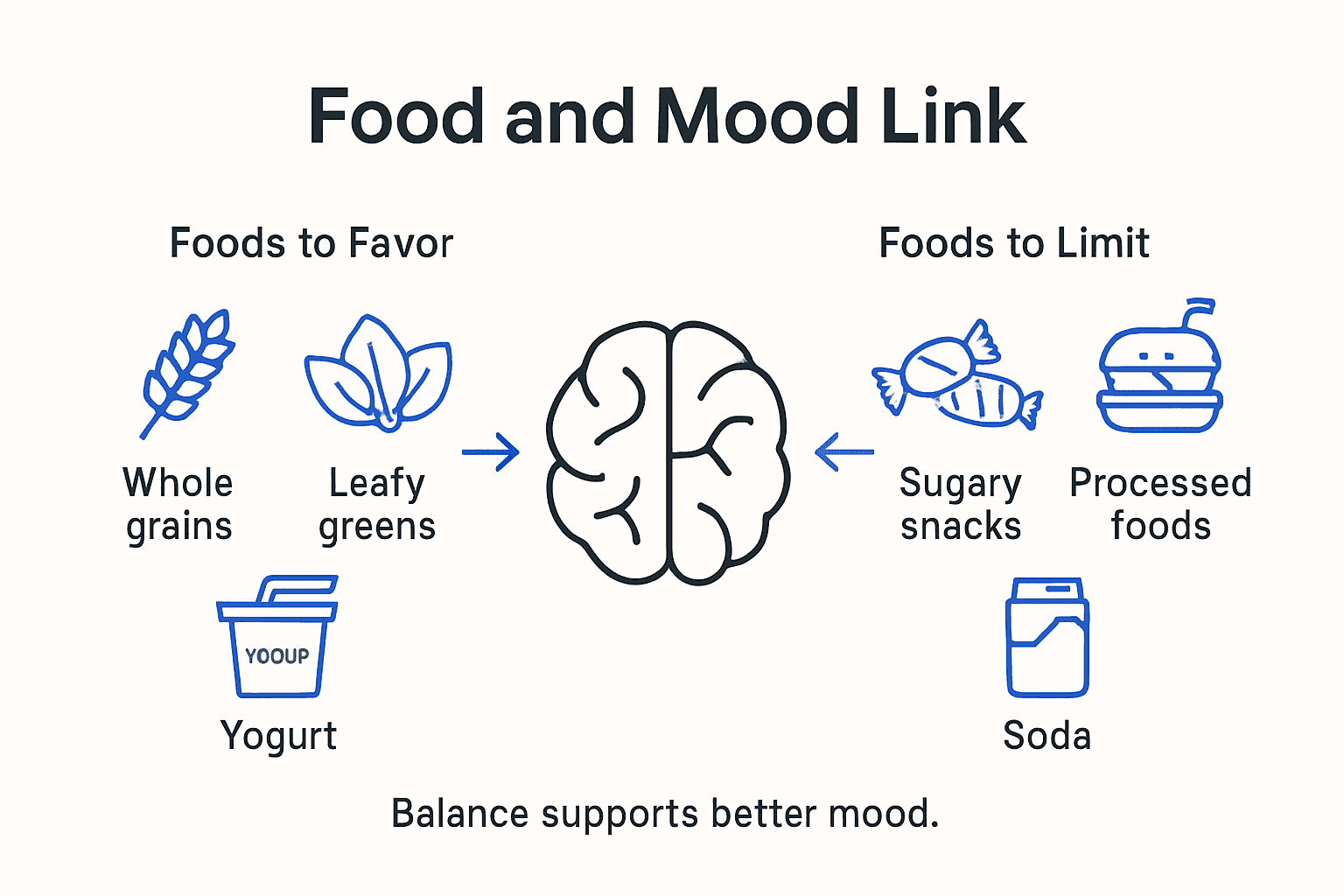
Ultra-processed foods are one of the health hazards that may lead to dangerous emotional instability and depression.
A diet full of sugar and processed carbs may lead to blood sugar crashes and spikes that cause bad mood, irritability, and fatigue.
Hormonal chaos due to the consumption of such foods can also inflict a depressive state on the human brain.
Moreover, the overconsumption of processed foods may affect the chemical structure of the brain, damaging it for good.
The artificial ingredients in junk food, along with sugar, can have a devastating effect on the entire body, as they impair the work of the digestive system.
It can be challenging to return to stable health after such damage, which can be the root cause of depression and other mental disorders.
Pro Tip: So, to track which products inflict a bad mood on you, keep a food diary and write down all the food items that make your mood worse after consumption.
Frequently Asked Questions:
Q-1. Can the emotional impact of a meal start with what your brain is up to after digestion, instead of the taste of the food?
A-1. Potentially, yes. Food comprises glucose, amino acids, fatty acids, vitamins, minerals, and various other compounds necessary for the proper function of the brain and nervous system. Researchers are also investigating communication between the gut and brain, and the role of gut microbes. Yet, the specific mechanisms by which certain foods could rapidly influence mood are complex and are still being elucidated.
Q-2. Why might two people eating the same “comfort food” report significantly different experiences afterward?
A-2. Mood responses to food are influenced by far more than nutrients. Expectations, memories, eating habits, variations in blood-glucose response, sleep, stress, and numerous other variables may be at work. This is why it can be so challenging to declare any given food inherently “good” or “bad.”
Q-3. Could there be a hidden variable in a person’s diet that could influence their mood, without them thinking about how nutrition and mental health intersect?
A-3. It is possible. Researchers are continuing to explore associations between food and mental health. For example, a 2025 review concluded that evidence connecting dietary modification, the gut microbiome, and mental health was accumulating, although there are still important uncertainties.
Q-4. Why could changes in the overall dietary pattern prove more important to mood than a single “happy” food?
A-4. Mood is unlikely to be related to any one particular food. Researchers have been looking more closely at overall dietary patterns, including the Mediterranean-style diet, which emphasizes vegetables, fruits, legumes, whole grains, nuts, fish, and other minimally processed foods. In the SMILES trial (a randomized study), participants who underwent a structured dietary improvement program experienced a significantly greater reduction in depressive symptoms than a control group after 12 weeks.
Q-5. Can you change your mood by eliminating a certain category of highly processed foods from your diet, without adding anything special?
A-5. It may be possible, if such a change involves improving your overall diet. Yet, you cannot claim to have improved mood by cutting out a category of highly processed foods, without adding something else. In general, the controlled studies conducted so far are looking at comprehensive dietary changes and not simply eliminating a specific category of foods.
Q-6. Could the gut–brain connection explain the impact of a different dietary approach on a person’s mood before they see a change in weight?
A-6. It is plausible, although researchers are continuing to explore the extent to which the gut microbiome contributes to this impact. It is known that a diet may influence the microbiome, and researchers are beginning to understand how this may contribute to the regulation of brain function and mental health. In the meantime, weight and mood need not necessarily change at the same rate.
Q-7. How can a food that temporarily comforts you become a detrimental strategy for managing distress?
A-7. When a person eats, they may feel comforted, distracted, or pleased. Yet, this does little to directly address the underlying source of their distress. They may also discover that relying on highly palatable foods as their default coping strategy means they are regularly displacing more nutritious foods with highly processed, calorie-dense, nutrient-poor foods. Food can certainly be part of a strategy for managing distress, but it should not be the sole strategy.
Q-8. Does eating a Mediterranean-style diet mean that food can replace treatment for depression?
A-8. Not at all. Evidence suggests that a Mediterranean-style diet may reduce depressive symptoms for some individuals, but it is not a panacea. As a meta-analysis of five randomized trials (1,507 participants) concluded, Mediterranean-diet interventions were associated with reduced depressive symptoms, although there was some heterogeneity between studies.
Q-9. Could changing the variety in your diet be more important to your mood than tallying up how many “healthy” foods you have eaten?
A-9. It is possible. A greater variety of nutrient-dense foods supports a greater variety of essential vitamins, minerals, fiber, and other beneficial compounds (not to mention polyphenols). Remarkably, the HELFIMED trial (a randomized study) observed that increased vegetable diversity was associated with decreased depression and improved mental health. That said, a correlation does not necessarily imply causation.
Q-10. What is the biggest mistake people make when attempting to use food to improve their mood?
A-10. The single biggest mistake is to expect that any individual food, supplement, or overly restrictive diet will transform your life. As discussed, researchers are currently looking most closely at overall dietary patterns. The evidence for individual supplements, probiotics, certain foods, and biological mechanisms in mental health is still mixed. Similarly, you should not attempt to self-treat persistent depression, anxiety, or significant shifts in mood without the support of a trusted mental-health professional.
Recommended
- How Inflammation from Obesity Increases Depression Risk? – LeanAndFit
- 7 Emotional Triggers for Overeating and How to Stop Them – LeanAndFit
- How Obesity Contributes to Hormonal Imbalances Linked to Depression? – LeanAndFit
- https://pmc.ncbi.nlm.nih.gov/articles/PMC7700826/
- How Stress Triggers Emotional Eating in Obese Individuals? – LeanAndFit
- Why Trust LeanAndFit.info?
- For educational purposes only