

Most adults consume about 17 teaspoons of added sucrose per day. Such an amount of sucrose intake can damage even the best-laid plans of dieting people and make them frustrated about their weight loss attempts.
The key to reducing excessive sugar intake is to analyze where exactly hidden sugars in diet can be found.
By looking at the practical recommendations on how to examine, reduce, and replace the amount of sucrose consumed, one can effectively address the issue of lowering one’s sugar intake to reach the desired weight.
You learn basically learn how to reduce sugar naturally.
Table of Contents
- Step 1: Assess Current Sugar Intake
- Step 2: Identify Hidden Sugars in Your Diet
- Step 3: Replace Sugary Foods with Healthier Options
- Step 4: Adopt Sustainable Eating Habits
- Step 5: Monitor Progress and Adjust Your Plan
Quick Summary
| Key Point | Explanation |
|---|---|
| 1. Track Your Sugar Intake | Assess your current sugar consumption by analyzing food labels and tracking your intake for one week. |
| 2. Identify Hidden Sugars | Learn to spot hidden sugars on ingredient lists, such as terms ending in ‘-ose’ and common synonyms. |
| 3. Replace with Healthy Alternatives | Swap out sugary foods for nutritious options, like choosing plain yogurt with fruits instead of sweetened varieties. |
| 4. Develop Sustainable Habits | Focus on gradual, mindful changes in your eating habits to promote long-term health and weight management. |
| 5. Monitor Progress Regularly | Keep a detailed food journal to track changes in your sugar intake and adjust your plan as needed. |
Step 1: Assess Current Sugar Intake
Before reducing and cutting sugar and losing weight, it is essential to calculate how much sugar you consume. This process will also help you identify your habits and preferences.
According to the CDC, it is vital to recognize the different types of sugars in the foods you eat daily.
First and foremost, you have to study the food labels and get familiar with the ingredients. Johns Hopkins Medicine advises to pay attention to the “sugar” line and remember that manufacturers may disguise different types of sugars.
You should keep in mind that terms like corn syrup, dextrose, fructose, maltose, and sucrose mean there is added sugar in the product. It is crucial to note all the foods that contain added sugars and monitor how much of them you eat per day.
A good idea would be to keep a food diary for a week and note everything you eat and drink that has sucrose in it – sodas, desserts, sauces, dressings, and processed foods. In addition, it is important to remember that an average adult person consumes 17 teaspoons of sugar per day, while women should only have 6, and men 9.
Therefore, you will get a better understanding of how much sugar you ingest and what products you should limit. This analysis will be a vital step in reducing your sugar consumption and losing weight.
Step 2: Identify Hidden Sugars in Your Diet
Now that you are already monitoring the amount of sugar you eat, it is time to become a sleuth and investigate where those sugars may be hiding.
According to the CDC, you can learn how to “spot the sneaky sugars” by reviewing the ingredients on the nutrition label and looking for words that suggest sugars are present.
As explained by Johns Hopkins Medicine, there are many places where you may find hidden sugars
Look out for ingredients that end in -ose such as glucose, fructose, and sucrose, and other terms such as corn syrup, rice syrup, honey, molasses, and fruit juice concentrate.
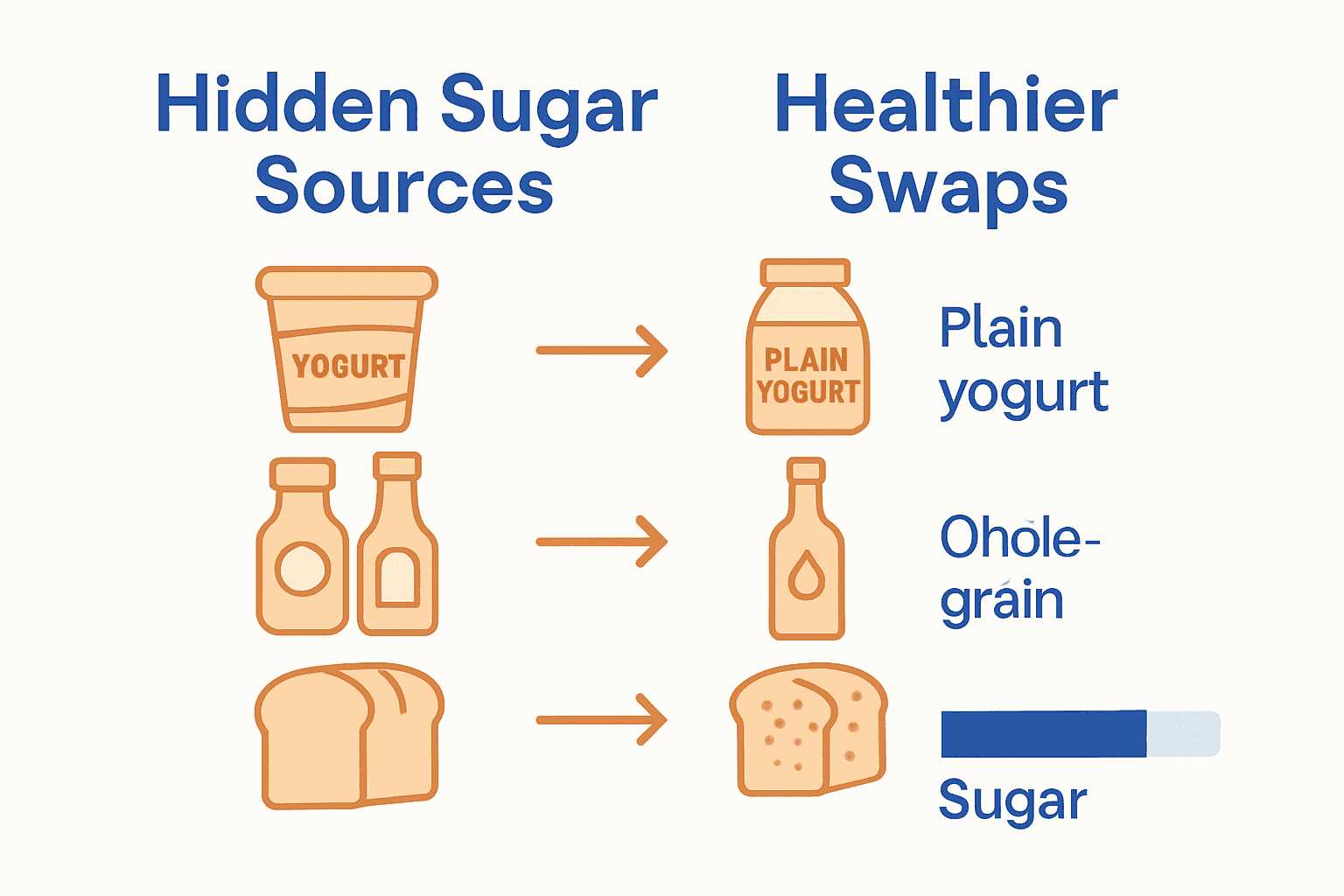
You may find these unhealthy ingredients in salad dressing, condiments, bread, pasta sauce, and even in healthful foods such as yogurt and granola bars. Make sure that if there is more than one type of sugar near the beginning of the ingredients list that it is not a concern.
Finally, studying the nutrition label can help you identify the amount of sugar you are eating.
Being able to read the label to see the amount of sugar will help you make smart choices about the foods you eat and help you lose weight naturally.
 Consider sugar addiction solutions for deeper strategies in managing your sugar intake effectively.
Step 3: Replace Sugary Foods with Healthier Options
The transformation of the diet requires the replacement of sweet foods with healthy ones. According to the recommendations of the CDC, it is necessary to replace sweet foods with unsweetened ones and satisfy the cravings for sweetness with natural sugars.
Johns Hopkins Medicine suggests replacing sweet foods with unsweetened products and using fresh fruits instead of those containing added sugars. Replacing some highly processed and sweet foods with whole foods is a good idea to begin with.
For example, it is possible to replace sweet breakfast cereals with steel cut oats and cinnamon, sparkling mineral water with slices of fruit instead of soda, and dark chocolate instead of milk chocolate.
If a person has a sweet tooth, they should replace sugar with healthy snacks.
It is advisable to read the labels on the packaging and try to choose products in which the amount of sugar is no more than 5 g per serving. It is essential to remember that taste preferences can be trained.
The most essential thing is to make changes that seem convenient and are enjoyable for you so that the transformation of the diet is not perceived as something terrible and frightening.

Step 4: Adopt Sustainable Eating Habits
CDC encourages people to think about gradual changes to their diet because achieving lasting results requires a slow and deliberate effort to adjust one’s eating behavior.
In particular, cutting down on sugar is an ongoing process that cannot be rushed. It is better to make appropriate concessions to your diet in a way that makes you feel comfortable and not deprive yourself of the things you enjoy.
According to the recommendations of the Johns Hopkins Medicine, in order to begin losing weight, it is necessary to develop strategies for healthy eating.
For example, you can plan your weekly meals and include food that will enrich your body with healthy nutrients. You can also try to eat a certain amount of food so that you do not eat more than necessary.
Using smaller plates and taking a break between meals will help you eat less without feeling hungry.
Moreover, it is important to read the composition of the products to know exactly what you eat. Finally, you should educate yourself on the topic of healthy nutrition and understand what is meant by a balanced diet.
Remember that healthy food is not a tool to punish yourself for overeating, but a means to take care of yourself. Every day is good if it differs from the previous one in at least something — this is the main rule on the path to healthy nutrition.
Needless to say, that you should not expect colossal results — everything is done within reasonable limits.
Step 5: Monitor Progress and Adjust Your Plan
CDC puts great emphasis on tracking and adjusting your diet in order to lose weight successfully. The point is to learn how your body reacts to the changes you make and get to know your needs and preferences.
The Johns Hopkins Medicine suggests drawing up a systematic plan to monitor your progress. It is recommended to maintain a food journal that will include your daily sugar intake, how full you felt after eating, and your usual levels of energy.
Measure your progress weekly by weighing yourself and recording other circumference measures.
See how you feel and be prepared to make some changes to your diet and exercise regime.
Also, think about how to track your fitness progress in order to stay motivated and be aware of your results.
The most important thing is to remember that your body is an individual and unique organism that will react differently to the same measures and regimes.
Be flexible and patient with yourself while observing the changes and adjusting your actions.
Take Control of Your Sugar Intake and Transform Your Weight Loss Journey
Struggling to find your way through the hidden sugars sabotaging your attempts to lose weight naturally is an ordeal many of us go through.
This article discussed the importance of recognizing sugar sources, reading the fine print on food packaging, and replacing sugar-heavy alternatives with healthier options to achieve the results you desire.
If you are looking to break away from the chains of poor nutrition and establish long-term dietary patterns that will contribute to you being able to reach your goals, check out our expert advice in Poor Nutrition – LeanAndFit and begin discovering practical ways to break free from your sugar addiction and improve your feeding habits.
Take the next step to support your natural weight loss goals by visiting https://leanandfit.info.
Dive into our comprehensive resources including the Best Lean & Fit Methods – LeanAndFit category for effective lifestyle changes.
Act now to reclaim your health and break free from sugar’s hold with trusted advice designed to fit your life. Your path to a leaner, healthier you starts here.
Frequently Asked Questions:
- Sugar Addiction Solutions: Break Free for Lasting Weight Loss – LeanAndFit
- Top Healthy Weight Loss Tips for Lasting Results – LeanAndFit
- Sugar Addiction Causes: Complete Breakdown and Guide – LeanAndFit
- https://pubmed.ncbi.nlm.nih.gov/12760444/
- Why Trust LeanAndFit.info?
- For educational purposes only