

More than 36 million American adults participate in yoga, but many of them cannot achieve significant weight loss.
Working out at home allows you to create a perfect routine that would help you in your intention to lose weight.
You will be able to improve your productivity and gain multiple health benefits because you can choose the right asanas and measure your progress.
This is how you learn beginner yoga for weight loss.
Table of Contents
- Step 1: Set Up a Comfortable Yoga Space
- Step 2: Choose Simple Yoga Poses for Weight Loss
- Step 3: Follow a Consistent Practice Schedule
- Step 4: Monitor Progress and Adjust Routine
- Step 5: Maintain Motivation and Prevent Plateaus
Quick Summary
| Key Insight | Explanation |
|---|---|
| 1. Create a dedicated yoga space | Choose a quiet, well-lit area for yoga to enhance focus and create a personal sanctuary. Personalize it to promote tranquility. |
| 2. Focus on simple weight loss poses | Incorporate foundational poses like Surya Namaskar and Warrior poses to boost metabolism and engage multiple muscle groups. |
| 3. Establish a consistent practice schedule | Aim to practice yoga three to five times a week at the same time to build a sustainable routine for effective weight loss. |
| 4. Monitor progress beyond weight | Track flexibility, strength, and energy levels, adjusting your routine based on measured improvements to avoid plateaus. |
| 5. Stay motivated through variety and community | Regularly change your yoga routines and connect with others to keep your practice engaging and maintain enthusiasm. |
Step 1: Set Up a Comfortable Yoga Space
Creating the dedicated space for your yoga practice at home will transform it into a sacred area of your house solely for your wellness and peace. As StyleAtHome suggests, the first step to creating your yoga haven is to pick the right place to set up a regular practice.
Choose a quiet spot to be able to concentrate properly on each exercise. It is better to find a place with plenty of natural light, so your yoga space should be near the window. Finally, do not feel like you need a lot of space for your yoga practice. Instead, find a small, cozy area free from any clutter you can use for your yoga retreat.
As Wired suggests, personalize your area with calming elements like candles, a few houseplants, or an essential oil diffuser to create a serene atmosphere.
The elements useful for your yoga practice will be a high-quality yoga mat, a couple of fluffy cushions or blankets for seated meditation, and maybe a small shelf or a table to hold your yoga accessories.
Make sure not to overload your yoga area with too many objects, and select mainly neutral colors and tones so that your space becomes a true sanctuary of relaxation and peace.
Step 2: Choose Simple Yoga Poses for Weight Loss
Choosing the right yoga postures can make all the difference between a stressful activity and a pleasure. The experts from the National Center for Biotechnology Information suggest including these useful poses in your daily routine to burn more calories.
The first yoga postures for weight loss are the most common ones that everyone can do. They help to increase the number of calories burned during the practice and start a metabolic transformation in the body. Try to include the Surya Namaskar, which is a set of poses, in your yoga routine. It warms up the body and increases the pulse.
Research in the Journal of Obesity highlights that poses like the Warrior series and Bridge pose can enhance metabolic rate and improve muscle tone, leading to increased calorie burn.
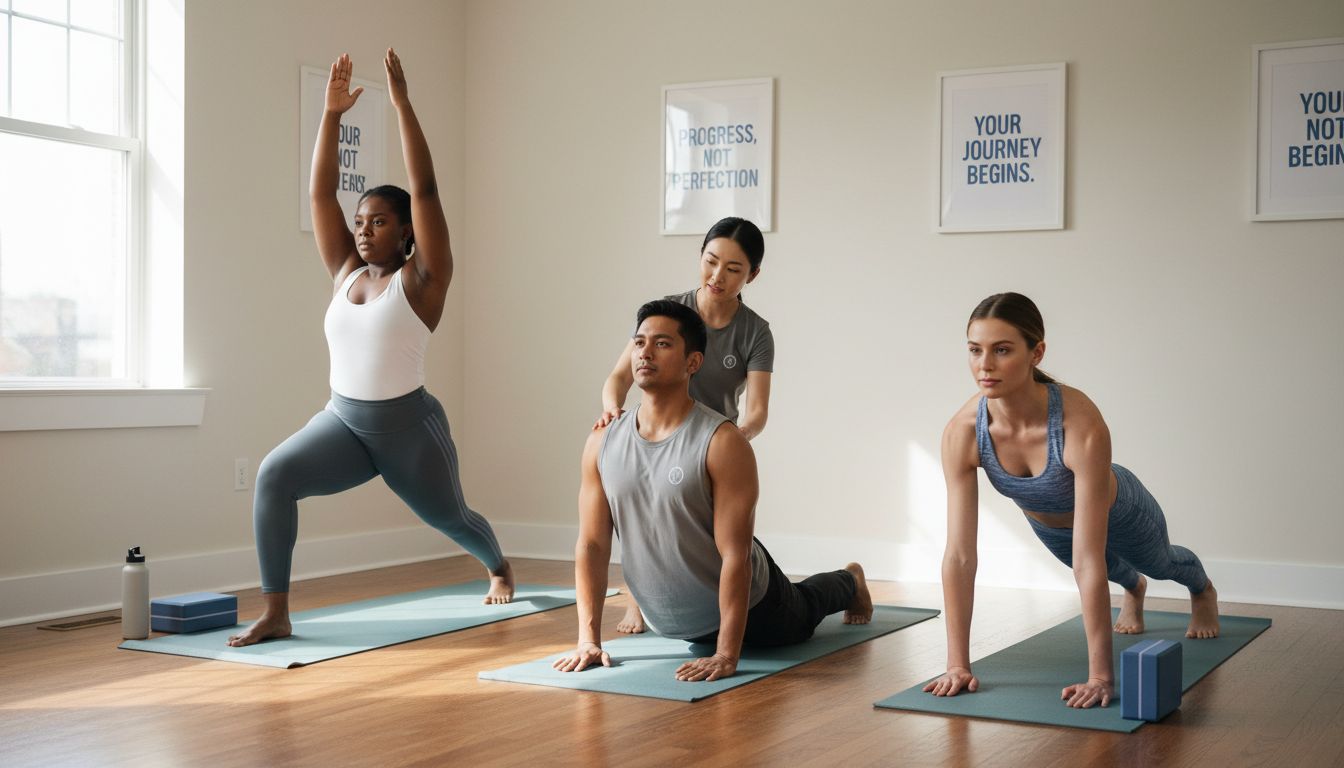
For novices, it is recommended to learn such poses as Warrior I and II to develop leg muscles, Bridge to work on the glutes and lower back, and Plank to hold the whole body. It is essential to set a good pace, do yoga most days of the week, and make each session at least 10-15 minutes long.
Developing a good habit of doing yoga exercises will help achieve results faster. The most comfortable way is to start with simple poses holding for a while. It is better to do fewer exercises but longer rather than the opposite. Moreover, it is important to focus on the body and its needs and not try to endure pain.
Finally, to lose weight, it is important not only to do yoga but also to pay attention to the daily diet.
 When you check out our complete guide to weight loss for beginners, you will discover how these yoga techniques fit into a comprehensive wellness strategy.
Step 3: Follow a Consistent Practice Schedule
Developing a sustainable approach to yoga practice is the key to achieving weight loss benefits and improving one’s fitness culture.
According to the study published in the National Center of Biotechnology Information, forming a regular practice schedule is essential to gain the benefits of weight loss and increased health.
The first step to developing a sustainable approach is to plan a schedule that is efficient enough to allow the person to stick to it in the long run.
One should aim for 3-5 sessions per week, and the timing of these sessions should be scheduled according to one’s comfortability. Some prefer morning sessions to energize themselves during the day, while others may feel most energetic during the evenings.
Moreover, the National Center of Biotechnology Information recommends practicing regularly, as a steady rhythm allows the body to accommodate the daily physical activity and helps to manage weight.
It is critical to reserve particular time slots for yoga and make it a non-negotiable point in one’s schedule. However, if one misses a session, they should not beat themselves over it.
On the contrary, a person should invest time in learning how meditation helps them to cope with stress, which, in turn, would help to manage weight better.
Therefore, it is important to develop a sustainable approach to yoga practice to maximize its efficiency in terms of weight loss.
Step 4: Monitor Progress and Adjust Routine
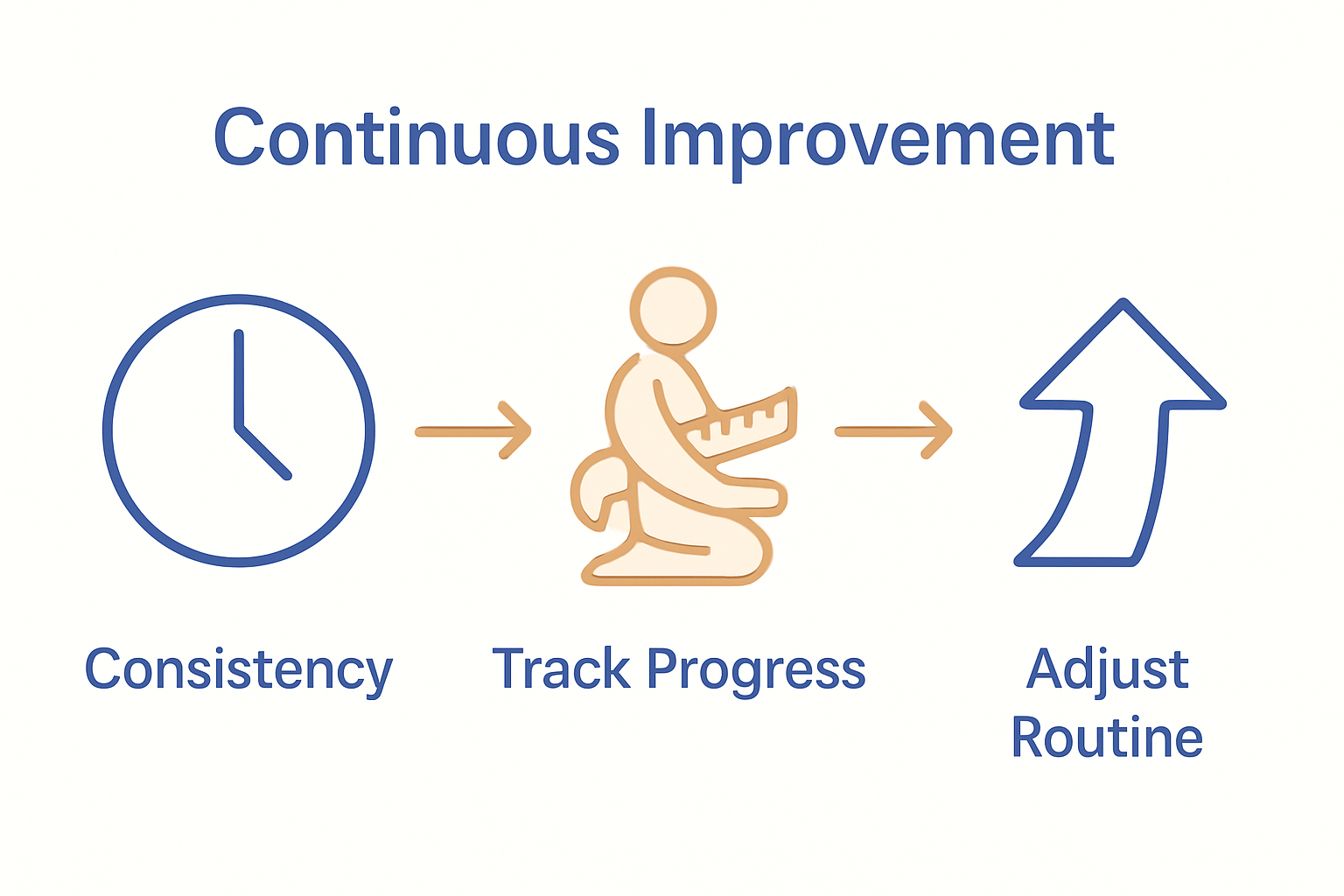
Keeping track of yoga progress is crucial in order to stay motivated and achieve weight loss goals.
According to the article published by the National Center of Biotechnology Information, measuring progress helps you recognize when you need to make changes in order to prevent stagnation and weight loss plateaus.
First of all, you should set goals and track your progress towards them.
You can weigh yourself, take pictures, measure body fat, keep a food diary, or monitor how your body looks and feels during specific yoga poses, which will show you the areas that need improvement. Secondly, it is vital to observe and assess your body’s response to the exercises.
According to the research, the more indicators of progress you follow, the more you will be able to intervene and adjust your plan in due time in order to continue seeing results without getting stuck in a rut. Keep track of how your body feels, how long you can hold particular poses, and how well you can perform them.
Pro tip: Be patient and kind to yourself. You will have good weeks and bad weeks. It is important that you learn how to effectively track your progress in order to stay motivated.
Keep in mind that your practice is a journey of transformation and self-discovery.
Modify your practice, experiment, and challenge yourself, but try to keep a sense of fun and adventure in your practice so that you can enjoy and be amazed by all that your body is capable of.
Step 5: Maintain Motivation and Prevent Plateaus
Keeping yourself motivated throughout your yoga weight loss program should be a top priority. For a start, studies reveal that smart goal-setting and rewards for achieving them are the best way to go if you want to ensure long-term success.
Try to think of new ways to challenge yourself and change your daily routine. According to NCBI, you should also try to experiment with various styles and modify your poses during each session.
In addition to power yoga, vinyasa, yin, and other types of yoga, you can try and see how you cope with more intense movements as well as increase the time held in a certain pose. Set monthly goals such as add 30 seconds to a certain pose or learn a new series of movements. You will find our exercise motivation tips quite helpful and inspiring.
Pro tip: Seek advice from and give to other like-minded people by joining online yoga communities or ask a friend to practice with you. Recall that motivation works only when you feel like you genuinely want to do something. So when you get frustrated or stuck, remember your initial goal and be kind to yourself. Focus on what you have accomplished rather than what you have not.
Take Control of Your Weight Loss Journey with Yoga and Lifestyle Changes
Struggling to keep the motivation up or have no idea how to make a proper routine for yoga to lose weight?
This post can help you get through common problems like finding a suitable place to practice yoga, learning which asanas to choose (Sun Salutations, Warrior II) and how to develop a well-structured schedule.
If you want to prevent these obstacles and other issues and finally get to the point where you can stick to a diet and a regular practice of yoga to shed those pounds, it’s time to learn more about beneficial lifestyle changes.
Maximize the results of your hard work and dedication with expert tips on healthy living and the most effective yoga routines for weight loss. Check out our Lifestyle Changes – LeanAndFit page to get going today and start making meaningful progress in your fitness journey.
Don’t forget to visit our Bodyweight Exercises – LeanAndFit page as well to equip yourself with useful knowledge on advanced bodyweight exercises that will help you take your fitness to new levels!
Start your journey today at https://leanandfit.info for expert guidance that keeps you motivated and on track. Your natural, lasting transformation begins with the right knowledge and consistent action—take the first step now.
Frequently Asked Questions:
Beginner yoga for weight loss: the main principles
This type of exercise is useful for the human body in several ways, and although it may seem that the effects of beginner’s yoga do not last long, they are noticeable and beneficial.
In addition, yoga helps to lose weight in the right way, makes the body flexible, and builds muscle.
Q-1. Is this kind of exercise not as effective weight loss, since, at first glance, it is low-intensity?
A-1. Yoga helps to lose weight, even though it may seem that the loads are not very intense, since working out is a complex process that involves all layers of the body, both physically and emotionally. This branch of yoga focuses on stretching, light movements, and breathing. In turn, this leads to a decrease in stress levels, a hormone that increases fat deposits in the body. Moreover, yoga teaches to eat right, which is another factor in weight loss.
Q-2. But how is it possible that after doing yoga, the body becomes light, if, in fact, the number of burned calories is not high?
A-2. After doing yoga, the body gets rid of tension, harmful substances, and toxins, which makes a person feel much lighter. Moreover, yoga helps to improve digestion and relieve constipation, which also has a direct effect on weight loss. These effects cannot be achieved by a large number of other sports due to the special techniques of movement and breathing.
Q-3. How does the breathing technique affect weight loss?
A-3. In turn, breathing techniques, or pranayama, have two main effects on the body: they saturate the cells with oxygen and help get rid of excess gas. In addition, they have a calming effect on the nervous system, which means that the production of stress hormones is reduced. All these effects have a positive effect on weight loss since stress is one of the main causes of overeating.
Q-4. Does yoga somehow help in getting rid of cravings?
A-4. Yoga helps to lose weight in several ways, one of which is the ability to fight cravings. The most common reason for them is a lack of some vitamins and nutrients in the body, and although cravings for certain foods cannot be eliminated, they can be controlled with yoga. Moreover, yoga helps to get rid of emotional eating due to the high level of self-awareness, which is a consequence of the meditative state during training.
Q-5. With what ease can a novice start doing yoga for weight loss? Are there specific poses, the absence of which will make it impossible to achieve the desired result?
A-5. To start yoga, you may not need to know any special movements, since there are several basic poses. However, to achieve the desired result, one must put them consistently without breaks, which can be challenging for beginners. A large number of poses are not required to start, but regular training is needed to feel changes in the body.
Q-6. Does yoga have such a strong effect on a person that he starts to watch his diet?
A-6. Yoga somehow affects a person’s mental activity and, in particular, his dietary habits. While training, a person is in a meditative state, during which he is more likely to observe his body and weigh his actions. After each yoga session, people have a greater awareness of their needs and desires, which is why they can more easily give up harmful habits and look after their bodies.
Q-7. Should a beginner do exercises every day to lose weight or is it possible to release a break?
A-7. It is better for a beginner not to try to do exercises more intense than usual, so as not to hurt their bodies. Instead, regular daily activities will allow a person to achieve the desired result faster and easier. Moreover, such a constant daily load will help to keep the body’s weight at the desired level in the long term.
Recommended
- Complete Guide to Weight Loss for Beginners – LeanAndFit
- Full Body Home Workout for Effective Weight Loss Results – LeanAndFit
- Top Healthy Weight Loss Tips for Lasting Results – LeanAndFit
- Effective Vegetarian Weight Loss Tips for Lasting Change – LeanAndFit
- 7 Essential Weight Loss Tips for Longevity-Minded Adults
- How to Start Weight Loss Treatment Online Naturally
- Why Trust LeanAndFit.info?
- For educational purposes only