

Most American adults are surprised to know that their metabolic age could be significantly different from the one on their driver’s license.
This is an essential parameter that determines how your body burns energy and can indicate potential problems.
With people becoming more interested in the subject, it is important to separate myths from reality and understand what affects metabolic age and how.
Table of Contents
- Defining Metabolic Age And Common Myths
- How Metabolic Age Is Calculated
- Key Factors Influencing Metabolic Age
- Comparing Metabolic Age To Chronological Age
- Improving Your Metabolic Age Safely
Key Takeaways
| Point | Details |
|---|---|
| Understanding Metabolic Age | Metabolic age reflects your body’s efficiency in processing energy, distinct from chronological age. |
| Factors Influencing Metabolic Age | Muscle mass, physical activity, and nutritional choices critically impact metabolic age. |
| Difference from Chronological Age | Chronological age is fixed, while metabolic age can fluctuate based on lifestyle modifications. |
| Strategies for Improvement | Adopting regular resistance training and balanced nutrition can enhance metabolic age effectively. |
Defining Metabolic Age and Common Myths
Metabolic age is indeed an unusual concept that can help understand how your body works better.
Explaining what it is and how it is determined will certainly help elucidate the essence of this term. Simply stated, a person’s metabolic age is the value that reflects how old a person’s basal metabolism is. It appears when comparing your Basal Metabolic Rate (BMR) with the average BMR of people of the same age.
Thus, most people will have a metabolic age close to their chronological age. However, it may differ substantially due to a person’s muscle mass, level of physical activity, and other factors.
The fact that metabolic age can be lower or higher than chronological age is essential. Besides, it is necessary to highlight some myths about metabolic age to avoid misunderstanding.
For example, many people believe that one’s metabolism does not change much with age. However, it is not correct – the truth is that all of us are born with a unique and variable metabolic profile.
There are also many other factors that affect the body’s ability to burn calories.
Muscle mass, the level of physical activity, diet, hormone levels, sleep, and stress are some examples of factors that change the metabolic rate.
Pro tip: You can get a detailed assessment of your metabolic profile and get a metabolic age if you visit a clinic that performs body composition analysis. This procedure is helpful because it provides a much more accurate picture of your body than weighing on a scale.
In conclusion, determining your metabolic age can be helpful as it allows you to understand how to take proper care of your body. This is especially important since everyone’s metabolism is different, and therefore, two people may have a wide variation in the number of calories burned per day.
However, it is necessary not to dismay at the prospect of a large number of changes and improvements that will need to be made to return to a healthy weight.
How Metabolic Age Is Calculated?
Calculating the metabolic age is a complex and involved process, one that requires more than a superficial examination. Bioimpedance is a method that analyzes the state of your metabolism in-depth, comparing it to a control group of people with a similar age.
The metabolic age is determined by the following characteristics:
- The basal metabolic rate
- The body composition
- The muscle mass percentage
- The body fat percentage
- The heart rate
- The level of fitness
These are the primary characteristics that determine the value. Using the method of bioimpedance, the scientists examine the person’s metabolic rates and compare it to an average person of the similar age. The calculation process can vary depending on the instruments used, but the general idea remains the same.
During the procedure, a professional uses specialized equipment to determine the level of body fat, muscle mass percentage, and other metabolic characteristics. In some cases, the process includes the examination of the heart rate. The calculation itself can vary from a simple equation to a complex multi-variable formula. The determined value is then compared to other people of a similar age.
The whole procedure takes several minutes. You will need to drink plenty of water before the examination and avoid strenuous activity and eating for 4 hours before the test. Calculating the metabolic age is an essential part of determining the current state of your body, a valuable experience that will help you improve your health and fitness level.
Key Factors Influencing Metabolic Age
Metabolic age is not a simple affair, since there are a lot of different factors that determine a person’s metabolic age.
Lifestyle and genetics can greatly influence the condition of one’s metabolism, and thus, the metabolic age.
The main factors which have a considerable influence on the metabolic age are:
- muscle mass/muscle condition
- level of physical activity
- eating habits
- hormonal activity
- amount of sleep
- stress levels
- genetic makeup
The decrease in muscle mass and level of physical activity are the main factors which cause a decrease in the metabolic age.
The levels of activity of the majority of people decrease gradually as they get older.
As a result, many adults and especially senior citizens tend to have a lower metabolic age than their chronological age suggests since their muscle mass begins to decrease as well.

Nutritional and lifestyle factors have a tremendous effect on your metabolism. Things like exercise, proper diet, getting enough protein, and strength training will all help you overcome your natural metabolic decline as you age.
Your hormone levels change as you get older (especially around menopause for women) and that can have a huge effect on your metabolism as well. It’s important to take control of what you can to help your body out.
Pro Tip: Boost your metabolic rate with some resistance training workouts and a high protein diet.
Now that you know these things effect your metabolic age, you can make changes to improve it!
Comparing Metabolic Age to Chronological Age
- Chronological age is the number of years a person has lived while the metabolic age indicates a person’s biological age relative to his or her metabolic performance.
- Metabolic age test results offer deeper insight into a person’s health status.
- Chronological age versus metabolic age comparison:
- Chronological age is a number, it does not change, while metabolic age can vary depending on the level of fitness and other factors.
- Chronological age is simply a count of years, while metabolic age is an indicator of the health status.
- Chronological age is predetermined, while metabolic age can be managed.
The information received from the bioimpedance test is quite valuable for determining the overall health status and it is interesting how people’s metabolic age may differ from their chronological age.
For example, some 40-year-old individuals may have the metabolic age of 30 while others may have the metabolic age of 50 or older.
One should be concerned about the large difference between chronological and metabolic age, since it may indicate a poor health status and a serious risk for chronic disease development.
While chronological age is simply a count of years, metabolic age reflects a person’s health status. People should understand that their metabolic age depends on the level of fitness, amount of physical activity, diet quality and other factors.
Here is a quick reference highlighting key differences between metabolic age and chronological age:
| Aspect | Chronological Age | Metabolic Age |
|---|---|---|
| Definition | Years since birth | Body’s functional age |
| Influenced by | Time | Lifestyle and health habits |
| Modifiable? | No | Yes, through lifestyle changes |
| Health insight depth | Surface-level | Detailed metabolic/physiological |
Pro tip: Metabolic Age Management: Regular screenings and tracking of your metabolic age can help you stay aware of your body and its needs as you make positive changes to your lifestyle including diet and exercise.
Metabolic age means taking control and tracking a number that indicates how healthy we are and how our bodies are managing on a day to day basis.
Improving Your Metabolic Age Safely
Metabolic age optimization is a comprehensive process that requires a systematic strategy.
Both physical activity and diet modifications are essential for making substantial progress in metabolic health and enhancing your body composition.
Therefore, here are some crucial ways for improving your metabolic age:
- Progressive resistance training.
- Cardiovascular training.
- Protein intake.
- Healthy sleep.
- Managing stress.
- Hydration.
Resistance training is necessary to improve the metabolic age since it increases the amount of lean body mass. The more muscle one has, the more calories they burn. As a result, resistance training helps to change body composition, which ultimately lowers the metabolic age.
Protein-rich foods are critical for building muscle tissue, which is why diets that are heavy in protein may help with metabolic health. Moreover, a balanced diet that includes whole foods and low-carbohydrate content can enhance one’s metabolism and assist in reducing metabolic age.
Proteins, together with complex carbohydrates and healthy fats, form a balanced meal that contributes to a healthy metabolism.
Pro Tip: Starting with small dietary and exercise modifications and gradually progressing to more strenuous activities is a clever approach to lowering metabolic age.
Therefore, to conclude, in order to improve the metabolic age, it is critical to make healthy adjustments to everyday habits and pay close attention to the body’s demands.
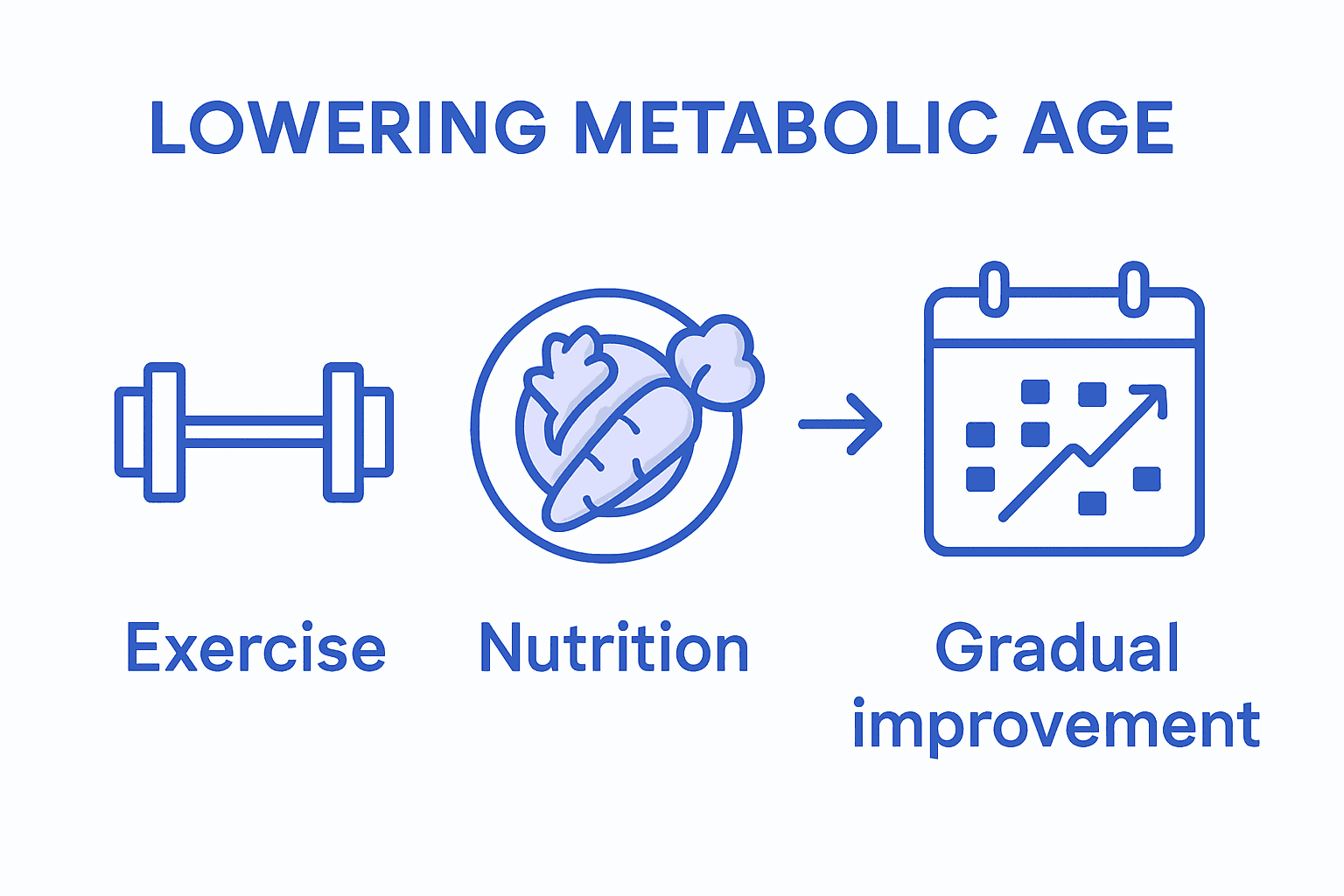
The following table summarizes how different lifestyle changes can impact metabolic age:
| Lifestyle Change | Potential Impact on Metabolic Age | Example Benefit |
|---|---|---|
| Increased resistance training | Reduces metabolic age | Boosts lean muscle mass |
| Improved sleep quality | Enhances metabolic efficiency | Supports hormone balance |
| Better stress management | Slows metabolic aging | Lowers cortisol levels |
| Nutrition rich in protein | Supports youthful metabolic rate | Preserves muscle, curbs hunger |
| Hydration practices | Optimizes cell function | Enhances metabolism |
Take Control of Your Metabolic Age Today
Understanding your metabolic age can be disheartening, when presented with a number that reflects a slow metabolism and challenges in lifestyle.
In this article you’ll learn how muscle building, physical activity and diet are factors that affect the metabolic age and that addressing these issues is a necessary step to improve your overall health.
Most people feel powerless when presented with the Metabolic Slowdown and its effects on weight and vitality, but there’s an upside, an opportunity for improvement.
Learn more about how to take control of your metabolism and turn the situation around, by visiting our new Metabolic Boosters section at LeanAndFit.info
Act now and take advantage of this opportunity to improve your health and change your metabolic age for the better.
Don’t miss this opportunity. Take action now and enjoy a healthy and happy life.
Frequently Asked Questions:
Q-1 Can metabolic age change even when your real age obviously cannot?
A-1 It can be altered as it is not your real age. This value can go up and down based on certain fitness equipment you decide to use or your general body composition.
Q-2 Why can two people of the same age get drastically different numbers?
A-2 Your metabolic age depends on such indicators as the predicted rate of calorie burning, lean mass, weight, and overall body composition. Therefore, two people may have an exactly same chronological age but a substantially different body composition which leads to different metabolic ages.
Q-3 Could building muscle mass cause your age to drop?
A-3 Yes, it could since building muscles means gaining lean mass which in turn increases the number of calories burned during a day. Your metabolic age is predicted using the value of resting metabolism and other factors such as body composition.
Q-4 What can a person learn from their “younger” metabolic age that they wouldn’t realize from another fitness assessment?
A-4 Your metabolic age may only give you a general idea of your current fitness level compared to another person. It is not a scientifically proven fact or a precise measurement of your health. However, it is a motivating tool that can show you how your physical activity and fitness level correlate with changes in your metabolic age.
Q-5 Why would the same person get different results from different body-composition machines?
A-5 Each device has its own algorithm and method of calculating body composition. Therefore, one machine may give a different result than another one because of variations in the reference population, the testing method, the hydration state, or how much food you ate before the test. These differences may impact the accuracy of the test and hence, the results you get.
Q-6 Can someone have a “younger” metabolic age and a poor cardiovascular profile?
A-6 Yes, they can. The two values are independent of each other meaning that your cardiovascular status has little to do with your metabolic age. You may have a poor cardiovascular profile and be physically fit at the same time. Therefore, you should not rely on just one number to predict or explain your overall health.
Q-7 Why shouldn’t a person use their metabolic age to diagnose a sluggish metabolism?
A-7 Metabolic age is not a diagnosis tool for sluggish metabolism. It is merely a guessed value based on the predicted resting metabolic rate or other fitness indicators. In reality, a resting metabolic rate can only be accurately determined in a strictly controlled environment. Even then, it is not a metabolic age, just a number that represents your calorie expenditure at rest. If you suspect that you have a sluggish metabolism, consult with your doctor about the most appropriate diagnosis and treatment options.
Q-8 Could focusing on reducing a “higher” metabolic age lead someone to pursue the wrong type of weight loss?
A-8 It could if the person starts obsessing over the number and goes on a crash diet and/or extreme exercise program without properly fueling their body. Such a person may lose weight, but not in a healthy way as they will fail to account for lean muscle mass. It is better to pursue a healthy balanced diet and proper exercise rather than trying to decrease your metabolic age.
Q-9 What changes in a person’s life have the most value in determining their metabolic health?
A-9 An active lifestyle, strength training, getting an appropriate amount of sleep, and eating a diet that consists of healthy foods and has no nutritional deficiencies are healthy habits that should be the main focus of any person that wants to improve their metabolic health. Having a good metabolic age is a nice bonus to all the positive changes you make to your health.
Q-10 What faulty assumption can a person make when they treat their metabolic-age number as an indicator of how old they are?
A-10 A person may start thinking that their metabolic age reflects their real age and how old they are. However, the real value of metabolic age is in being a motivator and predictor of health problems. When you think of your “real” age, it should not be a number provided by some fitness station, but rather a number you can be comfortable with given your current health.
Recommended
- Why Metabolic Rate Declines with Age? – LeanAndFit
- How Metabolism Works: Complete Science-Backed Guide – LeanAndFit
- Metabolism Explained: Complete Guide for Weight Loss – LeanAndFit
- Basal Metabolic Rate – How It Impacts Weight Loss – LeanAndFit
- Smartwatch Glicemie: Fiabilitatea Tehnicilor de Măsurare a Glicemiei 2024 ‣ www.iQualityStore.ro
- Why Trust LeanAndFit.info?
- For educational purposes only