

Most American adults don’t know the role that their metabolism plays in managing their weight.
Although almost 45 percent of Americans are currently dieting to lose weight, they don’t realize that the number one calorie burner in the body is their basal metabolic rate.
By knowing how your body works, you can make better choices about your diet and exercise and improve your overall health.
Table of Contents
- Basal Metabolic Rate Defined and Debunked
- Main Factors That Influence BMR
- How BMR Is Calculated and Measured
- BMR’s Role in Weight Loss Management
- Common Mistakes When Using BMR for Dieting
Key Takeaways
| Point | Details |
|---|---|
| Understanding BMR | Basal Metabolic Rate accounts for 60-75% of total daily energy expenditure, influenced by factors such as age and muscle mass. |
| Dynamic Nature of BMR | BMR changes dynamically with lifestyle and physical condition; higher muscle mass leads to a higher BMR. |
| Importance of Muscle Mass | Maintaining and building muscle through resistance training supports metabolic health and counters age-related BMR decline. |
| Accurate BMR Calculation | Using precise methods like indirect calorimetry provides a better understanding of individual energy needs compared to generic formulas. |
Basal Metabolic Rate Defined and Debunked
Your Basal Metabolic Rate (BMR) is the number of calories your body needs to function at a complete rest.
In other words, how many kilojoules your body utilizes every day to keep you alive, independent of any physical activity.
The BMR value is an essential element to consider when learning how to lose weight properly. 60-75% of your daily energy expenditure goes to your basal metabolic rate, which is impacted by multiple factors, such as:
• Age
• Muscle amount
• Composition of the body
• Genetic traits
• Hormones
One’s BMR is actually changing, depending on the activity level and muscle mass. Therefore, an individual has a variable BMR throughout their life.
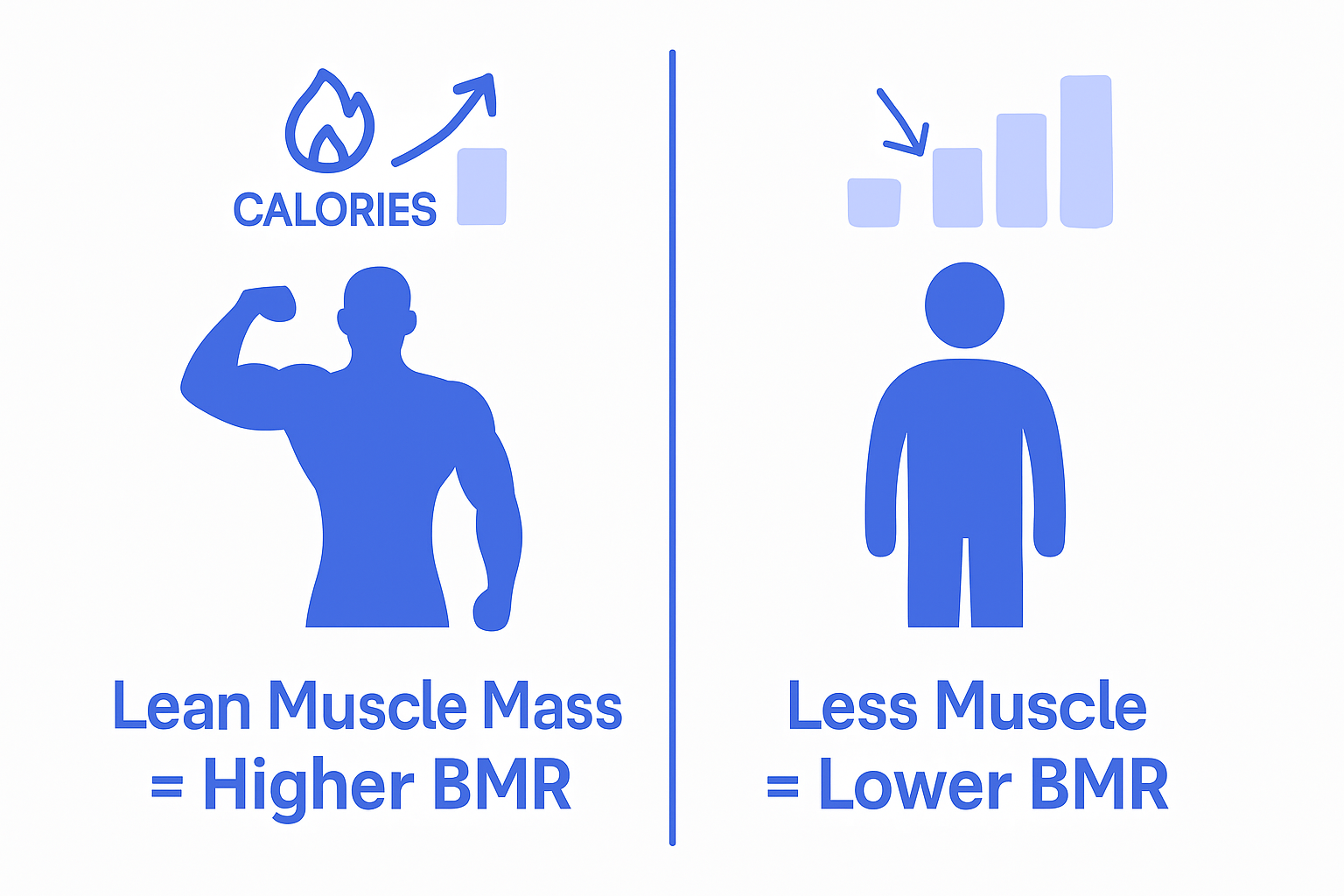
People that have more muscle mass tend to have a higher BMR than those who are sedentary and have a higher fat percentage.
As a result, working out can tremendously increase a person’s metabolic rate.

Research shows that BMR reduces as we age – it drops around 1-2% per decade after age 20. This means that as you get older it is all the more important that you keep working out to maintain your muscle mass so that you can keep your metabolism high.
Knowing how the body works will allow you to take control of your lifestyle choices to affect the metabolism.
Main Factors That Influence BMR
Your basal metabolic rate is actually quite complicated as there are a number of different factors that affect it.
The most important of them is your fat-free mass, and scientists have discovered that it is connected to the person’s energy expenditure. Scientists discovered that muscle mass is the most metabolically active tissue in the human body.
In one of the studies, 150 adults participated, and the researchers analyzed their BMR and recorded the following data:
Fat-free mass (FFM):
Body Fat (FM):
Age:
Thyroxine:
Genetics:
Hormones:
Fat-free mass was found to be connected to the BMR level as FFM comprised 63% of the variance, and for body fat – 6%, and age – 2%. This means that people should invest more effort into gaining muscle mass as it will tremendously improve their BMR.
In addition to the variables above, scientists also concluded that hormonal factors also affect the rate.
For instance, those with low thyroid hormones, testosterone, or insulin can have lower energy expenditure levels. Hence, people with hormonal imbalances should be aware that it might be harder for them to gain or maintain muscle mass or lose weight.
How BMR Is Calculated and Measured?
The calculation of the basal metabolic rate involves a number of steps and methods.
The principles of energy balance are the foundation on which scientists base their calculations and conduct experiments to determine the subject’s metabolism. The main two methods used to calculate BMR are predictive equations and direct calorimetry.
There are several types of scientific measurement techniques of basal metabolic rate, including:
- Predictive Equations
- Harris-Benedict Formula
- Mifflin-St Jeor Formula
- Direct Measurement Methods
- Indirect Calorimetry
- Oxygen Consumption Analysis
It was found that the best way to predict a person’s BMR is to use such variables as age, sex, height, weight, and body composition.
Most predictive equations were based on lean body mass. For example, one study produced one of the best equations that correlate lean body mass with BMR.
It states that BMR (calories/day) = 500 + 22 × lean body mass (kg). Thus, the correlation between body composition and metabolic rate is evident.
Indirect calorimetry is considered the most accurate method for determining BMR.
The procedure involves calculating the rates of oxygen consumption and carbon dioxide production in order to provide a precise estimation of an individual’s metabolic needs.
Although sophisticated and somewhat invasive, an indirect calorimetry test offers significantly better results than most of the commonly used predictive equations, thus providing a clear insight into one’s metabolic needs.
BMR’s Role in Weight Loss Management
Basal metabolic rate (BMR) plays a key role in understanding the processes that happen in our body. The calculation of calorie deficit for weight loss can be taken to a whole new level by grasping the concept of resting energy expenditure.
The role of the basal metabolic rate is multifaceted and highly influential on the process of weight loss that one experiences.
The connection between one’s BMR and their capability to lose weight can be summarized in the following points:
- BMR dictates calorie needs
- Affects body metabolism
- Predicts the outcomes of the weight loss process
- Creates a blueprint for the dietary and workout plan
- Highlights individual characteristics of metabolism
One of the main reasons why BMR is so important is the fact that one’s metabolism slows down as they age. Since muscle mass burns more calories, compared to fat, it is essential to build muscle in order to increase the metabolic rate.
Weight training is an excellent way to achieve that as it helps build muscle. That gives one a better chance to boost their resting energy expenditure and lose weight without becoming overly lean.
Losing weight is not a speedy process. It does not require one to starve themselves in an attempt to reach a certain number on the scale. Instead, the focus should be on adjusting one’s metabolic processes.
That allows them to burn fat at a quicker rate and get the desired result in record time.
Common Mistakes When Using BMR for Dieting
Misinterpreting the characteristics of the basal metabolic rate can lead to adverse outcomes when trying to lose weight. Calculating this indicator correctly is of utmost importance since the wrong values can be derived from it.
The mistakes that people tend to make when calculating the basal metabolic rate include:
- confusing it with the body’s total daily energy expenditure,
- not taking weight changes into account,
- disregarding aging processes,
- overlooking the effects of sex and hormones,
- using generic calculations instead of focusing on the individual.
The first mistake stems from the fact that people confuse basal metabolic rate with total daily energy expenditure. It is essential to remember that BMR stands for the energy expenditure at rest, meaning that it constitutes only a portion of the daily calorie needs.
Hence, a number of other factors should be taken into account when calculating the daily energy expenditure in order to decrease potential errors.
Several scientific studies confirm that errors in the calculation of the basal metabolic rate lead to adverse outcomes. Scientists concluded that individual characteristics such as sex, age, weight, and others should be considered when determining this indicator.
Therefore, ignoring these elements might result in consuming more food than necessary, increasing the chances of being unable to lose weight or facing subsequent difficulties in the process.
Unlock Your Metabolic Potential for Lasting Weight Loss
Understanding your Basal Metabolic Rate is the main key to overcoming any issues with losing weight that you may be facing.
Whether you are having a hard time building lean muscle or your body has plateaued and you are not seeing the results that you want, getting to know your body better will help you to achieve the results that you desire.
Learning how to increase muscle mass or dealing with any hormonal issues in your body will help you to naturally increase your BMR and assist in losing the fat that you want to get rid of.
Check out our Metabolic Boosters – LeanAndFit section for some great ways on how to naturally increase your metabolic rate. Get expert advice on the best diets and exercises that will help your body burn calories faster.
If you are facing issues on how to stop emotional overeating or have a binge eating disorder that is preventing you from losing the weight that you need to, we have the most recent and helpful information on how to handle these issues in our Binge Eating – LeanAndFit category.
Now is the perfect time to take charge of your issue and find the information that you need to help you overcome these challenges and start to naturally increase your metabolic rate.
Visit our website to https://leanandfit.info/ learn more about what is available to you and how you can boost your BMR and start getting the results that you deserve.
Frequently Asked Questions:
Q-1: What is understood by basal metabolic rate and how it impacts weight loss?
A-1: The Basal Metabolic Rate (BMR) is the rate of calories burned during a resting state required to keep the body functioning normally.
The BMR is one of the highest metabolic rates that account for approximately 60-70% of total daily energy expenditure in a sedentary individual.
Therefore, the BMR is integral in weight loss since it indicates the amount of calories that would be burned in a given day. Hence if the calories that you eat exceed your BMR, then you will gain weight.
Since over 42% of Americans are obese and overweight it is essential that they understand how to calculate their BMR so that they can develop a realistic diet plan.
Q-2: How do you calculate basal metabolic rate for weight loss in the USA?
A-2: There are different equations used to calculate the Basal Metabolic Rate including the Mifflin-St Jeor Equation.
These equations can help estimate the amount of energy required for physiological functions. For instance, an average-size person can require between 1200 and 1800 calories in a day. The information regarding the daily caloric requirement is essential since it helps in developing a diet chart for weight loss and management.
According to recent research, those who know their caloric requirements have a 30% higher chance of losing weight successfully.
Q-3: Does high basal metabolic rate help you to lose weight faster?
A-3: High Basal Metabolic Rate is an indicator of the amount of calories that would be expended in a given day.
This implies that individuals with a higher BMR would naturally have a higher rate of weight loss after undertaking an identical weight loss program.
According to recent research, persons with a higher percentage of muscle mass tend to have a higher BMR value due to increased thermogenesis by about 10-20%. Therefore, it is essential to increase your BMR to expend more calories to cause weight loss.
Q-4: How can you boost your basal metabolic rate to cause fat loss?
A-4: The best way to increase your BMR rate is by increasing your lean body mass.
This is because resistance training helps increase muscle mass, which is a metabolically active tissue that utilizes several calories. In addition, it is necessary to consume adequate protein in the diet since it helps increase the metabolic rate by about 15-20%.
In urban cities such as Austin, a lot of people are undertaking a bodybuilding lifestyle to increase their muscle mass to cause fat loss.
Q-5: What is the role of the basal metabolic rate in weight loss with a calorie deficit?
A-5: A calorie deficit is a condition that arises when the number of calories consumed is less than the amount of energy expended.
This means that a person will begin to lose weight after a certain period of being in a calorie deficit state.
The deficit should be at least 500 calories per day to cause appreciable weight loss. The deficit should be calculated based on your Basal Metabolic Rate.
Q-6: How does a low basal metabolic rate contribute to weight gain?
A-6: In most cases, a low Basal Metabolic Rate indicates that a person will have a hard time losing weight.
This is because the individual will have to expend a lot of energy to create a calorie deficit due to low thermogenesis.
Conditions such as aging and loss of muscle mass can significantly reduce the BMR level by 2-5% per decade.
Recommended:
- Metabolism Explained: Complete Guide for Weight Loss – LeanAndFit
- How Metabolism Works: Complete Science-Backed Guide – LeanAndFit
- How Binge Eating Disrupts Metabolic Rate? – LeanAndFit
- Understanding Healthy Metabolism Boosters: The Key to Weight Loss – LeanAndFit
- Why Trust LeanAndFit.info?
- For educational purposes only