
If you are on a diet, make sure you drink enough water — but will it really make you slim? Let’s take a closer look at the connection between water intake and weight loss.
In short, water may help with weight management, but there are some important caveats. Water is not a magic solution for weight loss, but it may support some healthy weight-management habits.
On the one hand, water is essential for normal physiological functions. On the other hand, it can act as a perfect substitute for caloric drinks and even help you feel fuller for a certain period.
A 2024 systematic review and meta-analysis of randomized controlled trials found that replacing sugar-sweetened beverages with water might provide a modest weight-loss benefit, although increasing water intake overall did not significantly affect body weight.
However, the general effectiveness of “increased water intake dietary interventions” for decreasing body weight, BMI, or waist circumference was “not supported” by a meta-analysis of randomized controlled trials.
Therefore, if you want to use the power of water to help you lose weight, consider that it is one of the healthy habits, not the ultimate solution.
Table of Contents
- Does Hydration Help With Weight Loss?
- How Can Water Support Weight Management?
- Can Drinking Water Before Meals Help You Eat Less?
- Does Drinking Water Boost Metabolism?
- Can Replacing Sugary Drinks With Water Help You Lose Weight?
- What Happens When You Are Dehydrated?
- How Much Water Should You Drink?
- When Should You Drink Water?
- Can You Drink Too Much Water?
- Simple Hydration Habits for Weight Management
- Frequently Asked Questions
- Bottom Line
- References
Does Hydration Help With Weight Loss?
Adequate hydration is essential for normal health, but that does not mean that drinking extra water causes weight loss.
Research on the effects of water drinking and body weight have shown conflicting results. Some studies have found positive effects on body weight from specific behaviors, like drinking water before meals or using water instead of sugary beverages. Others found that increasing overall fluid intake made little to no difference.
A 2024 systematic review of randomized trials concluded that the evidence for increasing daily water intake remains limited and inconsistent.
This distinction matters:
Drinking enough water is important. Drinking excessive amounts of water is not a reliable weight-loss strategy.
If you are trying to lose weight, staying hydrated is a healthy habit to maintain along with eating a balanced diet, getting enough exercise and sleep, and other healthy habits.
How Can Water Support Weight Management?
Water can support weight management in several practical ways.
Replacing Calorie-Containing Drinks
One simple way water can help is by replacing calorie-containing beverages.
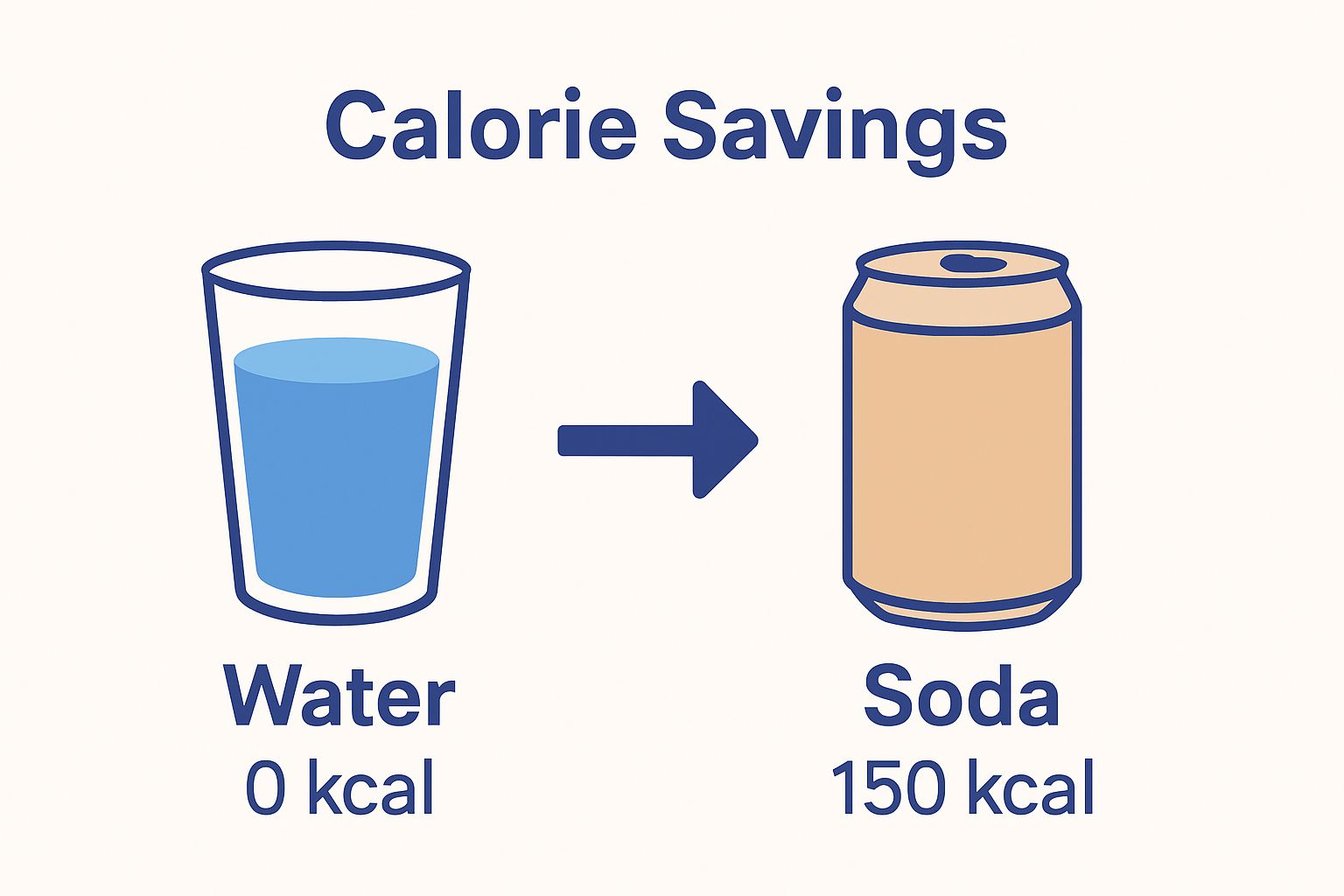
Sugary soft drinks, sweetened teas, energy drinks, specialty coffee drinks, and other sweetened beverages can provide a surprising number of calories without much satiety.
By replacing some of these drinks with water, you can reduce calories.
Of course, not all beverages that contain calories should be replaced with water- but if you’re looking for an easy way to cut calories, this is a good place to start.
Water Before Meals May Help Some People Eat Less
There have been some studies on drinking water before meals for weight loss.
In one study, adults who were obese were asked to drink 500 mL of water 30 minutes before their main meals as a part of a randomized trial.
In one small randomized trial involving 84 adults with obesity, participants who drank 500 mL of water 30 minutes before their main meals lost more weight over 12 weeks than the control group.
Another small study found that middle-aged and older adults who drank 500 mL of water before meals alongside a calorie-restricted diet lost more weight than those who followed the diet alone.
However, this does not mean that anyone who drinks water before their meals will lose weight.
The results may vary from person to person, and the study sizes were small.
For more detail, see our guide to drinking water before meals.
Staying Hydrated Supports Exercise
Fluid losses during exercise can cause health issues, especially during prolonged, strenuous activities or high temperatures.
Drinking fluids to replace those lost during sweating helps maintain hydration during physical activity.
However, it does not cause an increase in fat burning during a workout.
A person’s fluid requirements during exercise will vary depending on several factors, including the duration and intensity of the activity, the individual’s sweat rate, the environmental conditions, and other personal factors.
Can Drinking Water Before Meals Help You Eat Less?
This is one of the more studied areas of hydration and weight management.
Water consumed prior to a meal can lead to an increase in fluid volume in the stomach, thereby increasing satiety in some individuals.
In controlled experiments, water consumed before a meal has shown to reduce the amount of food consumed at a meal.
For example, studies in older adults showed that 500 mL of water ingested 30 minutes before a meal reduced caloric intake during the meal (in comparison to a control group). Furthermore, other studies have shown enhanced weight loss when pre-meal water was used in conjunction with a calorie-restricted diet.
However, this is not always the case. Studies have found little or no reduction in food consumption when pre-meal water was implemented. As such, pre-meal hydration should be seen as an optional tool and not a necessity for weight loss.
If you wish to use this strategy, it is advised to consume pre-meal water in comfortable sips, as forcing yourself to drink large quantities of water will cause discomfort.
Does Drinking Water Boost Metabolism?
This is one of the most exaggerated claims about water and weight loss.
Some early studies found that drinking water temporarily boosted metabolism (increased calorie burning), but those were small studies, and it’s a stretch to say that drinking more water will lead to significant fat loss.
There’s just not enough evidence to suggest that it’s a good idea.
In other words:
water is necessary for a properly functioning metabolism, but drinking more water than you normally do won’t give you a significant enough boost in metabolism to really affect your weight.
I would be very wary of any product or article that claims otherwise.
For a broader discussion of metabolism, see our guide to evidence-based metabolism boosters.
Can Replacing Sugary Drinks With Water Help You Lose Weight?
Indeed, this is one of the most straightforward methods for maintaining hydration.
Suppose that a person drinks several sugar-sweetened beverages per day; substituting one of them for water would reduce their caloric intake significantly with little effort.
According to a 2024 study, which conducted a systematic review and meta-analysis of relevant clinical trials, increasing water intake did not make a significant difference in overall weight. However, replacing sugar-sweetened beverages with water resulted in a noticeable, albeit modest, decrease in weight.
Therefore, it can be concluded that adjusting beverage preferences is a more efficient weight-reduction strategy than increasing water consumption.
A simple approach
Rather than asking the question:
How much extra water can I drink to burn fat?
Ask yourself:
Which calorie containing drinks can I replace with water?
This is a much more useful way to phrase the question.
What Happens When You Are Dehydrated?
Your body needs water to perform its normal functions. Significant losses of bodily fluids can have a negative effect on your performance, and, in severe cases, can be life-threatening.
Common signs of dehydration can include:
- Thirst
- Darker urine
- Dry mouth
- Headache
- Fatigue
- Dizziness
- Reduced physical performance
The goal is not to drink as much water as possible, but rather the goal is to maintain proper hydration according to your personal needs.
People that are exercising heavily, working outside in the heat, are sick with fever or vomiting, or have other special circumstances may require more water than normal.
How Much Water Should You Drink?
There is no specified amount of water that is required by all adults.
There are many factors that determine how much water you need to consume on a daily basis.
These factors are:
- Age
- Body size
- Activity level
- Climate and temperature
- Pregnancy and breastfeeding
- Illness
- Your diet
- Medications
- Your general health
Learn more on how much water to drink for weight loss by reading our comprehensive guide on this topic.
The National Academies of Sciences, Engineering, and Medicine has established adequate-intake levels of 3.7 liters of total water per day for men and 2.7 liters per day for women.
This does not mean that you should be drinking 3.7 liters of water for men and 2.7 liters of water for women every day. This number also includes water that you consume alongside your food.
For a more detailed discussion, see our guide to water-intake recommendations for adults.
What about the “8 glasses a day” rule?
Eight glasses is just a convenient rule of thumb, but a guideline nonetheless
Some people need less; some need a lot more due to such factors as exercise, heat, pregnancy, illness, and so on.
Instead of aiming to drink a specific amount, you should probably listen to your body’s thirst signals and fluid needs, taking into account environmental factors and activity level.
When Should You Drink Water?
There isn’t really a perfect time to drink water.
It’s helpful to drink:
- when you’re thirsty,
- with meals,
- before or during a workout,
- after profuse sweating,
- during hot weather
- when consuming calorie-containing drinks
Drinking water before a meal may assist in making you feel fuller, therefore helping you to eat less. If this interests you, you may want to read about drinking water before meals.
Don’t worry about trying to space out your water consumption to every hour if you don’t have a specific medical reason to do so.
Can You Drink Too Much Water?
Although it is vital to avoid becoming dehydrated, drinking too much water may also be harmful. The excess water may dilute the salt concentration in the blood, which is known as hyponatremia.
This may occur when someone drinks significantly more fluids over a short period than the kidneys can excrete. It might occur during prolonged physical activity.
The signs and symptoms of hyponatremia might include:
- Nausea
- Headache
- Confusion
- Weakness
- Vomiting
- Muscle cramps
It is crucial to understand that severe cases of water intoxication might be fatal.
That is another compelling reason why the adage, ‘More is better,’ does not always apply.
Those with ailments such as heart disease or kidney disease should consult their doctor before determining their fluid intake.
Simple Hydration Habits for Weight Management
You will not need an elaborate hydration program.
Instead, try these suggestions:
Water as a default
Make water (plain or unsweetened) your default drink when possible.
Replace sugary drinks
If you typically consume sugar-sweetened beverages, try replacing some of them with water. This should reduce your overall calorie intake.
Have water available
Keeping a water bottle on hand makes it easier to drink when you are thirsty.
Drinking with meals
You can drink water with your meals. There is no need to time your water consumption around your meals in any particular way.
Try pre-meal water, if desired
Some people find that drinking water just before their meals helps them feel full. If you like this idea, you can try this on a small scale (have water with only some of your meals) so as not to cause bloating. There is no need to drink a huge glass of water if you are not used to it.
Focus on water loss during activity
If you are exercising or sitting in hot, damp conditions for long periods of time, you need to watch yourself more closely.
Don’t overdo it
Drinking too much water will not cause you to lose weight faster.

Frequently Asked Questions:
Does drinking water help you lose weight?
It can help weight loss by replacing high-calorie drinks in your routine. Some research suggests it might help promote fullness, which may help you eat fewer calories by drinking water before a meal. There is no guarantee that drinking water alone will cause significant weight loss.
How much water to drink to lose weight?
There is not a specific amount of water you should drink to lose weight, but the amount of fluid you need depends on your size, activity level, climate, diet, health, and other factors
For general recommendations on how much water adults should drink, we have an article on that topic here.
Does drinking water before a meal help you lose weight?
It can help you feel full before a meal and may reduce the amount of food you eat during a meal. Small randomized trials have provided some promising evidence from randomized controlled trials when about 500 mL of water was drank before a meal. However, that doesn’t mean it will necessarily help you lose weight.
Read our detailed guide to drinking water before meals for weight management (https://leanandfit.info/how-drinking-water-before-meals-aids-in-weight-management/).
Does water burn belly fat?
No, drinking water does not specifically burn belly fat.
You cannot selectively target belly fat by drinking water. Reducing overall body fat generally reduces abdominal fat as well. The primary way to do that is through creating a calorie deficit by eating slightly less and exercising moderately. Other factors such as lean body mass, total activity level, dietary fiber, sodium intake, sleep, and genetics also affect belly fat measurements.
Does cold water burn more calories?
While you might expect cold water to boost your metabolism when you drink it, there isn’t good evidence that it has any significant or lasting effect on your body.
It might slightly burn some calories to warm the water to your core internal temperature, but it doesn’t burn nearly enough to make it a worthwhile pursuit
Does drinking water boost your metabolism?
In your cells throughout the day, your normal metabolism is dependent on the water you consume as part of your regular daily routine
However, drinking extra water has not been proven to increase your metabolism much or for long.
Statements that a certain amount of water will significantly boost your metabolism are best considered marketing.
Can drinking water suppress your appetite?
It can, for short periods of time and under specific conditions, but it’s inconsistent and not a reliable way to suppress your appetite.
Does 8 glasses of water equal about 2 liters of water per day?
Not exactly
The “8 × 8” rule generally refers to eight 8-ounce glasses of water, or about 64 ounces (1.9 liters). It is a rule of thumb, not a universal requirement.
Do you need to drink extra water while working out, as you tend to lose electrolytes in sweat?
Possibly, but it depends on both how much you sweat and the type of environment you’re in while exercising.
Is it possible to drink too much water?
Yes. Drinking excessive amounts of water, particularly over a short period, can dilute blood sodium and cause hyponatremia.
Bottom Line
Hydration is an important part of overall health, and it can support some practical weight-management habits.
The strongest practical reasons to prioritize water are simple:
- Water is essential for normal body function.
- Replacing calorie-containing beverages with water can reduce calorie intake.
- Drinking water before meals may help some people eat less.
- Staying adequately hydrated supports normal physical performance.
- Drinking excessive amounts of water does not guarantee faster weight loss.
When it comes to weight loss, the key is to pursue sustainable lifestyle changes rather than a specific number on the scale.
Therefore, when it comes to water, hydration levels should be sufficient to support general health and wellbeing, prioritizing water over other caloric drinks when appropriate, and not counting glasses or liters of water.
References:
- National Academies of Sciences, Engineering, and Medicine — Dietary Reference Intakes for Water, Potassium, Sodium, Chloride, and Sulfate
- Hakam N, et al. — Outcomes in Randomized Clinical Trials Testing Changes in Daily Water Intake. JAMA Network Open. 2024.
- Chen QY, et al. — Water Intake and Adiposity Outcomes among Overweight and Obese Individuals: A Systematic Review and Meta-Analysis of Randomized Controlled Trials. Nutrients. 2024.
- Parretti HM, et al. — Efficacy of Water Preloading Before Main Meals as a Strategy for Weight Loss in Primary Care Patients With Obesity: RCT. 2015.
- Dennis EA, et al. — Water Consumption Increases Weight Loss During a Hypocaloric Diet Intervention in Middle-Aged and Older Adults. 2009.
- Davy BM, et al. — Water Consumption Reduces Energy Intake at a Breakfast Meal in Obese Older Adults. 2008.
Medical Disclaimer: This article is for educational purposes only and does not replace individualized medical advice.
Why Trust LeanAndFit: See our Why Trust LeanAndFit page for information about our content approach.