

Losing weight most often comes down to a simple principle: over time, the body must expend more energy than it receives from food and beverages.
This is known as a calorie deficit.
However, it is important to note that developing a calorie deficit is not simply a matter of eating as little as possible or exercising as much as possible every day.
An individual’s personal requirements for calories are dictated by several factors, including body size, age, sex, level of activity, and overall energy expenditure.
These figures can also vary depending on your weight loss progress and the changes in your body weight.
A responsible approach to using a calorie deficit for weight loss is to create an appropriate energy deficit while still consuming enough food and nutrients to support health, energy levels, and long-term weight management.
So, understanding calorie deficit is vital for achieving sustainable weight loss.
A calorie deficit is one part of a broader evidence-based approach to weight management. If you want to understand how nutrition, physical activity, realistic goals, and long-term weight maintenance fit together, see our guide to evidence-based weight loss.
Table of Contents
- What Is a Calorie Deficit?
- How Does a Calorie Deficit Work?
- Calorie Deficit vs. Calorie Restriction
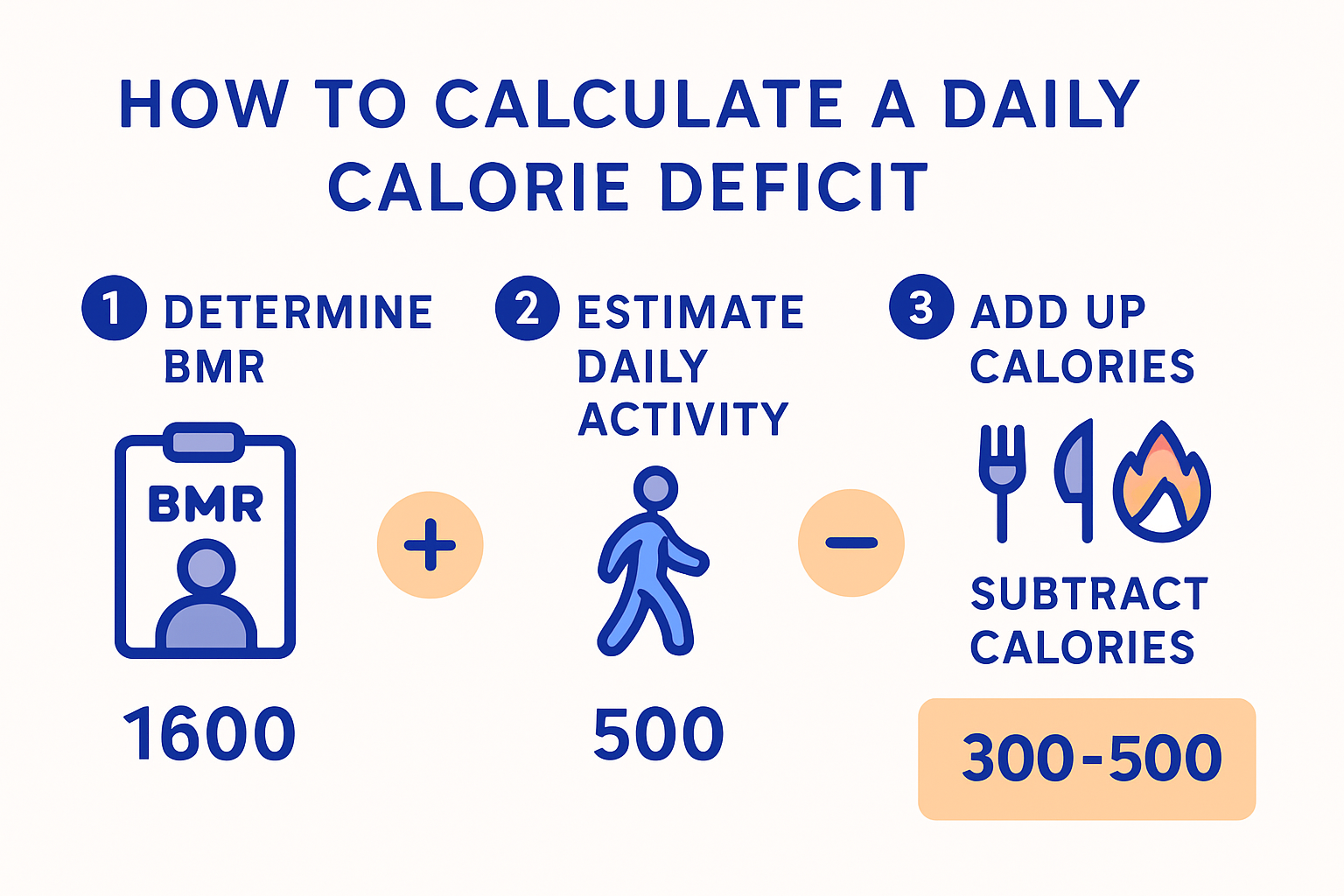
- What Is the Difference Between BMR and TDEE?
- How Is a Calorie Deficit Created?
- Why Does a Calorie Deficit Lead to Weight Loss?
- Does a Calorie Deficit Always Mean Fat Loss?
- How Large Should a Calorie Deficit Be?
- Do You Need to Count Calories to Lose Weight?
- How Food Choices Can Make a Calorie Deficit Easier
- The Role of Protein and Fiber
- Exercise and Calorie Deficit
- Why Weight Loss Slows Down During a Calorie Deficit
- Metabolic Adaptation and Calorie Deficit
- Common Calorie Deficit Myths
- Practical Strategies for Creating a Calorie Deficit
- Common Mistakes to Avoid
- How to Know Whether Your Calorie Deficit Is Working
- Frequently Asked Questions
- The Bottom Line
- References
What Is a Calorie Deficit?
A calorie deficit is a state in which the body burns more calories than it consumes within a certain period of time.
The body needs energy for its vital functions: breathing, blood circulation, regulating the body temperature, digestion, exercise, and other processes.
Therefore, if the amount of consumed energy is less than the amount of energy expended, the body will begin to use its reserves to compensate for the deficit.
When this energy deficit is maintained over time, body weight may decrease as the body draws on stored energy. Some of the change may come from body fat, while changes in water, glycogen, and lean tissue can also occur.
Calorie counting can be beneficial for some people because it provides greater awareness of how much energy they are consuming. However, it is not necessary for everyone, and some people may find portion control, meal planning, food choices, and physical activity easier to maintain.
NIDDK emphasizes that a healthy eating plan to lose weight should not be very restrictive so that a person can adhere to it for as long as possible. On the contrary, physical activity facilitates weight loss maintenance by increasing the number of calories burned.
Calorie Deficit vs. Calorie Restriction
A calorie deficit is a state of energy imbalance when the energy expenditure exceeds calorie intake (food + drinks), whereas calorie restriction is a dietary strategy that implies a reduction in calorie intake.
Thus, the two concepts are closely related but still different. One can induce a calorie deficit either by eating less or by exercising more (or both). The necessary amount of calorie intake during a deficit depends on the level of physical activity and is not determined by the idea of calorie restriction.
Therefore, it is essential to distinguish between these two concepts since people tend to mix them up.
How Does a Calorie Deficit Work?
The basic idea is simple:
Energy intake < energy expenditure → calorie deficit
Energy intake is mainly calories from food and beverages, while energy expenditure includes several components:
- Energy required to maintain physiological functions
- Energy burned during physical activity and exercise
- The energy cost of digestion and food processing
- Other variables specific to each person.
As a result, when energy expenditure is greater than energy intake, the body draws on stored energy to help meet its energy needs.
Therefore, weight loss can occur when a person consistently consumes less energy than the body expends, although the resulting change in body weight may include body fat, water, glycogen, and lean tissue. This is why a scale reading does not always correspond directly to changes in body fat.
What Is the Difference Between BMR and TDEE?
The terms BMR and TDEE are similar but they are not identical.
Basal Metabolic Rate:
The term basal metabolic rate (BMR) refers to the number of calories a person burns at rest.
This figure does not indicate the number of calories required to maintain the current weight.
Total Daily Energy Expenditure:
Total daily energy expenditure (TDEE) is an estimate of the total amount of energy the body uses in a typical day. It includes energy used for basic physiological functions, digestion, physical activity, and other daily processes.
Because it includes activity and other components of energy expenditure, TDEE is generally higher than BMR.
How Is a Calorie Deficit Created?
A calorie deficit can generally be created by altering either of the sides of the equation of the energy balance.
Some ways of reducing the intake of calories are as follows:
- Eating smaller portions
- Cutting down on high-calorie snacks and sugary drinks
- Consuming more vegetables and fruits
- Choosing foods that are nutrient-dense
- Limiting highly-processed foods
- Preparing healthy meals in advance
- Being mindful of the serving size
The other way of creating a calorie deficit is by increasing the number of calories expended through physical activity.
This can be done by:
- Going for walks
- Bicycling or swimming
- Running or weightlifting
- Engaging in recreational activities
- Increasing day-to-day physical activity
A calorie deficit can therefore be created through dietary changes, increased physical activity, or a combination of both.
However, it is important to note that in most cases, a combination of both modest adjustments to the diet and physical activity changes is a more realistic option to go for than going for large changes to either category.
Why Does a Calorie Deficit Lead to Weight Loss?
When the body uses more energy than it receives, it can draw on stored energy to help meet its energy needs. Due to this phenomenon, if this energy imbalance persists, one’s weight may begin to drop.
Of course, this loss is rarely linear, and weight may fluctuate up and down daily for an extended period.
A person’s weight on a scale is influenced by many things apart from adipose tissue, including:
- lean tissue,
- water,
- glycogen,
- food in the digestive tract,
- and other factors.
As such, daily weight on the scale is not a reliable indicator of adipose tissue changes. It is better to track them in general trends rather than specific numbers.
Does a Calorie Deficit Always Mean Fat Loss?
Not necessarily.
A calorie deficit is associated with weight loss when maintained over time, but the weight lost is not necessarily made up of body fat.
Changes in water and glycogen can cause relatively quick changes in body weight, and lean tissue can also be impacted.
This is one reason why a sensible weight loss plan should not solely focus on creating the biggest calorie deficit possible.
Adequate nutrition, sufficient protein, and resistance training can help support the preservation of lean tissue during weight loss.
If your goal is strictly to improve body composition, you may also want to track waist circumference, clothing fit, strength, physical function and long term weight trends rather than just the scale.
How Large Should a Calorie Deficit Be?
There is no magic number when it comes to calories.
Your body requires a certain amount of energy to function, and your daily calorie needs vary according to factors such as body size, age, sex, and physical activity.
Your health and any medications you are taking, along with any specific weight loss goals such as reducing belly fat and lowering cholesterol, also play a part.
There is no single calorie deficit that is appropriate for everyone.
You may see recommendations online suggesting a deficit of 300, 500, or even 1,000 calories per day. These numbers should not be treated as universal targets. The appropriate calorie intake depends on factors such as body size, age, sex, activity level, current weight, health status, medications, and individual goals.
Creating an overly large deficit can make it difficult to meet your nutritional needs and may increase hunger, making the eating plan harder to maintain.
The goal is therefore not to create the largest possible calorie deficit, but to find an approach that supports gradual weight loss while remaining nutritionally adequate and sustainable.
Do You Need to Count Calories to Lose Weight?
No.
Calorie counting can be beneficial for some people because it provides greater awareness of how much energy they are consuming. However, it is not necessary for everyone, and some people may prefer portion control, meal planning, food choices, and physical activity as ways of managing their energy intake and expenditure.
Some people may find other methods of creating a calorie deficit more desirable, such as:
- portion control,
- meal planning,
- eating more vegetables,
- eating whole fruits,
- eating foods higher in protein,
- eating more high fiber foods,
- limiting calorie dense foods,
- limiting soda or sweet drinks,
- paying attention to hunger and satiety cues,
- and exercising more.
NIDDK encourages choosing a healthy eating pattern that you can stick to, as opposed to a calorie restricting diet that can be hard to maintain.
If calorie counting is not working for you or is causing undue stress, there are other methods that may be more effective.
How Can Food Choices Make a Calorie Deficit Easier?
Creating a calorie deficit does not necessarily mean that every meal should be small.
The type of food that one consumes can also pack more nutrients and volume to give a sense of satisfaction after eating.
Some examples of foods that can fill a person up are vegetables, whole fruits, whole grains, beans, lentils, and other fiber-rich foods.
Moreover, food made up of proteins can also give a feeling of fullness.
A proper dieting pattern can help a person adhere to their calorie needs without depriving them of their favorite cuisine.
NIDDK recommends an eating pattern that includes vegetables, whole fruits, whole grains, and various protein sources in the daily diet.
This is why the overall eating pattern is essential to focus on, while still keeping in mind the energy in and out principle that determines weight change.
The Role of Protein and Fiber
Protein and fiber are both beneficial components of a weight-loss diet.
Protein
Protein-rich foods include:
- Fish, seafood
- Eggs
- Poultry
- lean meat
- beans, lentils
- soy foods
- Yogurt and other dairy foods
- Nuts and seeds
Eating protein-rich foods may help promote fullness and can be particularly useful during weight loss when combined with an appropriate eating pattern and resistance training.
Protein needs vary between individuals and can depend on factors such as body size, age, physical activity, and health status.
Fiber
Foods high in fiber include:
- vegetables
- whole fruits
- beans
- lentils
- whole grains
- nuts
- seeds
Fiber adds bulk to one’s diet and may leave you feeling full after a meal.
While it may be tempting to look for one specific food that will burn fat, it is usually healthier and wiser to focus on building a varied and wholesome diet that you can stick to in the long term.
For a deeper look at how fiber fits into a healthy weight-loss eating pattern, read our guide to fiber for weight loss.
Exercise and Calorie Deficit
Exercise can help create a calorie deficit by using up calories through physical exertion.
But exercise provides benefits beyond burning calories.
When you are physically active, your cardiovascular health, mental well-being, physical strength and overall functionality is at its peak.
The National Institute of Diabetes and Digestive and Kidney Diseases (NIDDK) recommends that healthy adults get at least 150 minutes of physical activity each week, and that some people may need to do more exercise in order to lose weight and maintain their weight loss, including muscle strengthening activities in addition to the 150 minutes.
Exercise should therefore be considered an important part of a weight-management strategy, rather than simply a way to offset the calories consumed from food.
If you find it easier to get in some form of exercise at home, you might want to look at our home workouts for weight loss.
Why Does Weight Loss Slow Down During a Calorie Deficit?
Weight loss is not regularly predictable over time. It may slow down as you begin to lose weight, for different factors.
As body weight decreases, the body generally requires less energy to support its daily functions. Physical activity levels and eating behaviors may also change over time.
Body water levels can rise or drop temporarily, masking body fat changes.
Therefore, a reduced calorie diet that was producing weight loss early on may not have the same effect later on in your weight loss journey.
A temporary plateau is not necessarily a bad thing. On the contrary, focusing on long-term trends is more effective.
Metabolic Adaptation and Calorie Deficit
As body weight decreases, energy expenditure can also change. Changes in physical activity, eating behaviors, appetite, and other physiological adaptations may also affect the rate of weight loss over time.
You may find that your actual rate of weight change differs from what a simple calorie calculation predicts.
NIDDK’s Body Weight Planner is one such calculator that attempts to factor in changes in caloric intake, level of physical activity, body weight, and desired maintenance weight rather than a set figure of calories.
Common Calorie Deficit Myths
Calorie deficits are presented on the internet in such a way that weight loss is seen as a simple maths problem, but the fundamental rule of energy balance only tells us part of the story: the human body does not react linearly to changes in calorie intake.
Here are some common calorie-deficit myths worth understanding.:
| Common Claim | What the Evidence Suggests |
|---|---|
| You need to eat as little as possible to lose weight. | A very large calorie deficit is not necessarily better. The goal is to create an appropriate deficit that can be maintained while still meeting nutritional needs. |
| A 500-calorie deficit guarantees one pound of fat loss every week. | A 500-calorie daily deficit is a commonly used approximation, but actual weight change varies because energy expenditure and body weight change over time. |
| BMR tells you how many calories you need to maintain your weight. | BMR describes energy expenditure at rest. Total daily energy expenditure also includes physical activity and other components. |
| Every pound lost on the scale is body fat. | Changes in body water, glycogen, lean tissue, and digestive contents can also affect scale weight. |
| You must count every calorie to lose weight. | Calorie tracking can help some people, but it is not essential for everyone. Portion control, food choices, meal planning, and physical activity can also help. |
| A calorie deficit should produce the same weight loss every week. | Weight loss can fluctuate and may slow as body weight decreases. Short-term changes do not always reflect changes in body fat. |
| Exercise simply burns off the calories you eat. | Physical activity has benefits beyond calorie expenditure, including supporting fitness, health, and weight-loss maintenance. |
| One specific food can create a calorie deficit or burn body fat. | No single food is responsible for weight loss. Overall energy intake, food choices, physical activity, and long-term habits matter more. |
Practical Strategies for Creating a Calorie Deficit
A calorie deficit becomes much easier to maintain as part of your everyday habits.
Here are some strategies that you might employ:
- Begin with realistic changes
Rather than making large reductions to your overall dietary intake, think about a few high-calorie habits that you can change.
For instance, rather than cutting out an entire food from your diet, you could simply choose to consume low-calorie drinks instead of calorie-rich ones.
- Watch out for portion sizes
Even healthy foods have calories in them.
Learning when to stop eating, and how much to eat in general, can actually allow you to cut calories without having to give up the foods that you love.
- Base meals around nutrient-dense.
Choose foods such as vegetables, fruits, whole grains, and protein-rich foods that provide important nutrients while fitting within your overall calorie needs.
- Limit liquid calories when possible
Sugary drinks, sweetened coffee drinks, juices, and other calorie-dense beverages can provide substantial amounts of energy without necessarily providing the same feeling of fullness as many solid foods.
- Get enough physical activity
Walking, bicycling, swimming, weightlifting, playing sports, and other physical activities can also help you burn calories.
- Make plans for meals in advance
This can make it much easier to resist the allure of high-calorie convenience foods when you’re too busy to cook.
- Keep track of your progress
This might take the form of weighing yourself, measuring your waist, keeping track of how much you’re eating and how much you’re exercising, or anything else that helps you to keep track of your journey.
According to NIDDK, tracking can help you to see patterns and keep you from getting discouraged.
Common Mistakes to Avoid
Some mistakes that people make in the calorie deficit may be demotivating.
Too big of a deficit
Trying to reduce calorie intake too aggressively can make it difficult to meet nutritional needs and may make the eating plan harder to maintain.
Focusing only on the scale
Daily body weight can fluctuate because of changes in water, glycogen, food in the digestive tract, and other factors. Looking at longer-term trends can provide a more useful picture of progress.
Not considering overall diet quality
Even when you are in a calorie deficit, it is important to consume enough nutrients to support your health.
Relying on exercise alone
Physical activity is important, but weight management generally involves both eating patterns and physical activity. There is no need to exercise excessively simply to compensate for food intake.
Thinking that the progress is always linear
The truth is, there will be days when you do not lose any weight, or you may even gain weight. This does not mean that your entire progress has gone down the drain.
Trying to match someone else’s calories
Even though two people can have the same weight, their bodies require a different amount of calories.
How to Know Whether Your Calorie Deficit Is Working?
There is no one sure way to tell that you are in a calorie deficit.
After some time, however, you may notice the following signs that your efforts are paying off:
- Weight loss
- Changes in how your clothes fit
- Loss of inches
- Improvements in physical activity
- An overall improvement in your day-to-day capabilities
- Being consistent with your diet and exercise program
According to the CDC, people who lost weight slowly and steadily (about 1-2 pounds per week) were more likely to keep the weight off than those who lost weight rapidly. It does not mean that you should aim for a pound or two per week, though.
It is normal for everyone and everything to work at a different pace, and your results will vary depending on your starting weight, general health, medication, level of physical activity, and a number of other factors.

Frequently Asked Questions:
What is a calorie deficit and how does it work for weight loss?
A calorie deficit occurs when the body uses more energy than it receives from food and beverages over time. The body can then draw on stored energy to help meet its energy needs. When this energy deficit is maintained, body weight generally decreases, although the change can include body fat, water, glycogen, and lean tissue.
How do you calculate a calorie deficit for weight loss?
The first step is to calculate your daily energy expenditure instead of your resting energy expenditure. A calorie deficit is achieved when you consume fewer calories than your body utilizes on a daily basis, increase the amount of energy you expend during physical activity, or a mix of the two.
There is no single calorie-deficit amount that is appropriate for everyone because calorie needs differ between individuals.
How many calories should you cut per day to lose weight safely?
There is no number of calories that are safe and suitable for every person. Every person has their own calorie requirements based on their age, sex, weight, height, the amount of physical activity they participate in, and the drugs they are taking. Additionally, the person’s objective for reducing weight will define how many calories a person should cut.
It is essential to determine a calorie deficit that is appropriate for your requirements and that you can adhere to.
What is the difference between a calorie deficit and a calorie surplus?
When the amount of energy the body utilizes surpasses the number of calories ingested, a deficit ensues. On the contrary, a surplus arises when the number of calories consumed outweighs the amount of energy that the body utilizes.
A sustained calorie deficit generally leads to weight loss, while a sustained calorie surplus can contribute to weight gain. Actual changes in body weight depend on factors such as energy expenditure, body composition, water balance, and changes over time.
Can you lose weight without exercise if you maintain a calorie deficit?
It is possible to lose weight without exercising so long as there is a calorie deficit. Working out, on the other hand, has several health benefits and can also aid in increasing the amount of energy the body utilizes throughout the day.
Exercise is not required for weight loss to occur if an energy deficit is maintained, but regular physical activity provides important health benefits and can contribute to energy expenditure and weight-loss maintenance.
How long does it take to lose weight with a calorie deficit?
There is no exact timeline because weight loss varies between individuals. Starting weight, calorie intake, physical activity, medications, health conditions, adherence, and changes in energy expenditure can all affect the rate of weight loss. Gradual, steady weight loss is generally more sustainable than trying to lose weight as quickly as possible.
What are common mistakes when trying to create a calorie deficit?
Common mistakes include creating an overly restrictive calorie deficit, relying only on exercise, overlooking portion sizes or liquid calories, focusing too heavily on individual weigh-ins, and assuming weight loss will occur at exactly the same rate every week.
What foods can make a calorie deficit easier to maintain?
Proteins, legumes, vegetables, fruits, and whole grains are healthy food to incorporate into a calorie-deficit diet. The foods that one can consume are determined by their preferences, nutritional needs, health status, and whether they are on a plant-based or animal-based diet.
Can a calorie deficit cause muscle loss?
Weight loss can involve changes in lean tissue as well as body fat, although the amount varies between individuals. Adequate nutrition, sufficient protein, and resistance training can help support the preservation of lean tissue during weight loss. The extent of lean-tissue loss varies according to factors such as the size and duration of the calorie deficit, diet, physical activity, age, and individual health factors.
How do you know if you are losing fat rather than just water?
Fat loss and water loss are both components of weight loss, but they differ significantly. It is impossible to determine the amount of fat loss by weighing yourself just once or twice because a lot of weight may be gained or lost in the short term due to water retention. Monitoring weight loss on the scale should be done over time in addition to waist size and how well the clothes fit.
The Bottom Line
A calorie deficit is an essential component of weight loss, but it does not necessarily mean starvation.
An efficient and balanced weight loss plan calls for a reduction in calorie intake, a healthy diet, physical activity, and a sustainable lifestyle.
Since every person’s body is unique, there is no quick solution for shedding pounds. It is impossible to predict how weight loss will proceed, and a decrease on the scale may be inconsistent or steady. In addition, water weight, glycogen, lean muscle, and other factors can affect how much you weigh.
Instead of trying to create the largest possible calorie deficit or maximize short-term changes on the scale, focus on gradual weight loss supported by a consistent eating pattern, physical activity, and a sustainable approach.
People with overweight or obesity should consult a healthcare professional and discuss a weight loss plan, especially if they have chronic conditions or concerns about using medication.
References:
- National Institute of Diabetes and Digestive and Kidney Diseases (NIDDK). Eating & Physical Activity to Lose or Maintain Weight.
https://www.niddk.nih.gov/health-information/weight-management/adult-overweight-obesity/eating-physical-activity - National Institute of Diabetes and Digestive and Kidney Diseases (NIDDK). Health Tips for Adults.
https://www.niddk.nih.gov/health-information/weight-management/healthy-eating-physical-activity-for-life/health-tips-for-adults - National Institute of Diabetes and Digestive and Kidney Diseases (NIDDK). Choosing a Safe & Successful Weight-loss Program.
https://www.niddk.nih.gov/health-information/weight-management/choosing-a-safe-successful-weight-loss-program - National Institute of Diabetes and Digestive and Kidney Diseases (NIDDK). Treatment for Overweight & Obesity.
https://www.niddk.nih.gov/health-information/weight-management/adult-overweight-obesity/treatment - National Institute of Diabetes and Digestive and Kidney Diseases (NIDDK). About the Body Weight Planner.
https://www.niddk.nih.gov/health-information/weight-management/body-weight-planner - Centers for Disease Control and Prevention (CDC). Steps for Losing Weight.
https://www.cdc.gov/healthy-weight-growth/losing-weight/index.html - Why Trust LeanAndFit.info?
- For educational purposes only
Last Revision Date: 10/09/2026