
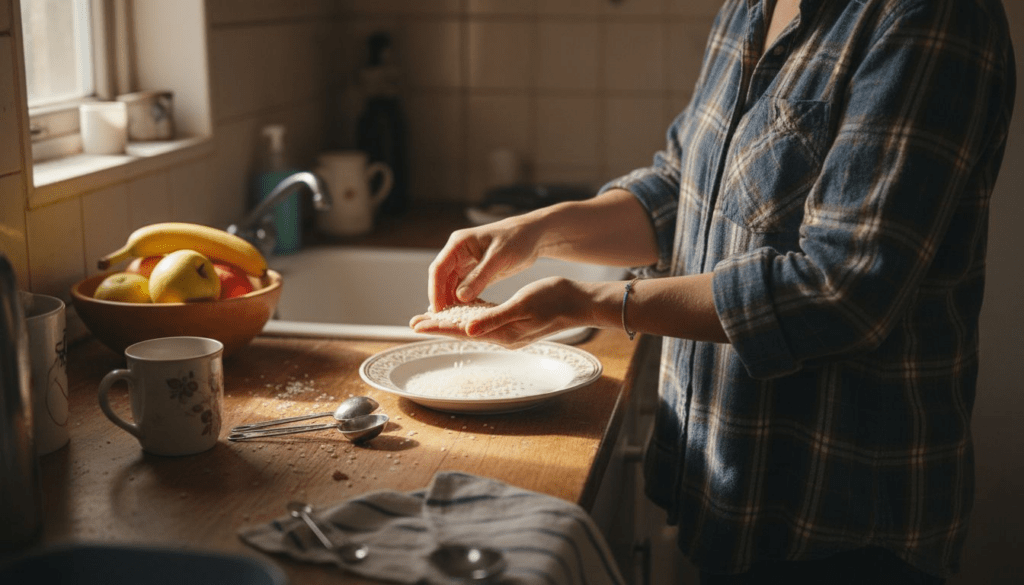
Most American adults trying to lose weight will be disappointed to hear that the portion sizes in the United States have almost doubled during the last twenty years.
This is because it has become increasingly easy to eat twice as much as one intends to consume.
Therefore, people who try to adhere to a healthy diet yet find themselves unsatisfied after meals may find these following tips helpful. They are all very practical and can be implemented from one’s own kitchen.
Use the following practical guidelines to help you eat a well-balanced diet and maintain your healthy lifestyle.
You would end up learning portion sizes visual guide tips for Weight Loss.
Table of Contents
1. Use Your Hand as a Reference for Measurement
2. Relate Certain Foods to Familiar Objects to Estimate the Portion Size
3. Learn How to Eat Healthy Using a Plate Method
4. Measure the Proportions of the Food You Eat
5. Pre-portion Your Healthy Snacks
6. Be Aware of Extra Calories When Eating Out
7. Eat Mindfully
Quick Summary
| Key Message | Explanation |
|---|---|
| 1. Use Your Hand for Portion Control | Your hand serves as a personalized measuring tool for estimating food portions easily. |
| 2. Visualize Portions with Household Items | Everyday objects can help you grasp serving sizes quickly, making portion estimates more intuitive. |
| 3. Practice the Plate Method for Balance | Organize your plate into sections to ensure balanced meals with appropriate nutrient distribution. |
| 4. Check Food Labels for Accurate Portions | Always read nutrition labels to understand serving sizes and avoid underestimating your calorie intake. |
| 5. Pre-Portion Snacks to Reduce Overeating | Prepare single serving snacks in advance to control portion sizes and avoid impulsive eating. |
1. Use Your Hand for Instant Portion Estimation
Estimating proper portions does not mean buying kitchen scales or measuring cups. All one needs to do is simply use his hands.
The human hand is a surprisingly accurate measuring device. A study done by the Human Performance Resource Center shows that there are several key parts of the hand that are equivalent to certain measurements.
- Hand Measurement What it equals
- Fist 1 cup of vegetables or milk
- Your thumb 2 tablespoons of salad dressing or nut butter
- Your palm upturned 1/2 cup of cooked grain or legumes
- The distance from your thumb to your little finger 3 oz. of meat, poultry, or fish
- Your thumbnail 1 teaspoon of butter or oil
A person can use their hands to measure the portions of the food that they eat. The reason why the hand measurement method is effective is because depending on your overall size, your body needs different amounts of food to keep you going. People who are larger need more food than those who are petite.
One can determine the amount of food that he needs to eat without having to buy any special equipment. Just simply use your hands. If you really want to get a good feel for the hand measurement technique, practice it for a few days. After you get used to it, it will be easier to estimate portions just by eyeing them.
2. Visualize Portions with Everyday Objects
When it comes to learning portion control, sometimes the best things are simple.
You can take household objects and use them as a guide to learning how much you should eat.
According to healthy South Dakota, common objects can serve as a reminder of just how much food you’re eating. These objects can be used as a substitute for the often difficult to use measuring cups and spoons.
Common Objects And Their Portion Equivalency:
- Small Stamp=1 tsp.
- 9 Volt Battery=1 Tbsp.
- Golf Ball=2 Tbsp.
- Deck of Cards=3 oz. Protein
- Computer Mouse=1/2 cup
- Baseball=1 cup
Using common objects as a reference is helpful, because now you can visualize portions and instantly know how much you should eat.
The American Diabetes Association says that using a visual guide is an effective way to control how much you eat.
TIP: You could make a note card with this information on it, and post it in the kitchen or keep it in your wallet as a reminder!
3. Understand Plate Method for Balanced Meals
Balanced nutrition does not mean living on a diet of healthy food but rather combining ingredients to create meals that both feed your body and allow it to lose weight.
The plate method is a good way to accomplish this by allowing you to see exactly how you can create a balanced plate with real food.
By dividing your plate visually, you can determine just how you can make sure you’re feeding your body balanced nutrition while also limiting your portions to help you shed those unwanted pounds.
Balanced Plate Tips:
- Non-starchy vegetables make up half of your plate,
- your protein makes up a quarter,
- and your complex carbohydrates take up the other quarter.
- This allows you to limit your portions while making sure you get the nutrition you need.
Having vegetables as the base of your meals keeps you fuller for longer while also giving you the nutrition you need to keep your body healthy and strong in your weight loss journey.
The protein in your meals will keep you feeling full for a longer period of time after each meal while the complex carbohydrates give you the energy you need to power throughout your day.
Pro Tip: Buy yourself a divided plate or use bands to divide your regular plate into sections so you can practice your balanced plates.
4. Check Portion Sizes on Food Labels
Food labels are an excellent guide to help us understand and control the portions we eat. Most people tend to eat multiple portions of food without realizing how much they are consuming.
The FDA offers great advice on how to read the nutrition facts label located on the packaging of most grocery items.
Some food label portion size tips include:
- Checking serving size listed at the top of the nutrition facts label
- Calculating calories per serving
- Comparing what you eat to the serving size
- Calculating your intake based on the number of servings
Most food packages have more than one serving per container. The calories stated on the label are the amount of calories that are in one serving. You must multiply the calories in one serving by the number of servings you eat in order to determine the total number of calories consumed.
For example, some chips have 150 calories per 1 ounce serving. There are 2.5 servings in a small bag of chips. This means that there are 375 calories in the whole bag.
Pro tip: A helpful tip would be to get a small measuring cup so that you can easily measure out the appropriate portions of food items you buy in bulk. You can then compare these portions to the serving size listed on the food package.
5. Pre-portion Snacks to Avoid Overeating
Mindless eating can easily ruin even the most well-planned weight loss diet.
By pre-portioning your snacks you can be rest assured that you are getting the best weight loss snacks and that you won’t overeat.
Now when looking for healthy snack ideas for weight loss, you’ll need to think about preparing single serving size portions.
Here are some pre portioning strategies to consider:
- Use small containers. Break up your bulk snacks into single serving size portions.
- Buy portion control bags. You can buy bags that have measurements on them.
- Portion the food out when you get it home.
- Make grab and go packs. Set aside healthy portions of snack foods each week.
- By pre portioning your food, you’re able to stop mindless eating.
It’s also helpful in that it stops you from grabbing more food than you should.
Pro Tip: A great tip is to store pre-portioned foods at eye level in the refrigerator or on shelves. When stored this way, it stands a better chance of being seen and used.
6. Recognize Hidden Calories in Sauces and Extras
Sauces, dressings, and condiments may be taking a piece of your weight loss action.
These additions to food can add hundreds of unwanted calories to your diet.
Many people are surprised at just how much these additions can add to their diets.
The American Heart Association has information on hidden calories that may be lurking in your food.
High Calorie Ingredients:
- Ranch Dressing: 2 Tablespoons adds 120 calories
- Mayo: 1 Tablespoon has about 90 calories
- Barbecue Sauce: 2 Tablespoons can have 50 calories and 12 grams of sugar
- Cheese Sauce: Can add up to 100 calories
- Butter: 1 Tablespoon adds 100 calories
- Instead try using herbs, lemon juice, vinegar or mustard to add flavor.
These additions to food will add flavor without adding calories. Check the labels of these items and watch your portions.
Pro tip: A good way to measure is to have a small measuring spoon in your kitchen to measure what you are adding to your food and the calories it is adding to your diet.
7. Practice Mindful Eating for Better Control
Mindful eating is a technique that changes the perspective of eating from something we do mindlessly to something we consciously participate in. It is different from just controlling your portions because it teaches you to focus on your body’s signals about when it needs food and when it has had enough.
The school of Harvard T.H. Chan public health school has some tips on how to eat mindfully.
They include:
- Eating without distractions like the TV or cell phone
- Chewing food slowly
- Focusing on the taste, smell, and feel of the food
- Putting the fork or spoon down between each bite
- Rating your level of hunger before eating and during the meal
- Practicing mindfulness makes you eat slower.
That way, your brain gets enough time to tell your stomach that it is full so that you do not end up eating more than necessary. Mindfulness helps you to become more aware of your body’s natural hunger and fullness cues so that you can make healthy decisions about when to eat.
Pro Tip: A good place to start with mindful eating is to decide to practice it once per day. Pick a meal that you do not have a lot of distractions at and try to focus on every single thing you taste.
Below is a comprehensive table summarizing various portion control strategies and methods discussed throughout the article.
| Strategy | Implementation | Benefits/Outcomes |
|---|---|---|
| Hand Measurements | Use your hand to estimate serving sizes, such as using a fist for 1 cup of vegetables. | Personalized portion sizes without tools. |
| Everyday Object Visuals | Use household items like a deck of cards to visualize portion sizes. | Quick recall and estimation without measurements. |
| Plate Method for Meals | Divide plate into sections: half for vegetables, and quarters for protein and carbs. | Balanced meals with controlled portions. |
| Reading Food Labels | Check serving sizes and calculate total consumption from the label. | Awareness of true caloric intake. |
| Pre-portion Snacks | Use small containers or bags to divide bulk snacks. | Prevents overeating and controls calorie intake. |
| Recognizing Hidden Calories | Measure sauces and condiments to avoid extra calories. | Maintains portion control and calorie awareness. |
| Mindful Eating Practices | Eat slowly, without distractions, and focus on hunger levels. | Helps recognize fullness and prevents overeating. |
Frequently Asked Questions:
Q-1: Can your hand become a surprisingly useful portion-size measuring tool when kitchen scales are unavailable?
A-1: Yes. Your hand provides a convenient visual reference: a palm-sized portion can represent protein foods, a cupped hand can estimate foods such as cooked grains or fruit, and a thumb can help approximate portions of fats such as nut butter. Because hand size varies with body size, this method can be naturally personalized.
Q-2: Why can the same plate of food look like a small meal to one person and an oversized portion to another?
A-2: Portion perception is influenced by plate size, food arrangement, density, and visual surroundings. A large plate can make a moderate serving appear small, encouraging larger portions. Using consistent visual references and dividing the plate into food groups can make portions easier to judge.
Q-3: Could changing the shape of your plate make portion control easier without counting calories?
A-3: It can help with visual portion awareness. A practical approach is to fill roughly half the plate with non-starchy vegetables, while dividing the remaining space between protein-rich foods and carbohydrate-containing foods. The exact proportions can be adjusted according to individual nutritional needs.
Q-4: What does a “fist-sized” portion actually teach you about controlling foods that are easy to overeat?
A-4: A fist can provide a quick visual estimate for certain foods, particularly when serving sizes are difficult to measure. It can be especially useful for foods such as cooked rice, pasta, potatoes, or fruit. The goal is consistency rather than mathematical precision.
Q-5: Why can measuring cooking oils by the spoon be more important for weight loss than shrinking your vegetable portion?
A-5: Oils are calorie-dense, so relatively small quantities can contribute substantial energy. Vegetables, by contrast, generally provide fewer calories per volume and can add fiber and fullness. Measuring oils, dressings, spreads, and similar additions can therefore improve portion awareness without unnecessarily reducing nutrient-rich foods.
Q-6: Can a visually “healthy” bowl still contain more food than your body needs?
A-6: Yes. Foods such as oats, nuts, seeds, avocado, whole grains, and dried fruit can be nutritious but relatively energy-dense. A meal can therefore contain high-quality ingredients while still providing more calories than intended. Visual portion guides can help maintain balance without eliminating these foods.
Q-7: How can comparing a restaurant portion with your own hand reveal hidden serving-size differences?
A-7: Restaurant servings can be considerably larger than the amount a person intends to eat. Comparing the protein portion with your palm, carbohydrates with a cupped hand, and fats with a thumb-sized reference can make oversized servings easier to recognize before eating the entire plate.
Q-8: Why is dividing a snack before eating it often more effective than trying to stop after eating “just a little”?
A-8: Eating directly from a large package makes it difficult to recognize how much has been consumed. Separating a planned portion into a bowl or container creates a clear visual stopping point and reduces the likelihood of continuing to eat simply because more food remains available.
Q-9: Can portion size matter even when the food itself is considered weight-loss friendly?
A-9: Yes. No food automatically causes weight loss simply because it is labeled “healthy” or “weight-loss friendly.” Overall calorie intake, food composition, activity, and individual needs all matter. Portion awareness allows nutritious foods to remain part of a balanced diet without unintentionally eating excessive amounts.
Q-10: What is the simplest visual portion rule for building a weight-loss plate without weighing every ingredient?
A-10: Start by visually dividing the plate: emphasize non-starchy vegetables, include a moderate portion of protein, and add an appropriate serving of whole grains or other carbohydrate-rich foods. Use small amounts of calorie-dense fats and sauces. This creates a practical framework that is easier to maintain than measuring every bite.
Recommended:
- Effective Portion Control Tips for Healthy Eating Success – LeanAndFit
- Portion Sizes Explained: Complete Weight Loss Guide – LeanAndFit
- How Mindful Eating Helps Control Portion Sizes in Obesity Treatment? – LeanAndFit
- Weekly Meal Planning Tips for Weight Loss Success – LeanAndFit
- Why Trust LeanAndFit.info?
- For educational purposes only