Over 60 percent of American adults claim that they want to get more exercise, but do not know how to start.
The abundance of information on the subject can be overwhelming to those who have no idea where to begin or do not have a personal trainer to turn to and the resources to pay for.
This article by leanandfit.info provides an overview of the best beginner’s workouts, which can get American adults to the point of exercising at home without spending a fortune at the gym and can ensure they continue to do it by following a number of scientifically-proven methods that will yield better results regardless of their level of experience.
Table of Contents:
1. Start With Bodyweight Exercises For Beginners
2. Boost Results With High-Intensity Interval Training
3. Try Low-Impact Workouts Like Pilates And Yoga
4. Use Everyday Items As Creative Exercise Tools
5. Follow Online Workout Videos For Guided Sessions
6. Combine Cardio And Strength For Best Results
7. Set Up A Weekly Home Fitness Plan For Motivation
Quick Summary
| Key Point | Explanation |
|---|---|
| 1. Start with bodyweight exercises. | Use your body weight for resistance to build strength and flexibility without equipment. |
| 2. Incorporate High-Intensity Interval Training (HIIT). | Alternate intense bursts of activity with resting phases to enhance fat burning and cardiovascular health efficiently. |
| 3. Explore low-impact workouts like Pilates and yoga. | These methods provide strength and flexibility while minimizing joint stress, perfect for sustainable fitness. |
| 4. Utilize everyday items as workout tools. | Common household objects like water bottles or chairs can effectively serve as exercise equipment for resistance training. |
| 5. Create a structured weekly fitness plan. | Plan specific workout types, include rest days, and set achievable goals to maintain motivation and progress. |
1. Start With Bodyweight Exercises for Beginners
Bodyweight exercises are a great way to achieve a healthier lifestyle.
This type of training utilizes one’s own bodyweight as resistance and is an excellent introduction to the world of fitness. An article by Harvard Health Publishing about the benefits of body weight exercises even backs up this claim
These types of activities can be very helpful to people looking to gain strength and get into shape.
Bodyweight exercises are great for building a fitness foundation, as they can be done anywhere, with little to no equipment, and at any level of difficulty. The following are some of the reasons why bodyweight workouts are an effective way to gain strength, lose weight, and get in shape.
The following are a few basic bodyweight movements that can serve as the foundation for any fitness regimen.
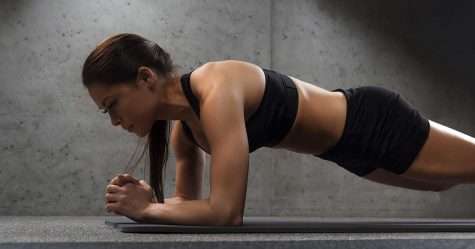
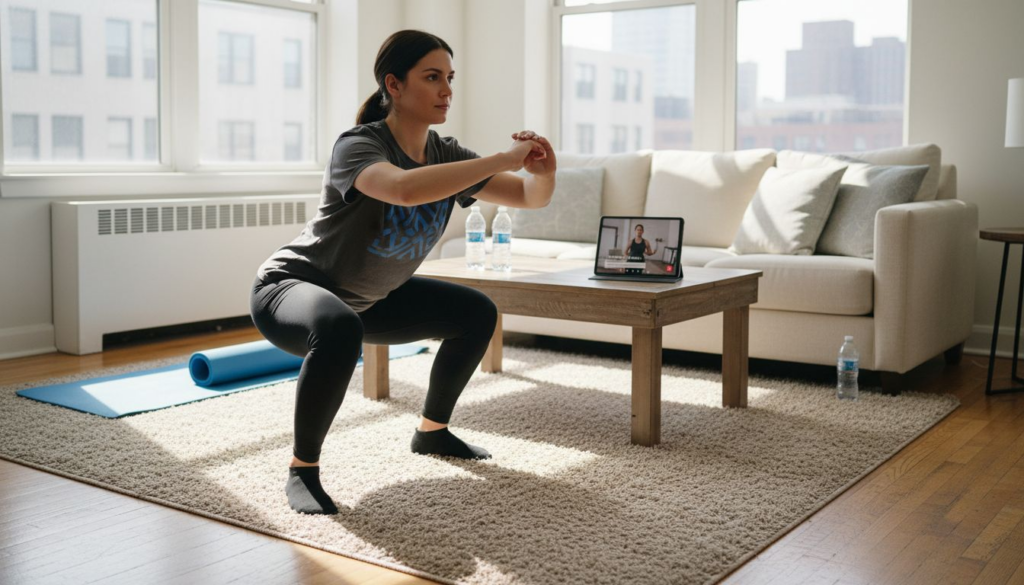
Squats, push ups, lunges, and planks are all excellent bodyweight exercises that target several big muscle groups, and are necessary for anyone looking to gain muscle and lose body fat. It is important that one starts with beginner forms of these exercises, such as push ups against a wall, or knee lunges.
Once one gains enough strength and endurance, they can move on to more advanced variations of these moves.
The best way to start is to do two or three sets of eight to twelve reps of each exercise
Pro Tip: As a beginner, it is vital that one listens to their body and does not push through pain. Starting with bodyweight exercises is a great way to get into shape, and gain fitness and strength, without hurting yourself in the long run. Bodyweight exercises are a great way to start a fitness journey, and can be done anywhere, at any time, with little to no equipment.
2. Boost Results With High-Intensity Interval Training
High Intensity Interval Training (HIIT) is a game changing workout method that offers the most in the shortest amount of time
When you engage in high intensity interval training, you will alternate between working out at maximum effort for a short interval and a lower intensity period of recovery. This unique type of workout has been proved to help people burn fat and get fit faster, and also has some interesting side benefits.
Harvard Health Publications writes about the benefits of high intensity interval training and how this workout can help you become healthier and fitter in a much shorter amount of time than other forms of exercise
These workouts force your body to work harder to overcome the stresses placed upon it, and offer the benefit of increased weight loss and fitness.
How High Intensity Interval Training Works
This form of training is based upon short bursts of all out effort and lower intensity recovery periods. When you work out at this high level for one to two minutes, then lower the intensity for half that amount of time, you will start to see and feel the benefits of HIIT.
After you finish your workout, the amount of calories you have burned continues to increase for up to an hour and a half. This is commonly called the afterburn effect or excess post-exercise oxygen consumption (EPOC).
Sample HIIT Workout
- Workout Interval
- Sprinting: 30 seconds running as fast as you can and 30 seconds of walking
- Bodyweight exercise: 40 seconds of burpees and 20 seconds of rest
- Cycling: 45 seconds of hard peddling and 15 seconds of easy peddling
In addition to the benefits of fitness and fat loss, research published in the journal
Scientific Reports sheds new light on the possible benefits of these unique workouts. A study made on older adults showed that they had increased brain function when it came to processing information. People who participated in this study also did better in tests of executive function.
Pro Tip: If you are new to this workout, try to keep the high intensity intervals shorter and as you get fitter, increase the time. The workouts last anywhere between 15 to 20 minutes, and you should always start with shorter intervals and listen to your body to avoid overexertion.
3. Try Low-Impact Workouts Like Pilates and Yoga
Low-impact workouts like Pilates and yoga offer a gentle yet powerful approach to fitness that can transform your body without putting excessive stress on your joints.
These mindful exercise methods provide comprehensive health benefits that extend far beyond traditional strength training.
Research published in the Journal of Physical Therapy Science demonstrates Pilates’ remarkable impact on body composition and functional fitness, especially for individuals seeking sustainable fitness solutions.
Unlike high intensity workouts that can strain your body, these practices focus on controlled movements, breathing techniques, and overall body alignment.
Benefits of Low Impact Workouts
Pilates and yoga deliver multiple advantages for weight loss and overall wellness:
- Improved Flexibility: Gradually increases range of motion
- Enhanced Core Strength: Builds muscle without heavy weights
- Stress Reduction: Combines physical movement with mental relaxation
- Better Posture: Aligns body and reduces muscle imbalances
The International Journal of Yoga confirms significant health benefits, highlighting how these practices contribute to holistic wellness by reducing stress and improving overall physical condition.
Both Pilates and yoga offer scalable difficulty levels, making them accessible for beginners while providing challenging variations for advanced practitioners.
You can start with basic mat routines and progressively incorporate more complex movements as your strength and confidence grow.
Pro Tip: Begin with online beginner classes or tutorials to learn proper form and technique. Invest in a quality yoga mat and wear comfortable, stretchy clothing that allows unrestricted movement.
4. Use Everyday Items as Creative Exercise Tools
Who says you need thousands of dollars worth of equipment at the local gym to achieve an incredible workout? Your home may be stocked with a variety of equipment you did not know you had!
According to the American Council on Exercise, many items that households use on a daily basis can be transformed into unique and challenging exercises.
Resistance Training Using Household Items
- Items that can be utilized for resistance training include:
- Water Bottles
- Chairs
Below are a few creative exercises to try using items in your home!
The NHS showcases a home cardio workout that uses common items found in the home as well as a variety of different types of exercises to create an effective workout. A chair can easily be used for step ups as well as a triceps dip. Items such as stairs can be utilized for a cardiovascular workout.
Other creative exercises that can be performed in your home include:
- Using water filled water bottles as weights (can be light or heavy depending on how much water is in the bottle)
- Creating slides on the smooth floor with a kitchen towel
- Utilizing stairs for a cardio and lower body workout
- Using a backpack as a weighted vest
Resistance training does not have to be expensive. It is all about getting creative with the items you have available in your home!
Pro tip: Make sure that the items you utilize for resistance training are safe and stable for use. Double check that any chairs used are sturdy and weights are secure to make sure nothing slides or breaks during your workout.
5. Follow Online Workout Videos for Guided Sessions
Online workout videos have fundamentally changed the way people work out at home, giving them professional guidance that helps them get in shape.
The internet contains a wealth of knowledge that can help anyone involved in fitness.
Online Workout Video Tips
The convenience of a guided workout in the comfort of one’s own home is a huge appeal for people who want to stay healthy.
Here are a few tips for finding a good online workout:
- Finding the Right Online Workout Videos:
- One should look for online videos of workouts that are led by certified fitness professionals.
- The workout’s difficulty should be appropriate for one’s fitness level; the equipment needed should be accessible; and the length of the workout should be convenient.
- There are a variety of different types of workouts, which appeal to a variety of different people.
- Some examples are yoga and flexibility workouts, high-intensity interval training, strength training, dance fitness, and cardio and weight loss workouts.
- Many sites offer a free trial so one can try out different workouts and fitness instructors to find a good fit.
A Tip to Improve Your Chances of Success:
One should create a well-organized workout area in the house where they’ll be working out. They should place the TV or computer in an area where the fitness instructor will be able to see clearly, and where there is enough room to move around and do the workout comfortably.
6. Combine Cardio and Strength for Best Results
The most effective way to work out is to combine cardio and strength training.
Using both exercises will help you burn fat and gain muscle faster.
Many comprehensive fitness guides feature information on how cardio and strength-training exercises work together.
Reasons for Combining Both Exercises
Here are some of the many advantages of cardio and strength training:
- Cardio
Strength Training
Burn calories and fats
Gain muscle mass
Enhance cardiovascular system
Increase metabolism rate
Make a workout plan that includes both types of exercises
Workout Advice
- You should alternate days of doing one type of exercise to days of doing the other.
You may try circuit training.
You should also try high-intensity interval training.
The best choice is to do a combination of exercises that utilize all of your muscles.
By using these simple and effective methods, you will be on your way to a healthier lifestyle.
Pro Tip: Try working out with both types of training, but do not try to combine them on the first day. Aim for two or three days of strength training and two or three days of cardiovascular exercises per week, and take a day off after each session.
7. Set Up a Weekly Home Fitness Plan for Motivation
A weekly fitness plan is an excellent guide to achieving the best results you can imagine. The right strategy will inspire and motivate you to work out and help you stick to a program.
Exercises are highly customizable, so motivation and inspiration techniques will differ from person to person. However, they should all include ideas that will help you develop a proper roadmap to fitness goals and keep you enthusiastic about working out.
Weekly Fitness Plan Elements
These tricks are perfect for building a solid weekly fitness plan:
1. Determine the types of exercises – strength training, cardio, HIIT, active recovery, and others
2. Decide how many days you will spend working out and those you will spend resting
3. Think about a proper level of difficulty for each type of training
4. Add variety to your plan so that it does not get boring
You may want to include a sample structure below as a guideline:
- Cardio/Weekday Workout: Monday, Tuesday
- Strength Training: Thursday
- Upper Body: Wednesday
- Lower Body and Core: Friday
- Flexibility Training: Saturday
- Rest Day or Light Walking: Sunday
- Active Recovery or Yoga: Wednesday
Motivation Tips
Moreover, here are some motivation tips that will help you get fit more efficiently:
- Use a fitness journal to track all your progress
- Set weekly goals and reward yourself when you achieve them
- Add some variety to your routine and do not miss any of your planned workouts
- Try using progress pictures and fitness communities for additional motivation
Moreover, remember that a fitness plan is flexible, and you should always make changes when needed according to your schedule and fitness level.
Pro Tip:
A good idea is to print a weekly fitness calendar and fill it with your workouts, and track all your achievements. You can color certain cells green when you achieve your goals instead of using a traditional diary.
Below is a comprehensive table summarizing the main strategies and benefits of various fitness approaches discussed throughout the article.
| Fitness Approach | Details | Benefits |
|---|---|---|
| Bodyweight Exercises | Use body weight as resistance; includes squats, push ups, lunges, and planks. | Builds foundational strength, improves flexibility, burns calories. |
| HIIT | Alternates short bursts of intense exercise with rest periods (e.g., sprints, burpees). | Enhances cardiovascular health, boosts metabolism, supports cognitive performance. |
| Low-Impact Workouts | Involves Pilates and yoga focusing on controlled movements and body alignment. | Improves flexibility, reduces stress, builds core strength. |
| Household Items | Utilizes items like water bottles, chairs, and towels as exercise tools. | Provides a cost-effective way to engage in resistance and functional training. |
| Online Videos | Guided virtual sessions by certified instructors tailored to fitness level. | Offers flexibility, diverse workout options, and professional guidance. |
| Combining Cardio & Strength | Mixes exercises for a balanced routine (cardio and strength on alternate days). | Maximizes fat burning and muscle building, improves endurance and body composition. |
| Weekly Fitness Plan | Structured weekly routine including various workouts and rest days. | Enhances motivation, ensures consistent progress, prevents workout monotony. |
Frequently Asked Questions:
Q-1: Can a home workout be effective even when you have no equipment, little space, and just 15 minutes?
A-1: Definitely, a lot of bodyweight exercises like squat, lunges, push-ups, step-ups, glute bridges, mountain climbers, etc. can be performed for a short period of time to work multiple muscle groups contrary to what equipment at a gym can do. However, even short workouts need to be combined with sufficient daily activity.
Q-2: Why can the simplest home workout to repeat be more valuable for weight loss than the most challenging workout you can do once?
A-2: The key idea for weight loss and getting fit is consistency. The most intense workouts may make you sore and tired and less likely to repeat them. On the contrary, a simple and light workout is more likely to be continued.
Q-3: How can everyday movement at home be turned into a weight-loss workout without feeling like a traditional workout?
A-3: Climbing stairs, talking on the phone while walking, doing regular chores, stretching, sitting less, and standing up in general can be added to regular workouts or replace them when there is not enough time. Additionally, it helps prevent a sedentary lifestyle.
Q-4: Could changing the order of exercises make a short home workout more productive?
A-4: Certainly, the first exercises should be more intense since you have plenty of energy at the beginning of a workout. For instance, complex lower body exercises can be done first, then upper body, and finally, core workouts. It depends on personal fitness and preferences.
Q-5: What is the easiest way to turn an ordinary home workout into a progressive workout for fitness?
A-5: It is possible to gradually increase the intensity of a workout by adding more reps, increasing the time of each set, decreasing the breaks between sets, using weights, and replacing simpler exercises with more difficult ones.
Q-6: Can walking inside your house be a part of a weight-loss workout?
A-6: Indoor walking, marching, and climbing are excellent ways to increase daily activity level and burn calories. They can also be used as a warm-up and a cool-down when doing a more intense workout. Moreover, they can replace regular outdoor walks when a person does not have time for them.
Q-7: Why should a home workout for weight loss include muscle-building exercises?
A-7: Working out, sweating, and getting a pump do not necessarily mean that you have done an effective workout for weight loss. Muscles need to be challenged to grow and stay dense. Resistance and bodyweight exercises can be added to the workout to build and retain muscle mass.
Q-8: How can I know if my home workout is becoming too easy for me?
A-8: If you can confidently repeat the same sets without any significant changes and feel tired only when you finish, it probably means you should increase the intensity. It can be done by adding more reps and sets, decreasing the breaks between sets, increasing the duration of each set, and replacing simple exercises with more complex ones. You do not need any equipment for these workouts.
Q-9: Could planning a home workout depend on my energy levels at different times of the day?
A-9: Probably, yes, since some people feel energetic in the morning and others in the evening. It is essential to recognize the best time for working out and make a plan according to it. Additionally, it is worth paying attention to daily activities and schedule so that working out is not impossible on days when a person is too busy.
Q-10: What makes a home workout plan more resistant to the common “slump” when motivation disappears?
A-10: A workout plan should be based on daily activity, not motivation. It should also include simple exercises that can be repeated several times, regular scheduled workouts, and other options for days when a person is too tired or does not feel like working out. Besides, a “short” 10-minute workout can be used as an alternative on busy days so that lack of time is not an excuse for not exercising.
Recommended:
- Effective Workout at Home Tips for Safe Weight Loss – LeanAndFit
- Full Body Home Workout for Effective Weight Loss Results – LeanAndFit
- Unlock Your Potential: Exercise Motivation Tips to Succeed – LeanAndFit
- Strength Training for Weight Loss: Effective Strategies That Work – LeanAndFit
- Why Trust LeanAndFit.info?
- For educational purposes only