Most American adults struggle with portion sizes that have nearly doubled since the 1970s, fueling the nation’s obesity crisis.
Everyday meals often come piled high, making it tough for health-conscious Americans to control calorie intake and shed extra pounds.
Understanding how portion sizes shape your diet is key and this guide offers practical, easy-to-use strategies for achieving lasting weight loss without feeling deprived.
Table of Contents
- Defining Portion Sizes In America
- Rising Trends And Key Differences
- Effects On Obesity And Health Risks
- Practical Strategies To Control Portions
- Common Mistakes In Portion Control
Key Takeaways
| Point | Details |
|---|---|
| Understanding Portion Sizes | Portion sizes in America have expanded significantly, affecting dietary habits and contributing to obesity. Individuals must differentiate between personal portion choices and standardized serving sizes. |
| Health Risks of Larger Portions | Increased portion sizes correlate with higher calorie intake, leading to obesity and chronic health conditions such as type 2 diabetes and cardiovascular disease. |
| Practical Portion Control Strategies | Using smaller plates, measuring food, and practicing mindful eating can help individuals manage portion sizes effectively. |
| Common Mistakes to Avoid | Misunderstanding serving sizes, eating from large containers, and distractions during meals can lead to unintentional overeating. Identifying these pitfalls is crucial for better portion control. |
Defining Portion Sizes in America
Understanding portion sizes is crucial for managing weight and maintaining healthy eating habits in the United States.
A portion size represents the actual amount of food an individual chooses to consume, which often differs significantly from standardized serving sizes.
According to USDA nutrition research, portion sizes reflect personal choice, while serving sizes are standardized measurements used for nutritional guidance and food labeling.
In America, portion sizes have dramatically expanded over the past few decades. What was once considered a standard meal portion in the 1950s has grown substantially, contributing to increased calorie intake and obesity rates.
The International Food Information Council highlights that most Americans struggle to distinguish between portion sizes and serving sizes, which can lead to unintentional overconsumption.
To effectively manage portion sizes, individuals must develop practical strategies. Key methods include using smaller plates, measuring food servings, understanding nutrition labels, and practicing mindful eating techniques.
Visual comparisons can help – for instance, a serving of protein should approximate the size of a deck of cards, while a serving of grains might resemble a tennis ball. These simple visual cues can help Americans make more informed dietary choices and maintain healthier eating patterns.
Pro tip: Keep a set of measuring cups and a food scale in your kitchen to accurately track portion sizes and develop better portion awareness.
Rising Trends and Key Differences
Portion sizes in the United States have undergone significant transformations over the past few decades, revealing striking trends in food consumption and nutrition.
Food consumption research from the USDA Economic Research Service demonstrates a clear and substantial increase in average portion sizes, particularly from restaurant and fast-food sources.
This trend has profound implications for dietary habits and public health, showing how portion sizes have expanded far beyond traditional serving recommendations.
The most dramatic changes have occurred in commercial food environments. Restaurants and fast-food chains have progressively increased portion sizes as a marketing strategy, often providing meals that contain two to three times the recommended caloric intake.
The Portion Balance Coalition’s comprehensive report highlights how these expanded portions have become normalized, fundamentally altering consumer expectations about what constitutes a standard meal.
This trend is particularly evident in categories like soft drinks, burgers, pizza, and pasta dishes, where portion sizes have grown exponentially since the 1970s.
Understanding these differences requires examining both serving sizes and actual consumed portions. While serving sizes remain standardized by nutritional guidelines, actual consumed portions frequently deviate significantly.
This discrepancy creates challenges for individuals attempting to maintain healthy dietary habits. Key differences include variations in restaurant servings versus home-cooked meals, regional dietary patterns, and socioeconomic factors that influence food consumption behaviors.
These nuanced variations underscore the complexity of portion size trends in American nutrition.
Here’s a comparison of portion sizes in home-cooked meals versus restaurant meals in the United States:
| Aspect | Home-Cooked Meals | Restaurant/Fast-Food Meals |
|---|---|---|
| Typical Portion Size | Usually matches guidelines | Frequently exceed recommendations |
| Control Over Ingredients | High, can manage calories | Low, added fats and sugars common |
| Visual Cues Available | More likely, easy to measure | Often difficult, larger plates used |
| Calorie Density | Lower, easier to moderate | Higher, more energy-dense dishes |
Pro tip: Compare restaurant portion sizes to standard serving sizes using a pocket-sized nutrition guide to make more informed dining choices.
Effects on Obesity and Health Risks
Increased portion sizes have become a critical driver of obesity and associated health risks in the United States.
Comprehensive research from dietary guidelines systematic reviews demonstrates a direct correlation between larger food portions and higher daily energy intake, significantly elevating the risk of weight gain and chronic health conditions.
These expanded portion sizes contribute to a complex web of metabolic disruptions that extend far beyond simple caloric overconsumption.
The health consequences of oversized portions are profound and multifaceted. Chronic overconsumption leads to increased risks of serious medical conditions, including type 2 diabetes, cardiovascular disease, metabolic syndrome, and certain cancers.
Nutrition research analyzing portion size trends reveals that larger, energy-dense portions fundamentally alter metabolic processes, triggering hormonal responses that promote fat storage and insulin resistance.
This physiological cascade creates a challenging environment for weight management and overall health.

Understanding the mechanisms behind portion-related health risks is crucial for developing effective intervention strategies. Larger portions not only increase total caloric intake but also disrupt natural hunger and satiety signals.
The body becomes conditioned to expect and consume more food, creating a cyclical pattern of overeating that becomes increasingly difficult to interrupt.
This neurological and physiological adaptation represents a significant challenge for individuals attempting to manage their weight and metabolic health.
The table below summarizes key health risks linked to consistently consuming oversized portions:
| Health Risk | Portion Size Impact | Long-Term Consequence |
|---|---|---|
| Obesity | Increases daily caloric intake | Chronically elevated body weight |
| Type 2 Diabetes | Promotes insulin resistance | Higher risk of glucose issues |
| Cardiovascular Disease | Raises blood pressure, cholesterol | Increased risk of heart events |
| Metabolic Syndrome | Disturbs hormonal balance | Complex systemic health problems |
Pro tip: Use smaller plates and practice mindful eating techniques to naturally reduce portion sizes and reset your body’s hunger perception.
Practical Strategies to Control Portions
Practical portion control strategies are essential for managing weight and maintaining healthy eating habits. Understanding and implementing effective techniques can dramatically transform how Americans approach food consumption.
By developing mindful eating strategies, individuals can learn to recognize appropriate serving sizes, reduce overall calorie intake, and create sustainable dietary patterns that support long-term health goals.
Visual cues and physical tools play a crucial role in portion management.
Portion control techniques from nutrition experts recommend several practical approaches, including using smaller plates, pre-portioning snacks, and learning to estimate serving sizes through simple visual comparisons.
Techniques like comparing protein servings to a deck of cards or understanding that a cup of grains should approximate the size of a tennis ball can help individuals make more informed eating decisions without feeling restricted.
Successful portion control also involves strategic environmental modifications and behavioral changes.
This includes serving meals on individual plates instead of family-style presentations, keeping high-calorie foods out of immediate reach, and practicing mindful eating by paying attention to hunger and fullness signals.
Restaurant strategies such as splitting meals, requesting half-portions, or immediately boxing up half the meal can prevent overconsumption while still enjoying dining experiences.
Pro tip: Invest in a set of portion control containers or a food scale to accurately measure and track your food intake without disrupting your normal eating routine.
Common Mistakes in Portion Control
Portion size mistakes represent a significant challenge for many Americans attempting to manage their dietary intake.
Eating directly from large containers, misjudging restaurant serving sizes, and multitasking during meals create substantial risks of unintentional overeating.
These seemingly minor errors can lead to dramatic increases in daily caloric consumption, often without individuals realizing the extent of their intake.
One critical error involves misunderstanding food labels and serving sizes. Nutrition experts highlight systematic misinterpretations of recommended portion measurements, where consumers frequently consume multiple servings while believing they are eating a single portion.
This confusion is particularly prevalent with packaged foods, where packaging design and marketing can deliberately obscure true serving sizes, making accurate portion tracking challenging.
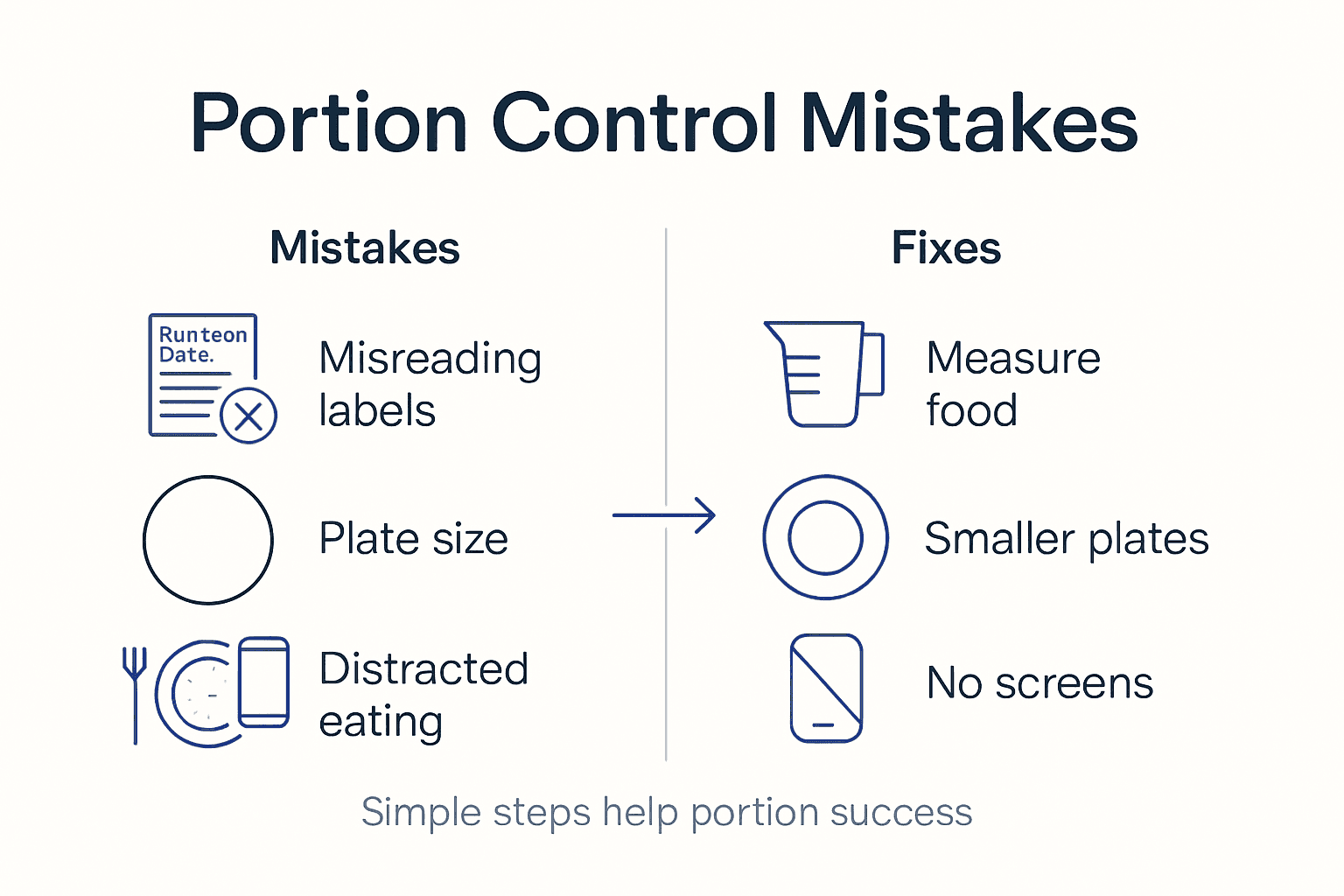
Psychological and environmental factors also contribute significantly to portion control mistakes. Eating while distracted, using oversized dinnerware, and consuming meals in social settings without mindful attention can lead to unconscious overconsumption.
The normalization of large portion sizes in American food culture further compounds these challenges, creating an environment where substantial food quantities are perceived as standard rather than excessive.
Understanding these psychological triggers can help individuals develop more intentional eating strategies.
Pro tip: Use smaller plates, measure servings before eating, and practice eating without digital distractions to improve portion awareness.
Take Control of Your Portions to Transform Your Health
Struggling with grown portion sizes and their impact on your weight and health is a common challenge.
The article highlights how confusing portions with serving sizes causes unintentional overeating and contributes to obesity and metabolic risks.
If you want to break free from this cycle, mastering mindful eating strategies is essential for regaining control over your intake and resetting your body’s hunger signals.
Discover practical tips and expert advice in our Mindful Eating – LeanAndFit section that can guide you toward healthier habits today. Act now to improve your relationship with food by learning portion control techniques that work in real life.
Visit leanandfit.info for reliable resources, and explore how preventing common portion mistakes can make a lasting difference. Empower yourself with knowledge and simple tools to maintain a balanced diet without stress or confusion.
Frequently Asked Questions
Q-1: What are portion sizes, and how do they differ from serving sizes?
A-1: Portion sizes refer to the amount of food an individual chooses to consume, while serving sizes are standardized measurements used for nutritional guidance and food labeling.
Q-2: How have portion sizes changed in the United States over the past few decades?
A-2: Portion sizes in the U.S. have expanded significantly, often doubling or tripling compared to traditional serving recommendations, especially in restaurant and fast-food contexts.
Q-3: What are some effective strategies for controlling portion sizes?
A-3: Practical strategies include using smaller plates, measuring food servings, pre-portions for snacks, understanding nutrition labels, and practicing mindful eating techniques to avoid overconsumption.
Q-4: What health risks are associated with consuming oversized portions?
A-4: Consistently consuming oversized portions is linked to obesity, type 2 diabetes, cardiovascular disease, and metabolic syndrome due to increased daily caloric intake and hormonal disruptions.
Recommended
- Portion Sizes Explained: Complete Weight Loss Guide – LeanAndFit
- 7 Easy Portion Sizes Visual Guide Tips for Weight Loss – LeanAndFit
- Effective Portion Control Tips for Healthy Eating Success – LeanAndFit
- Portion Control for Obesity: The Overlooked Cure – LeanAndFit
- Why Trust LeanAndFit.info?
- Solo con fines educativos.