

Nearly 50 percent of people fail to stick to their new habit during their first few weeks due to the best of their intentions.
Modifying your behavior can be an uphill battle when myths and misconceptions about habits lead you astray.
Recognizing the factors that contribute to successful habits and how they help you in your day-to-day life enables you to overcome these challenges and focus on the positive changes in your life to improve your health.
Table of Contents
- Defining Healthy Habits And Common Myths
- Types Of Habits For Better Health
- The Science Behind Habit Formation
- Proven Strategies To Build New Habits
- Overcoming Obstacles And Common Pitfalls
Key Takeaways
| Point | Details |
|---|---|
| Holistic Approach to Health | Healthy habits encompass physical, mental, and social wellness, integrating balanced nutrition, regular exercise, and stress management. |
| Small, Consistent Changes | Effective lifestyle transformations arise from incremental, sustainable changes rather than extreme measures. |
| Understanding Habit Formation | Successful behavior change involves motivational and volitional phases, with emphasis on creating systems that facilitate habits. |
| Overcoming Obstacles | Identifying and addressing common obstacles is key; cultivating resilience and favorable environments supports habit formation. |
Defining Healthy Habits and Common Myths
Building healthy habits is not a fast process that makes you lose weight in a short time. It is something that makes you improve your lifestyle and take better care of yourself.
Research from Havard School of Medicine reveals how to make healthy habits and what myths to avoid.
Healthy habits do not only focus on a person’s physical state but also consider other factors such as psychology and spirituality.
As research from Harvard Health indicates, key components include:
- Regular physical activity
- Balanced nutrition
- Adequate sleep
- Stress management
- Social connections
- Continuous learning
One of the myths about healthy lifestyle is that it involves a tons of restrictions.
Actually, it is a series of simple actions that make you healthier and is easier to perform than many people think.
For example, a light walk you can do every day is better than sporadic intense exercises.

Another popular myth is that healthy habits are boring – they are, in fact, a means to an end that should be fun and rewarding.
To successfully build healthy habits, it is essential to understand their underlying psychology.
In other words, it is vital to comprehend how one functions without motivational factors and develop appropriate tools for building a sustainable and rewarding mechanism.
Healthy lifestyle maintenance is not a function of inspiration but an element of well-established rituals.
As such, a sustainable strategy for developing healthy habits will inevitably entail establishing a system of regular, easy-to-follow routines that can be enforced even during periods of low motivation.
For a more in-depth discussion of the topic, we invite you to consult our article on building a lifestyle-oriented action plan at our healthy life blog.
Types of Habits for Better Health
Health habits are not one-size-fits-all strategies, but rather a personalized collection of practices that contribute to overall wellness.
Harvard Health identifies several critical habit categories that form the foundation of a healthy lifestyle, each playing a unique role in physical and mental well-being.
These habit types can be broadly categorized into several key domains:
- Physical Health Habits
- Regular exercise
- Balanced nutrition
- Adequate sleep
- Regular medical check-ups
- Mental Wellness Habits
- Stress management techniques
- Mindfulness practices
- Continuous learning
- Emotional regulation
- Social and Lifestyle Habits
- Maintaining strong relationships
- Setting healthy boundaries
- Work-life balance
- Active social engagement
According to Harvard Health, the most effective health habits are those are integrated into your daily life. It is not about being perfect. Instead,
it is about making healthier choices that will improve your life.
For example,
you can do simple things like getting enough exercise or taking short meditation breaks throughout your day.
By learning which of these habit categories best suits you, you can focus on developing the other health habits that you lack.
Some people may already have healthy rest habits, but not necessarily healthy diet or exercise habits. Others may have excellent social habits but need to develop their rest habits.
The point is that you must know your needs and address them
If you want to develop a more structured approach to forming new health habits, we recommend reading our post on healthy eating habits for beginners.
The Science Behind Habit Formation
Habit formation is not a simple or a black-and-white process.
In accordance with the Health Action Process Approach, successful behavior change requires a number of different but interconnected incentive and volitional stages that transform occasional behavior patterns into established habits.
The scientific understanding of habit formation reveals several critical stages:
- Motivation Phase
- Developing initial intention
- Understanding personal reasons for change
- Creating meaningful goals
- Volitional Phase
- Strategic planning
- Developing action strategies
- Building self-efficacy
- Maintenance Phase
- Sustaining behavioral changes
- Adapting to challenges
- Preventing relapse
Drawing insights from Atomic Habits, the habit formation process can be understood through four interconnected stages: cue, craving, response, and reward. Each stage plays a crucial role in transforming a deliberate action into an automatic behavior.
The cue reminds of the habit, the craving encourages the behavior, the response is an action itself, and the reward satisfies the craving making the habit a repetitive loop.
Building a habit effectively rarely means drastic changes – instead, it is all about the psychology and tricks to facilitate the changes that are beneficial to your daily life. Essentially, the key to developing a successful habit lies in making small changes to your behavior that, over time, become almost subconscious.
Therefore, building a habit can be a slow process that requires patience and planning.
Our article about small goals in fitness can offer you some valuable ideas and help you build a solid plan for developing a beneficial habit.
Proven Strategies to Build New Habits
Habit transformation requires more than good intentions.
According to insights from Atomic Habits, successful behavior change hinges on creating systems that make new habits obvious, attractive, easy, and satisfying.
Key strategies for building sustainable habits include:
- Make Habits Obvious
- Design your environment to support desired behaviors
- Use visual cues and reminders
- Create clear implementation intentions
- Make Habits Attractive
- Link new habits with positive emotions
- Create compelling narratives around behavior change
- Use habit stacking techniques
- Make Habits Easy
- Reduce friction in performing new behaviors
- Start with minimal viable actions
- Simplify the path of least resistance
- Make Habits Satisfying
- Implement immediate rewards
- Track progress visually
- Celebrate small wins
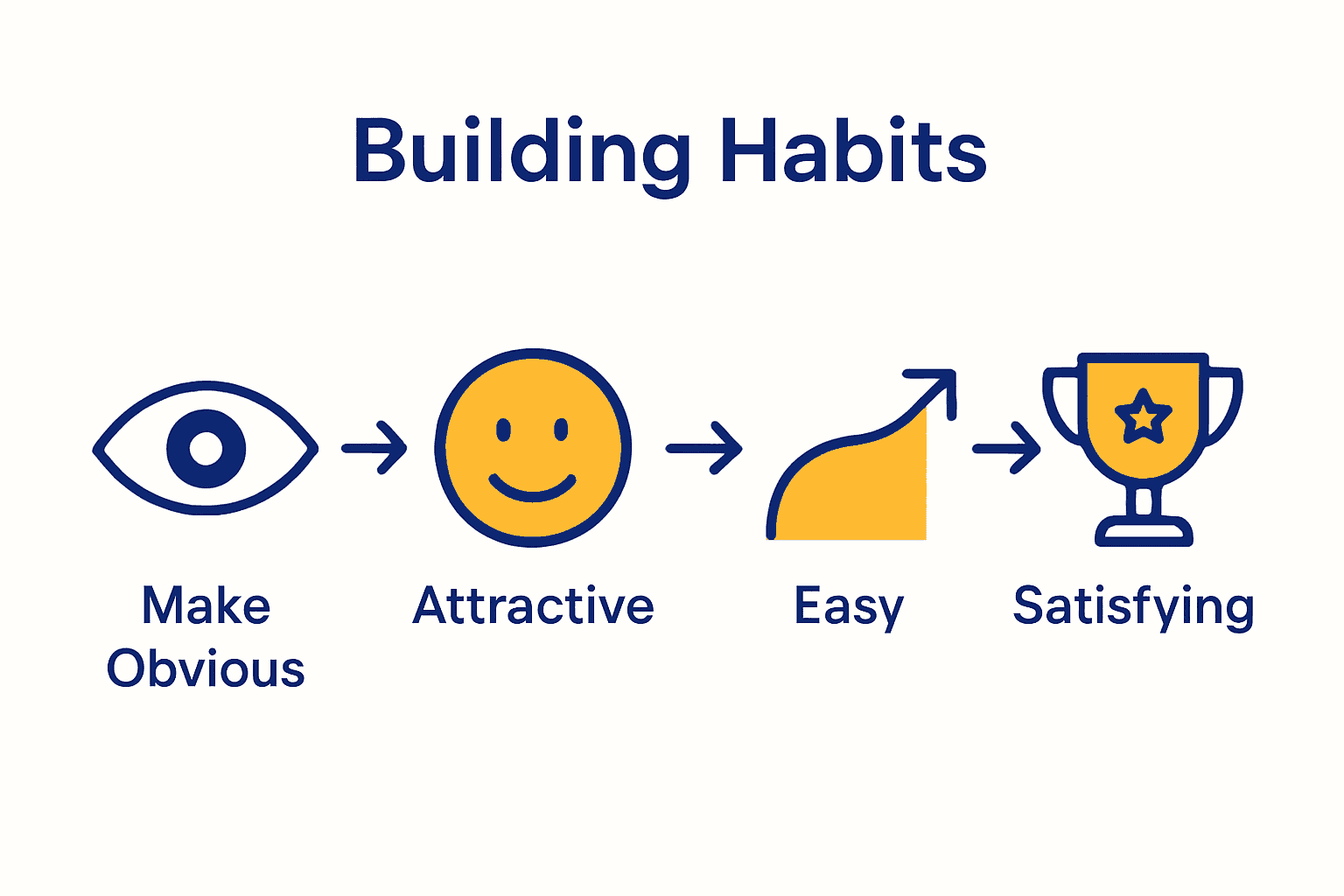
The basic idea is systems over goals. By creating an environment which encourages the behaviors that we want to see, we can begin noticing significant improvements in our desired lifestyle.
Small changes to our environment add up and help us develop better habits without requiring us to think about them. It’s all neuroscience!
Our habits are a result of the psychological triggers that we encounter daily.
All of this means that there is one incredibly easy way to start improving your life right now. The article on how to stay motivated to exercise can give you more ideas on how to make the change and accomplish your goal.
Overcoming Obstacles and Common Pitfalls
Developing sustainable habits is a prolonged process that requires motivation, but it also includes awareness and understanding of potential obstacles that may arise.
It is shown in Atomic Habits that many of the failed attempts are connected precisely with improper attention to the creation of a solid framework and concentrating too hard on the result itself.
Common obstacles in habit formation include:
- Motivation Fluctuations
- Unrealistic expectations
- Inconsistent commitment
- Lack of immediate results
- Environmental Challenges
- Unsupportive social circles
- Triggering physical spaces
- Limited resources
- Psychological Barriers
- Negative self-talk
- Fear of failure
- Imposter syndrome
- Structural Limitations
- Poor time management
- Inadequate planning
- Competing priorities
Creating an environment in which the desired success may be habitual is essential to building a successful mindset.
The environment should be organized in a manner that makes bad habits hard to be performed and good habits habitual. The psychological aspect of habit building is also of great importance.
One should realize that some bad habits are bound to occur; therefore, a person should not give up. A positive attitude and mindset are required while being in the process of building good habits.
In case some bad habits occur, the advice from our guide on how to overcome weight loss plateaus may be useful in overcoming them.
Take Control of Building Your Healthy Habits Today
Struggling with motivation and consistency when developing new habits can be challenging
The article highlights how essential it is to create systems that make habits obvious, attractive, easy, and delightful to overcome fluctuations in motivation and environmental challenges.
If you want to transform these habit formation tactics into a change that lasts, discovering effective Consistency Hacks can help you stay consistent and achieve your goals even without much self-control.
Get started on your transformation and take a look at our valuable resources and guides about developing long-lasting healthy habits
Our exercise regimens are perfect for busy people who want to achieve real results in fitness and transform their lives. No more procrastination — make your first step to a healthier life now! “your free products”
Frequently Asked Questions:
- What Is Healthy Living? Complete Overview and Guide – LeanAndFit
- 10 Essential Tips for Healthy Eating Habits – LeanAndFit
- Understanding Healthy Lifestyle Changes for Better Living – LeanAndFit
- Beginner’s Guide to Supplements: Build Your Ideal Routine – Nutribliss Inc.
- https://www.cdc.gov/healthy-weight-growth/losing-weight/index.html
- Longevity ernährung: So isst du dich zu einem längeren Leben – mybody®x
- Why Trust LeanAndFit.info?
- For educational purposes only