

Nearly 1 out of every 3 American adults are classified as obese, but there are few sustainable solutions regarding a healthier physical and mental state.
Healthy-minded Americans are tired of the fad diets and strenuous exercise that may not necessarily yield results.
Mindful movement may be the answer that provides tools for Americans to not only lose weight, but to enjoy the fitness process itself.
Table of Contents
- Defining Mindful Movement And Core Principles
- Popular Types And Everyday Variations
- How Mindful Movement Works In Fitness
- Physical And Mental Benefits For Weight Loss
- Common Mistakes And Safe Practice Tips
Key Takeaways
| Point | Details |
|---|---|
| Mindful Movement Principles | Focus on present moment awareness, non-judgmental observation, and intentional breath coordination to enhance the mind-body connection. |
| Benefits of Mindful Movement | Regular practice improves physical fitness, reduces stress, and cultivates emotional regulation, leading to overall well-being. |
| Types of Mindful Movement | Explore various practices like Yoga, Tai Chi, and Walking Meditation to find a style that aligns with personal fitness goals. |
| Safety Tips | Start slowly, listen to your body, and modify activities as needed to prevent injury and maintain enjoyment in your fitness journey. |
Defining Mindful Movement and Core Principles
Mindful movement is an innovative approach to fitness, which combines a conventional workout with psychological processes.
The essential idea is to complement exercises with cognitive functions.
A variety of principles define this phenomenon, which primarily consist of a specific focus on movements.
Unlike a regular workout, where the process may be subconscious, here the aim is to be aware of every action.
Every performer should concentrate on the flow of thoughts and pay attention to their body.
Five fundamental principles, which are used in mindful movement, include the following:
- keeping the process in present time
- eliminating judgment,
- breathing in the present,
- exertion of muscles,
- and concentration on the activity.
These points, which are primarily focused on the unity of workout and cognitive behavior, enable a person to improve the awareness of bodily actions.
Pro tip: Try to initiate mindful movement in your life at least once per day for 5-10 minutes.
Popular Types and Everyday Variations
Mindful movement can take many forms, but they are united by the idea that people can engage in physical activity while focusing on their mental state.
There are many ways to participate in mindful movement, which makes it very accessible for all interested parties.
Wellness activities in which people can engage in mindful movement have seen an explosion in popularity and variety, offering every participant a possibility to find something right for them.
Probably the most popular mindful movement is Yoga, which can be found in many variations, from very relaxing restorative styles to high-intensity power styles.
Other mind-body practices include Tai Chi and Qigong, varieties of Asian traditions that involve slow movements and special breathing techniques to clear the mind.
These activities are beneficial in that they help the mind and body synchronize, increasing flexibility, balance, muscle tone, and vitality.
Other types of mindful movement are:
- Pilates, which focuses on core strength and control, and Barre, a dance-like workout that tones muscles
- Somatic movement therapies, such as the Feldenkrais and Nia Technique, which improve body awareness and encourage mindful, easy movement;
- Walking meditations, which are similar to yoga but involve walking; and
- Adaptive yoga, which is yoga modified for people with limited ranges of motion.
Mindful movement is a valuable way to improve one’s fitness while reaping the additional benefits of reducing stress and increasing focus.
The most important thing is to choose an activity that is right for one’s body, and level of fitness – and then have fun with it!

Here’s a comparison of popular mindful movement practices and their unique focal points:
| Practice Type | Primary Focus | Physical Benefit | Mental/Emotional Benefit |
|---|---|---|---|
| Yoga | Breath & alignment | Flexibility & balance | Reduces stress, calms mind |
| Tai Chi | Flowing movements | Joint mobility | Enhances relaxation, focus |
| Pilates | Core engagement | Strength & posture | Builds concentration |
| Walking Meditation | Rhythmic foot movement | Cardiovascular health | Cultivates presence |
| Barre | Ballet-inspired moves | Muscle endurance | Boosts motivation, self-discipline |
| Qigong | Breath-energy flow | Vitality & stability | Cultivates inner calm |
| Feldenkrais | Gentle awareness | Improved coordination | Increases body intelligence |
Pro tip: Experiment with multiple mindful movement styles to discover which practice feels most natural and enjoyable for your body and mind.
How Mindful Movement Works in Fitness?
Attending to your movements while exercising turns a mundane activity into a mindful experience.
Mindful movement differs from a typical workout in that one pays a lot of attention to what is happening in one’s body throughout the duration of the exercise.
Practicing mindful movement encourages people to focus on their sensations and thoughts related to exercise.
As a result, one can achieve greater control and skill in any physical activity and reap the rewards of a good workout.
Mindful movement can be beneficial in many ways.
Some of these are listed below:
- Attention control
- Emotion regulation
- Embodied cognition
- Reduced stress
- Performance enhancement
Mindful sport performance enhancement programs can help people get more out of their workouts. They achieve this by helping people focus on certain aspects of their physical activity. Moreover, they can teach people to focus on the process rather than the outcome related to their fitness goals.
This can make exercise a mindful experience while also helping a person get into a better headspace regarding their fitness objectives.
A mindful movement can be incorporated into a person’s fitness regimen in various ways.
If one is new to this, one can try a body scan meditation. A body scan can be done right before a physical activity as a warm-up. It should last about a minute, and the goal is to bring attention to one’s body and be aware of any sensations that may arise. A mindful movement practice can be a valuable addition to one’s fitness routine.
Not only can it help one improve their performance, but it can also be a relaxing experience that would help one unwind during a busy day.
Physical and Mental Benefits for Weight Loss
Mindful movement strategies are an innovative way to lose weight since it is more than just working out and dieting.
People can improve their lifestyles by getting active and exercising their minds along with their bodies.
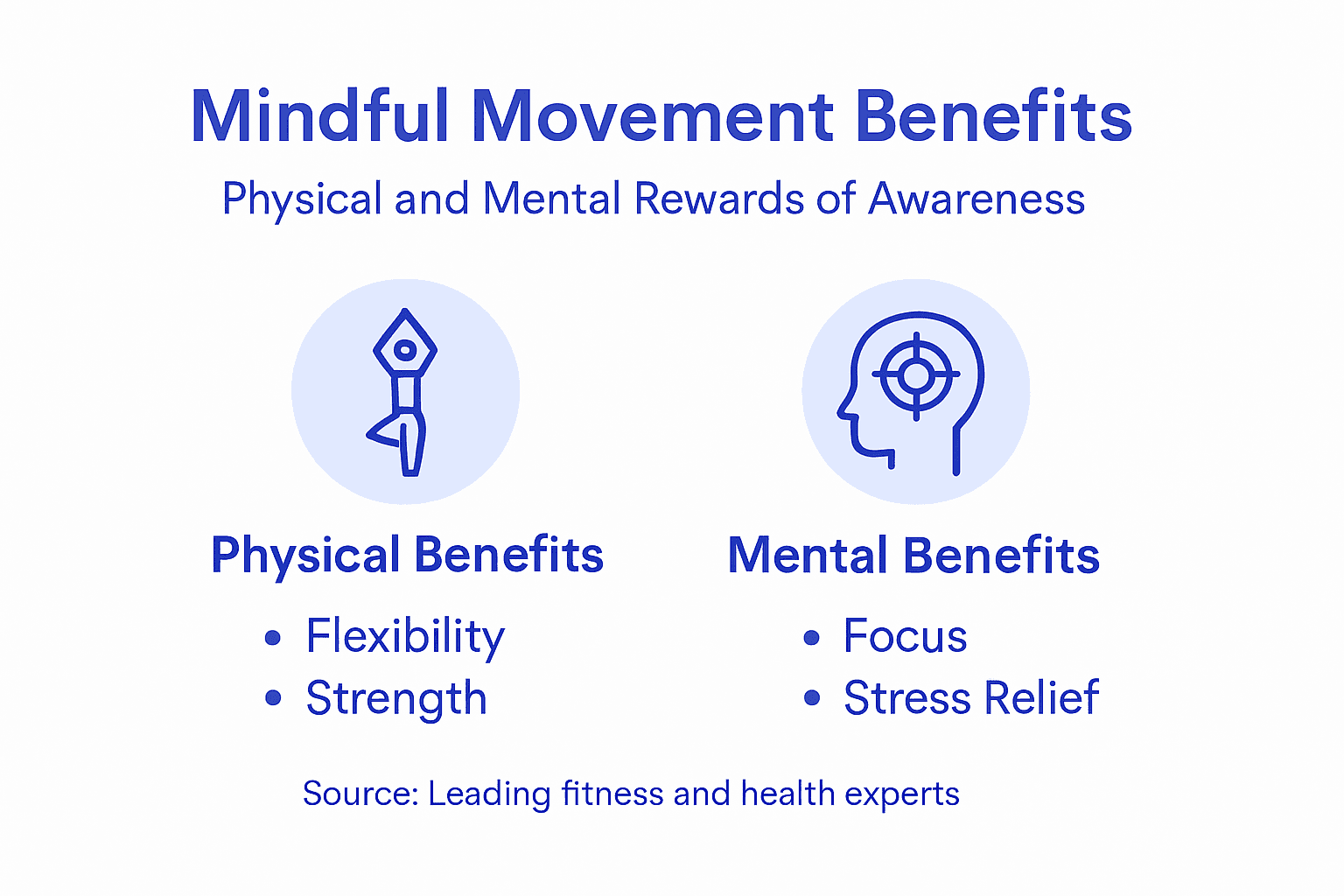
The physical benefits of mindful movement exercises are numerous. They include improved cardiovascular functioning, muscle strengthening, increased flexibility, and better metabolism.
In addition, such activities reduce stress hormones in the body, which has a beneficial effect on weight and weight gain. Mindful movement helps to control and reduce weight, as well as improve the psychological state of a person.
The psychological benefits of mindful movements are as follows:
• Alleviation of stress-related eating habits.
• Increased awareness of hunger and fullness.
• Improvement of mood.
• Reduction of anxiety and depression associated with overweight and obesity.
• Development of a positive attitude toward food and the body.
Stress reduction through mindful walking can help with weight loss and weight gain management. By reducing levels of stress hormones, such as cortisol, and restoring homeostasis, mindful movement allows a person to gain control over their weight and have the right attitude towards their body.
Below is a summary of mindful movement’s impact on physical fitness versus mental wellness:
| Aspect | Physical Fitness Impact | Mental Wellness Impact |
|---|---|---|
| Cardiovascular | Enhances heart health | Lowers stress response |
| Strength | Builds muscles & endurance | Encourages personal empowerment |
| Flexibility | Increases range of motion | Releases physical tension |
| Stress Management | Regulates cortisol levels | Improves emotional regulation |
| Concentration | Boosts movement precision | Heightens present-moment focus |
Pro tip: Integrate 15 minutes of mindful movement daily, focusing on your breath and bodily sensations to create a sustainable weight loss practice.
Common Mistakes and Safe Practice Tips
Safe mindful movement practices call for individuals to be aware of their limits and pay attention to their bodies.
People tend to make mistakes that could reduce their chances of having a healthy body.
The following are some common mistakes that people make when engaging in mindful movements:
- Moving too fast
- Ignoring the body’s signals
- Failing to time movements with breathing.
People engaging in mindful movements should avoid these mistakes by allowing their bodies to lead. They should not push themselves too hard since it could hinder their progress and affect their mood. Instead, people should take slow steps, move their bodies gently, and pay attention to every part.
The major safety guidelines during mindful movements are;
- Starting slow
- Listening to one’s body
- Modifying movements
- Focusing on breath
- Working out with professional instructors.
Strategies for effective mindful movement involve working out gradually and making changes according to one’s needs and abilities. One should know that every individual is different and thus should not copy others’ actions as it could lead to damage.
People should create journals to help them track their progress during mindful movements.
Unlock Lasting Weight Loss with Mindful Movement and Behavior Changes
Being unable to find the ways to make fitness valuable for your life can be disheartening.
However, what if you knew that the mindful movements constitute a tool to achieve an effective connection between mind and body, which will not only improve your physical condition, but also assist through stressful situations and lower the emotional barriers that prevent from losing weight?
The key elements of emotional regulation, stress reduction, and body awareness are vital aspects that will enable you to overcome the challenges, barriers, and setbacks in your fitness activities.
Make sure to combine these movements with the proper behavioral therapy, such as in our Behavioral Therapy – LeanAndFit program, and the mindful eating like in the Mindful Eating – LeanAndFit section, in order to maximize your chances of success.
Get started with the improving of your health and attitudes toward the physical exercises and eating habits today with the help of our expert-developed plans at LeanAndFit.info .
Engage your mind in a series of beneficial activities and uncover the secret to successful mindfulness practices that will help you achieve your goals of improving your appearance and building your fitness level.
Frequently Asked Questions:
Q-1. Can a mindful movement influence the approach toward the workout to promote weight loss?
A-1. A mindful movement could shape a different approach to the workout.
Instead of following the standard pattern of putting effort to exercise automatically, one could be aware of the pressure on the feet, stability, the breathing process and the position.
Such awareness would allow understanding the limits and the feelings associated with them better, thus making workouts a more tolerable yet regular event.
Q-2. Can a mindful movement in a slow manner make weight loss easier?
A-2. A mindful movement could be incorporated in the daily routine.
Instead of trying to make all exercises hard and punishing, one could do slow movements in a specific manner.
They might be more effective in the long run and could be used for developing other types of activity, such as slow walking or yoga.
Q-3. Can the process of mindful movement help to differentiate the feeling of overworked muscles not to be pushed further?
A-3. Mindful movement might assist in the progress of workout patterns since it does not rely solely on the response to immediate sensations.
One could differentiate the feeling of soreness and pain and be aware of the ability to move. Such tracking of the body’s response would help to make a mindful movement beneficial for the workout pattern.
Q-4. Can mindful movement transform the experience from ‘calorie-burning’ to a lifetime journey?
A-4. Mindful movement could help achieve transformation since the goal of weight loss often relies on the number of calories burned.
However, when a person tracks the breathing, movement, the workout environment, the sensations in the muscles, and the emotions, the workout becomes a full-life experience.
It goes beyond the opportunity to burn more calories by doing exercises as a daily routine.
Q-5. Can a 20-minute mindful walk be more effective than a regular walk without mindfulness?
A-5. The effectiveness of a 20-minute walk relies on the goals set. When one aims to burn more calories, a regular walk would be appropriate since the step counter would show a notable increase.
However, such a walk would not be as effective in terms of mindfulness because this type of movement is not about measuring the steps but about being aware of every movement and the sensation accompanying them.
Thus, 20 minutes is probably not enough to burn hundreds of calories, but it might help to improve the daily routine.
Q-6. Can mindful movement help to notice the transition from effective exercises to overworking?
A-6. Probably, mindful movement could help to recognize overworking since a person would be aware of the muscles’ movement.
If additional training elements are included, such as breathing, then one would realize the body’s response to the workout and all the uncomfortable or painful sensations associated with it.
However, this does not mean that the advice of medical professionals should not be followed.
Q-7. Can mindful movement be effective for weight loss when it is not a very intense workout?
A-7. It depends on the definition of effectiveness. When it is used in terms of calorie burning, then mindful movement would hardly help to lose weight.
However, there are reviews and research papers published on this topic that prove that mindfulness-based interventions could improve certain areas associated with weight loss, such as BMI, waist circumference, and weight.
They could be effective tools for maintaining a routine, which will ultimately lead to weight loss.
Q-8. Can the perception of the emotional state during the workout transform the approach to exercising if a person continues to train after several months?
A-8. It depends on how the emotional response to exercising is managed. Mindfulness brings a more conscious approach to the process of working out. It makes one aware of emotions, thoughts, and the environment in general.
Thus, if a person realizes that certain conditions during a workout are more unpleasant than others, they could be avoided.
However, there is not enough information to state that mindful movement transforms the approach to exercising in a way that makes one continue training for several months.
Q-9. What is the difference between a mindful movement and a regular workout when a person is not focused on the movement itself?
A-9. The difference lies in the fact that mindful movement brings awareness to the process of exercising.
When a person is not focused on the movement itself during a regular workout, they could be thinking of other things and miss certain discomforts associated with training.
In mindful movement, one would bring the attention to the breathing process, the movement of the muscles, balance, rhythm, and the environment. It is applied in many movement-type activities, such as yoga or dance.
Q-10. Can the transformation of the approach to exercising be more effective for weight loss than making the workout more difficult?
A-10. It can be more effective for some people since it would be easier to maintain this type of movement regularly. In terms of weight loss, it is essential to keep track of all food items and measure the calorie intake and the number of burned calories.
A conscious approach to the daily routine would improve the results of any workout, whether intense or moderate.
However, mindful movement is not probably not a cure for obesity, but it is a helpful tool for improving the overall well-being and the ability to exercise.
There are reviews that show that mindfulness-based interventions have a positive effect on waist circumference, BMI, weight, and the maintenance of an appropriate routine in certain populations.