

Most adult Americans are consuming far more added sugars than they probably ever knew on a daily basis.
These sugars have a sneaky way of finding their way into the diet, even in healthy foods, and can even derail the best of weight loss efforts.
Learn how to be aware of them and how to stop them from creeping into your diet in the article below.
Know your enemy when it comes to sneaky sugars and learn how to begin making better nutritional choices in your daily life.
Table of Contents
- Step 1: Assess Current Foods For Hidden Sugars
- Step 2: Read And Understand Ingredient Labels
- Step 3: Replace High-Sugar Foods With Healthy Alternatives
- Step 4: Monitor Daily Sugar Intake Consistently
- Step 5: Verify Progress And Adjust Your Approach
Quick Summary
| Key Point | Explanation |
|---|---|
| 1. Identify Hidden Sugars | Examine ingredient lists for various sugar names to recognize added sugars in everyday foods. |
| 2. Learn to Read Labels | Understand how to differentiate between naturally occurring and added sugars by studying nutrition facts and ingredient lists. |
| 3. Substitute for Healthier Options | Replace high-sugar foods with natural sweeteners and whole food alternatives to maintain taste without excess sugar. |
| 4. Track Your Sugar Intake | Use a daily food journal or apps to monitor sugar consumption and recognize high-sugar sources in your diet. |
| 5. Regularly Assess Progress | Compare current sugar intake with recommendations and adjust strategies based on your observations to maintain your health goals. |
Step 1: Assess current foods for hidden sugars
Understanding where do hidden sugars hide in the daily diet is essential.
Learning to read the labels and being aware of different names of sugar on the packaging will help in reducing the intake of unnecessary sweets.
First, it is important to study the ingredients of the foods that are usually eaten.
There are more than 60 different names and synonyms for sugar.
Some of the most common are sucrose, dextrose, maltose, corn syrup, and other ‘ose’ ending words. Ingredient lists of many packaged products may contain surprising amounts of added sugars, so it is important to watch out for them when buying groceries. Moreover, pay attention to the nutritional information on the packaging: indicate how much sugar comes from natural sources (fruits, vegetables, dairy) and how much is added to the product.
On average, an American eats about 22 teaspoons of sucrose per day, and the majority of them are not consumed deliberately. It is necessary to compare the amount of sugar per serving with the recommended daily amount and choose products with natural sugars as much as possible.
Here is a reference table of common hidden sugar names to help you spot them on ingredient labels:
| Sugar Alias | Common Food Sources | Notable Property |
|---|---|---|
| Dextrose | Baked goods, sodas | Simple sugar, raises blood sugar |
| Maltose | Cereals, processed bread | Derived from starch |
| High-fructose syrup | Soft drinks, sauces | Often used as sweetener |
| Sucrose | Candy, desserts | Table sugar, quick energy spike |
| Agave nectar | Granola bars, yogurts | Perceived as natural, still high |
| Cane sugar | Sweetened beverages | Often used instead of sucrose |
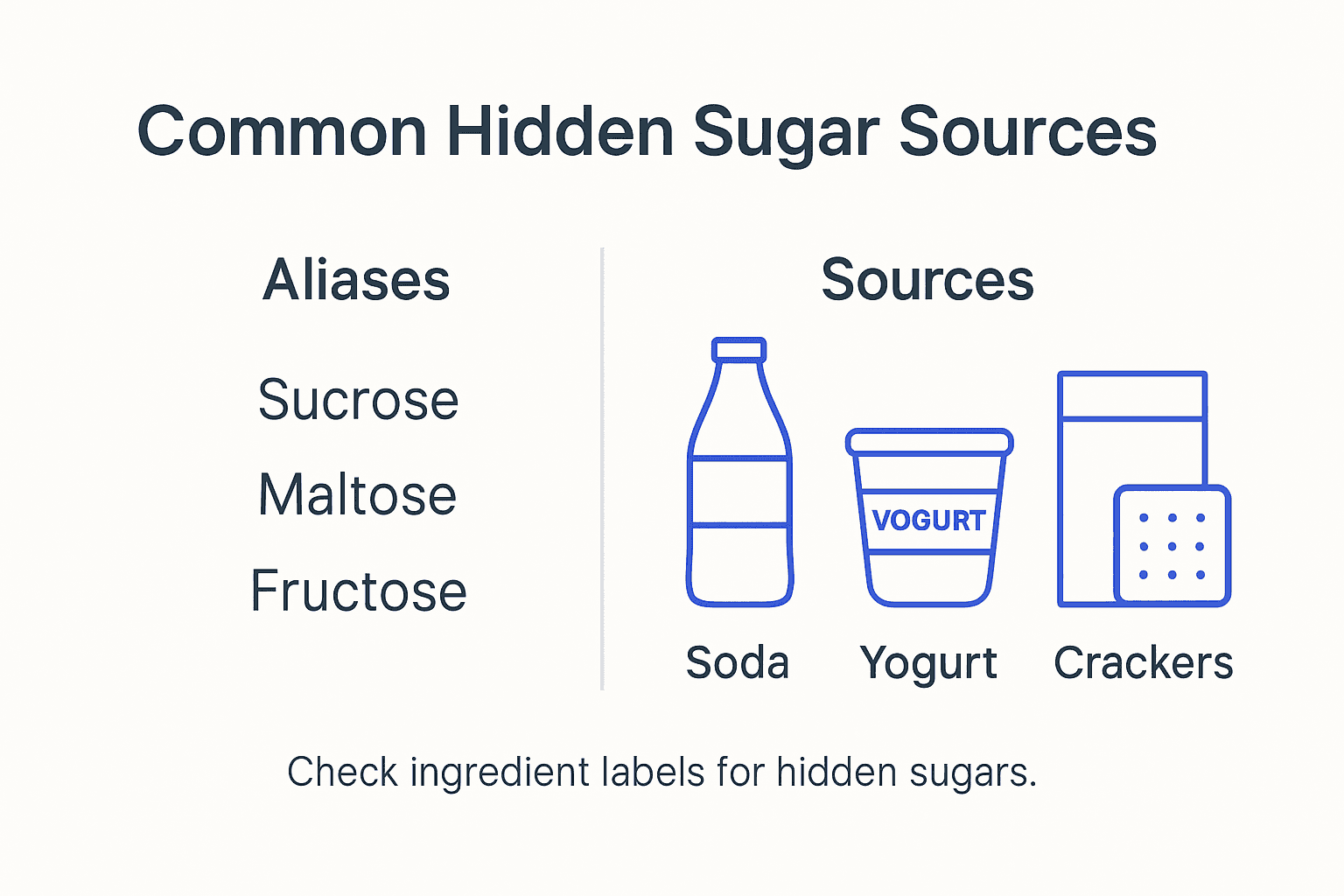
Pro tip: Keep a food diary for one week and highlight every item containing hidden sugars to raise your awareness and make more informed dietary choices.
Step 2: Read and understand ingredient labels
Learning how to decipher labels is your first step toward limiting your intake of hidden sugars and making better food choices.
By doing this you will learn how to spot added sugars that are disguised on food labels.

The nutrition facts label now includes important information on sugar.
To identify added sugars you must analyze the ingredient list and look for terms such as high-fructose corn syrup, cane sugar, maltose, honey, ending in -ose, or with the word syrup in it.
Additionally make sure to note that most processed foods list the ingredients in order of how much is in the product starting with the ingredient that has the highest amount.
Next, distinguish between sugars that occur naturally in food and the added sugars found in processed items. Limit consumption of added sugars and say yes to natural sugars.
Remember that when reading labels the total sugars is a combination of naturally occuring and added sugars. Make sure to limit added sugars found in junk food.
Pro Tip: One smart tip is to bring along a magnifying glass or use your phone’s zoom feature to view smaller labels
Step 3: Replace high-sugar foods with healthy alternatives
Changing the diet involves replacing sweet items with healthier ones to get a chance to improve the health indicators and feel better.
The key to reducing the amount of sugar is to make the right replacements.
They would allow to cut off the calories coming from sucrose and fructose and decrease the risk of developing diabetes and other metabolic disorders.
The most caloric and harmful types of sugar should be replaced with products which are high in fiber, vitamins, and minerals.
For example, when baking a cake, it is possible to substitute white sugar and brown sugar with unsweetened applesauce, mashed bananas, or 100% pure fruit juice.
In terms of sweeteners, sparkling water, herbal teas, and water with sliced fruits or vegetables are the best option.
Yogurt lovers have to give up sweeteners and flavored products and choose plain yogurt with added fruits.
It is also worth considering monk fruit sweetener and stevia as they are low in calories and do not raise blood sugar levels.
Moreover, they help to satisfy the craving for something sweet.
As per leanandfit.info, “The point is not to avoid sweet foods and drinks entirely but to replace refined sugar and sucrose with healthy products to improve the nutritional quality of the diet and ensure the normal functioning of the endocrine system”.
Pro Tip: However, it is better to make the replacements gradually so that the body and taste buds get used to the new texture and flavor.
Step 4: Monitor daily sugar intake consistently
Keeping track of how much sugar you consume every day is an essential component of managing your dietary patterns.
It can help you establish a beneficial framework regarding the amount of carbohydrates ingested and improve your nutritional choices in the long term.
To begin with, monitoring blood sugar levels assists in maintaining proper control of the diet and overall wellbeing. Create a list of foods you eat and consider all products in which sucrose may be present. Most commonly, people consume more carbohydrates than necessary and severely affect their health.
In addition, try to adhere to the standard dietary instructions and complement them with information on sugar-rich products.
Finally, use modern technology to estimate the amount of carbohydrates you ingest daily and compare it to the recommended one.
A variety of mobile applications can help you measure the required data by simply scanning a barcode of a product. However, if it seems difficult to use technological tools for monitoring, make a table or a notebook where you will note all foods that require checking.
Pro Tip: Essentially, the current stage of health awareness makes it vital to keep track of the daily carbohydrate intake and improve nutritional habits.
This summary table compares practical methods for tracking sugar intake:
| Tracking Method | Convenience Level | Accuracy | Key Advantage |
|---|---|---|---|
| Smartphone app | High | Very accurate | Automatic calculations |
| Handwritten journal | Moderate | User-dependent | Offers detailed insight |
| Spreadsheet | Moderate | High | Easy data visualization |
Pro tip: Set a weekly review time to analyze your sugar intake patterns and celebrate small victories in your nutrition journey.
Step 5: Verify progress and adjust your approach
If you want to cut sugar successfully, you need to constantly monitor and adjust your diet.
The assessment will help you see your achievements and track your progress in reducing sugar to maintain good health.
First of all, analyzing your food journal will give you an honest reflection of your current state, and the results will inspire you to adjust your diet.
Check if your sugar intake aligns with the recommended norms.
Evaluate if you are on the right path by analyzing your food journal and tracking your progress. Highlight those products with a high amount of carbohydrates that you eat regularly and try to find ways to exclude them from your diet. Moreover, write down all the details about your nutrition and observe which situations or snacks cause an increase in your sugar levels.
Next, based on the received information, you need to make changes and adjustments to your daily diet.
In this case, patience and perseverance will be your best allies. Moreover, you can consult with a nutritionist or dietitian about adjusting the diet and reducing sugar levels.
Finally, it is essential to track your progress so that you can visually see how much you have achieved and how much is left.
Pro Tip: You can do this by compiling a personal monthly report on sugar reduction progress. This will also help you stay motivated and inspired.
Frequently Asked Questions:
- How to Reduce Sugar Naturally for Lasting Weight Loss – LeanAndFit
- Sugar Addiction Solutions: Break Free for Lasting Weight Loss – LeanAndFit
- How to Curb Sugar Cravings Naturally for Lasting Weight Loss – LeanAndFit
- Sugar Addiction Causes: Complete Breakdown and Guide – LeanAndFit
- https://www.hopkinsmedicine.org/health/wellness-and-prevention/hidden-sugars—how-to-take-the-mystery-out
- Why Trust LeanAndFit.info?
- For educational purposes only