Every American with a full schedule knows how tough it is to squeeze in workouts that actually help you lose weight.
High-Intensity Interval Training, or HIIT, stands out as a smart solution because it compresses aerobic and strength training into quick sessions, often around 30 minutes.
This approach ramps up your heart rate to about 80 percent of its maximum, making it ideal for busy people seeking fast, effective results.
Discover how HIIT works, why common myths fail to hold up, and which formats offer maximum flexibility for your health goals.
Table of Contents
- HIIT Workouts Explained And Common Myths
- Popular HIIT Types And Workout Variations
- How HIIT Burns Fat And Builds Fitness
- Time Efficiency Compared To Traditional Cardio
- Potential Risks And How To Stay Safe
Key Takeaways
| Point | Details |
|---|---|
| HIIT Efficiency | HIIT workouts maximize results in shorter time frames compared to traditional cardio, requiring only 20-30 minutes per session. |
| Accessibility | HIIT can be adapted for all fitness levels and requires minimal equipment, making it suitable for a wide audience. |
| Fat Burning and Fitness | HIIT accelerates fat loss and improves cardiovascular health through intensive, high-effort intervals followed by recovery. |
| Safety and Progression | Caution is necessary to avoid injuries; start gradually and listen to your body to ensure a safe workout experience. |
HIIT Workouts Explained and Common Myths
High-Intensity Interval Training (HIIT) represents a revolutionary approach to fitness that transforms how people think about exercise efficiency.
Unlike traditional steady-state cardio, HIIT alternates between intense bursts of activity and short recovery periods, creating a metabolic environment that maximizes fat burning and cardiovascular improvement.
At its core, HIIT involves strategic interval training designed to push your body’s limits.
The method requires participants to elevate their heart rate to approximately 80% of maximum capacity during intense intervals, followed by brief rest periods. These short, powerful bursts challenge both aerobic and anaerobic energy systems more effectively than conventional workout approaches.
Common myths about HIIT often prevent people from experiencing its transformative potential:
- Myth 1: HIIT requires maximum effort for the entire workout
- Reality: Intervals are intense but structured with intentional recovery periods
- Myth 2: HIIT only works for young, extremely fit individuals
- Reality: Modifications exist for all fitness levels and ages
- Myth 3: You need extensive equipment or gym space
- Reality: Many HIIT workouts can be performed with bodyweight exercises in small spaces
Despite its challenges, HIIT offers remarkable benefits for athletic capacity including improved glucose metabolism, increased fat oxidation, and enhanced cardiovascular conditioning. Variations like Tabata and Sprint Interval Training provide diverse approaches to implementing this powerful training method.
Pro tip: Start with shorter HIIT sessions and gradually increase intensity, listening to your body’s response and allowing proper recovery between workouts.
Popular HIIT Types and Workout Variations
High-Intensity Interval Training (HIIT) is not a one-size-fits-all approach, but rather a flexible fitness strategy with multiple dynamic variations designed to challenge different fitness levels and goals.
Workout formats can be strategically adapted to suit individual needs, making HIIT an incredibly versatile training method.
Some of the most popular HIIT variations include:
- Tabata Training
- 20 seconds of ultra-intense exercise
- 10 seconds of complete rest
- Typically repeated for 4-8 total rounds
- Excellent for maximum metabolic impact
- Sprint Interval Training
- Alternating short, all-out sprints with walking or light jogging
- Ideal for cardiovascular conditioning
- Requires minimal equipment
- Circuit Training HIIT
- Multiple exercise stations
- Short, intense intervals at each station
- Targets different muscle groups
- Provides full-body workout experience
Circuit HIIT especially offers remarkable flexibility, allowing participants to design workouts using bodyweight exercises, resistance bands, or minimal equipment.
This approach ensures that HIIT remains accessible regardless of fitness level or available resources.

Each variation targets different physiological systems, creating unique metabolic responses that can accelerate fat burning, improve cardiovascular health, and enhance overall athletic performance. The key is selecting a format that matches your current fitness level and specific health objectives.
Here’s how popular HIIT variations differ on core characteristics:
| HIIT Variation | Typical Interval Format | Equipment Needed | Primary Benefit |
|---|---|---|---|
| Tabata | 20s effort, 10s rest, 4-8 rounds | None, bodyweight | Maximum calorie burn |
| Sprint Intervals | 30s-1min sprint, 1-4min rest | Treadmill or open space | Cardiovascular capacity |
| Circuit HIIT | Varied by station (30-60s) | Bands, dumbbells, bodyweight | Full-body conditioning |
Pro tip: Experiment with different HIIT variations to discover which style challenges and motivates you most effectively, remembering that proper form always trumps intensity.
How HIIT Burns Fat and Builds Fitness?
High-Intensity Interval Training (HIIT) is a powerful metabolic accelerator that transforms body composition through scientifically proven physiological mechanisms.
Cardiovascular and metabolic health improvements occur rapidly, triggering complex biochemical responses that go far beyond traditional steady-state cardio workouts.
The fat-burning process in HIIT is uniquely sophisticated:
- Metabolic Boost
- Elevates resting metabolic rate
- Increases post-workout calorie burn
- Activates fat oxidation mechanisms
- Continues burning calories hours after exercise
- Hormonal Optimization
- Reduces insulin resistance
- Increases human growth hormone production
- Regulates cortisol and stress hormones
- Enhances testosterone and muscle-building potential
- Energy System Engagement
- Stimulates both aerobic and anaerobic systems
- Improves overall cardiovascular efficiency
- Increases mitochondrial density
- Accelerates muscle adaptation and recovery
Physiologically, HIIT triggers unique pathways that traditional exercise cannot replicate. Muscle growth and energy system activation create a powerful metabolic environment that supports rapid fat loss and fitness enhancement.
Pro tip: Start with shorter, less intense HIIT sessions and progressively increase duration and intensity to allow your body to adapt and prevent potential injury.
Time Efficiency Compared to Traditional Cardio
HIIT revolutionizes workout efficiency, delivering maximum results in minimum time. Fitness gains occur dramatically faster compared to traditional moderate-intensity cardio, transforming how busy professionals approach physical fitness.
The time-efficiency advantage of HIIT becomes crystal clear when examining workout metrics:
- Traditional Cardio
- 45-60 minute sessions
- Steady, moderate intensity
- Lower metabolic engagement
- Limited post-workout calorie burn
- HIIT Workout
- 20-30 minute sessions
- Alternating high and low intensity
- Maximum metabolic activation
- Extended post-workout calorie expenditure
Federal exercise guidelines validate HIIT’s efficiency: 75 minutes of vigorous exercise equals 150 minutes of moderate activity.
Cardiovascular Benefits Breakdown shows HIIT’s remarkable potential.
Brief intense workouts deliver comprehensive health improvements that traditional cardio requires significantly more time to achieve. The compact nature of HIIT makes it ideal for professionals struggling to find extended workout windows.
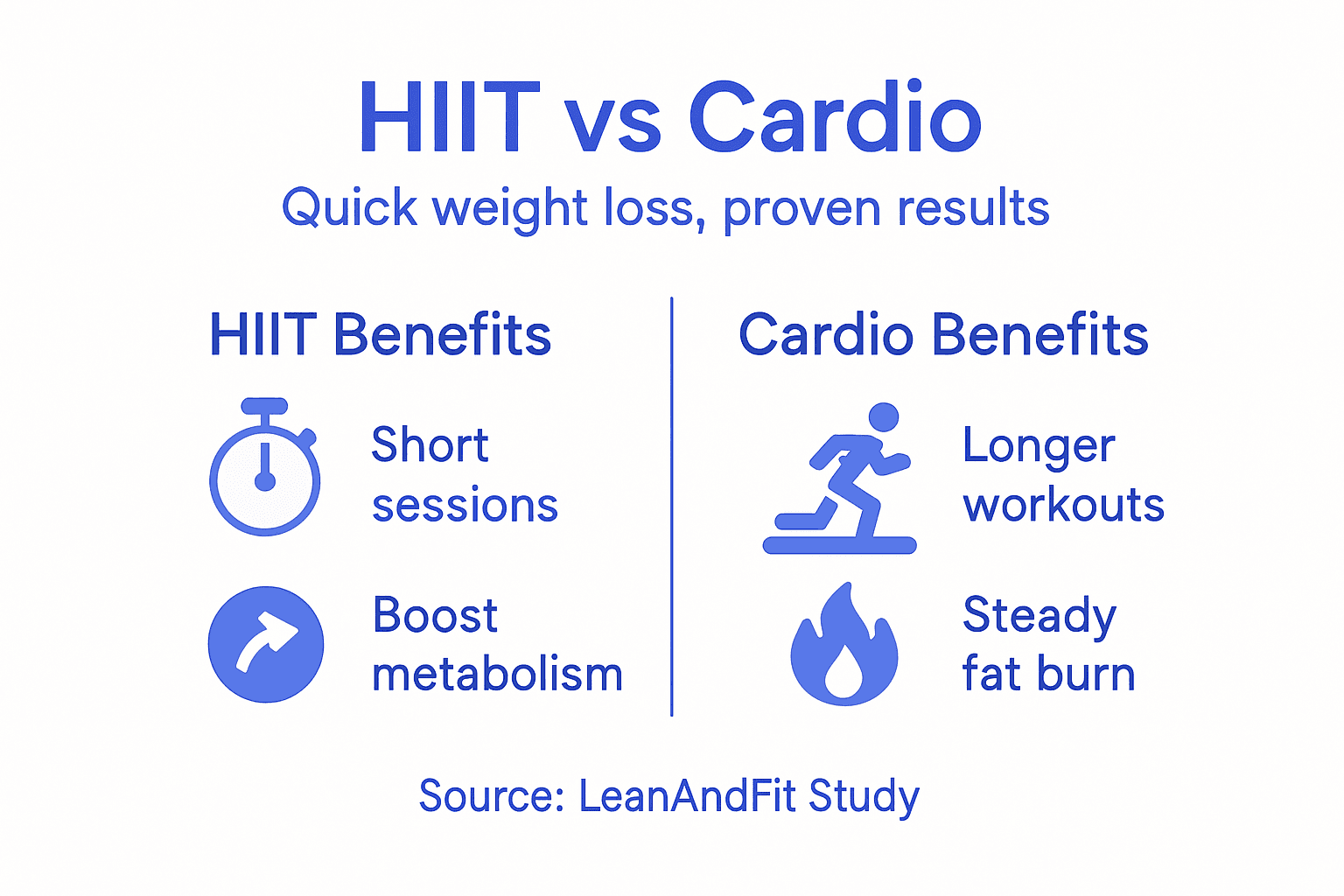
Compare the time efficiency and fitness impact of HIIT versus traditional cardio:
| Metric | Traditional Cardio | HIIT |
|---|---|---|
| Session Length | 45-60 minutes | 20-30 minutes |
| Intensity Level | Moderate | High, varies |
| Post-Workout Burn | Minimal | Extended increase |
| Progress Speed | Gradual | Rapid improvement |
Pro tip: Start with 10-minute HIIT sessions and progressively increase duration as your fitness level improves, ensuring consistent adaptation and minimizing injury risk.
Potential Risks and How to Stay Safe
HIIT demands careful approach, with potential risks that require strategic management. Musculoskeletal injury prevention represents a critical consideration for anyone embarking on high-intensity training programs.
Key risks associated with HIIT include:
- Physical Strain Risks
- Muscle sprains and strains
- Joint overload
- Tendon and ligament stress
- Potential cardiac stress for unprepared individuals
- Performance-Related Risks
- Overtraining syndrome
- Excessive fatigue
- Compromised immune function
- Metabolic system disruption
Properly managed HIIT requires comprehensive safety protocols. Gradual progression and symptom monitoring are essential for minimizing potential health complications.
Individuals with pre-existing health conditions should consult healthcare professionals before initiating any intense workout regimen.
Proper warm-up, controlled intensity, and listening to your body are non-negotiable safety principles.
Pro tip: Begin with low-intensity intervals, use proper form, and allow sufficient recovery time between high-intensity workouts to prevent potential injuries.
Unlock Rapid Weight Loss with Expert HIIT Guidance
Struggling to maximize the benefits of your HIIT workouts or uncertain about how to safely accelerate fat burning and improve cardiovascular health
The challenge is real but conquering it is easier when you have the right tools and knowledge.
This article highlights common HIIT misconceptions and explains how strategic interval training can transform your health and fitness journey.

Experience the full power of High-Intensity Interval Training by exploring our curated HIIT Sessions – LeanAndFit collection.
Discover tailored routines and expert tips designed to boost fat oxidation and strengthen your heart safely. For those who prefer fresh air and variety try mixing in Outdoor Workouts – LeanAndFit to keep motivation high and workouts exciting.
Ready to build strength alongside your cardio efforts visit our Resistance Workouts – LeanAndFit page for complementary exercises proven to enhance muscle growth and metabolic rate.
Don’t wait let leanandfit.info guide your next step toward sustainable weight loss and vibrant health today.
Frequently Asked Questions
What are the benefits of HIIT workouts for weight loss?
HIIT workouts are highly effective for weight loss as they maximize fat burning through intense intervals that elevate your heart rate, leading to increased calorie expenditure both during and after exercise.
How does HIIT improve cardiovascular health?
HIIT improves cardiovascular health by engaging both aerobic and anaerobic energy systems, enhancing overall heart efficiency and increasing blood circulation, which can lead to better heart health.
Can beginners safely start HIIT workouts?
Yes, beginners can safely start HIIT workouts by choosing lower intensity intervals and gradually increasing the intensity and duration as they become more conditioned, while also allowing for proper recovery time.
How much time do I need to dedicate to HIIT for effective results?
You can achieve effective results with HIIT in just 20-30 minutes per session, significantly less time than traditional cardio workouts, while still seeing improvements in fitness and weight loss.
Recommended
- How to Use High-Intensity Interval Training (HIIT) for Fat Loss? – LeanAndFit
- HIIT Training: Rapid Weight Loss and Fitness Boost – LeanAndFit
- Is HIIT the Secret to Getting Lean and Fit or Just Overhyped? – LeanAndFit
- Why Tabata HIIT Workout Beats All for Getting Lean and Fit? – LeanAndFit
- Why trust leanandfit.info?
- For educational purpose only