

Every American knows that having a hectic schedule can make it difficult to find time to work out in a way that allows one to shed unwanted pounds.
High-Intensity Interval Training, or HIIT, is an example of a program that makes the most of one’s time by combining two types of exercises – cardio and strength training – into short, near 30-minute workouts.
HIIT workout benefits for weight loss are immence but lesser known to most.
They allow one to raise the heart rate to 80 percent of the maximum, making them a great option for people who want to achieve the best results in the shortest time possible.
Learn more about the benefits of HIIT workouts, what common myths are proven to be misleading, and which variations to choose to get the most out of your training.
Table of Contents
- HIIT Workouts Explained And Common Myths
- Popular HIIT Types And Workout Variations
- How HIIT Burns Fat And Builds Fitness
- Time Efficiency Compared To Traditional Cardio
- Potential Risks And How To Stay Safe
Key Takeaways
| Point | Details |
|---|---|
| HIIT Efficiency | HIIT workouts maximize results in shorter time frames compared to traditional cardio, requiring only 20-30 minutes per session. |
| Accessibility | HIIT can be adapted for all fitness levels and requires minimal equipment, making it suitable for a wide audience. |
| Fat Burning and Fitness | HIIT accelerates fat loss and improves cardiovascular health through intensive, high-effort intervals followed by recovery. |
| Safety and Progression | Caution is necessary to avoid injuries; start gradually and listen to your body to ensure a safe workout experience. |
HIIT Workouts Explained and Common Myths
High-Intensity Interval Training (HIIT) is a relatively new concept in the field of fitness that has the potential to fundamentally change one’s perspective on working out.
Unlike traditional forms of physical activity, HIIT involves alternating between short bursts of intense exercise and periods of lower-intensity movement.
This unique approach creates optimal conditions for fat loss and cardiovascular improvement.
The key characteristic of HIIT is that it requires individuals to engage in interval training, which pushes their bodies to the limit.
In terms of intervals, one must exert themselves to the maximum extent during the HIIT session, raising the heart rate to approximately 80% of the maximum.
Moreover, this type of workout typically involves a combination of aerobic and anaerobic exercises.
There are several common myths about HIIT that prevent people from discovering the benefits of this training:
Myth 1: HIIT requires one to work out at the absolute maximum throughout the session
Reality: HIIT workouts consist of intervals, which means that one can take breaks in between.
Myth 2: HIIT is only suitable for young and highly fit individuals
Reality: There are modifications of HIIT designed for people of all ages and fitness levels.
Myth 3: One needs special equipment and a gym to perform HIIT
Reality: Many exercises can be done without any equipment and in small spaces.
While HIIT can be quite strenuous, it has a wide range of benefits for the body, including improvements in glucose metabolism, fat burning, and cardiovascular function. Tabata and Sprint Interval Training are two popular variations of HIIT that allow one to achieve excellent results.
Pro tip: it is advisable to start with shorter HIIT sessions and increase their intensity and duration over time, depending on one’s level of fitness and how the body reacts to the workout.
Popular HIIT Types and Workout Variations
High Intensity Interval Training is not a monolothic entity but rather consists of a variety of different workout types that involve varying approaches, intensities, and goals.
The main idea behind them is similar – increasing the intensity beyond one’s comfort zone in order to provoke greater physiological reward in terms of calories burned and fitness gains.
However, the ways in which this intensity is achieved are manifold and can be selected on an individual basis.
Some of the most popular HIIT variants include:
Tabata Training – 20 seconds of intense exercise followed by 10 seconds of rest performed in 8-12 cycles
Sprint Interval Training – alternating short bursts of all-out sprinting with walking or slow jogging
Circuit Training HIIT – a set of exercises performed in a circuitous fashion with brief rests in between
The circuitous approach seems to be the most flexible one as it allows a person to choose bodyweight exercises, resistance bands, or even small equipment at a gym in order to create a challenging HIIT session.

However, each variation can be tailored toward different areas of the body that need improvement, stimulating fat loss, improving heart function, and increasing performance.
It is important to choose the option that suits your current level and goals.
Here’s how popular HIIT variations differ on core characteristics:
| HIIT Variation | Typical Interval Format | Equipment Needed | Primary Benefit |
|---|---|---|---|
| Tabata | 20s effort, 10s rest, 4-8 rounds | None, bodyweight | Maximum calorie burn |
| Sprint Intervals | 30s-1min sprint, 1-4min rest | Treadmill or open space | Cardiovascular capacity |
| Circuit HIIT | Varied by station (30-60s) | Bands, dumbbells, bodyweight | Full-body conditioning |
Pro tip: Experiment with different HIIT variations to discover which style challenges and motivates you most effectively, remembering that proper form always trumps intensity.
How HIIT Burns Fat and Builds Fitness?
High Intensity Interval Training is a metabolic power plant, a process that fundamentally changes your body composition through a series of physiological mechanisms.
Your body burns fat in a fundamentally different way during these kinds of workouts, and the aftereffects of HIIT exercise influence your metabolism for hours after you finish your workout.
There are several key differences between regular cardio and HIIT that have a major impact on weight loss and fitness gains.
Metabolic Power Plant
Elevated metabolic rate
Increased calorie expenditure
Fat oxidation activation
Sustained calorie burn after workout
Hormonal Regulation
Decreased insulin resistance
Increased growth hormone secretion
Reduced stress hormone levels
Improved testosterone production
Energy System Utilization
Engagement of both aerobic and anaerobic systems
Increased cardiovascular efficiency
Higher mitochondrial density
Accelerated muscle adaptation
These physiological changes are unique to high intensity interval training, as they capitalize on the body’s natural response to intense physical stress.
The combination of muscular and metabolic stress during HIIT creates an environment conducive to rapid fat loss and improved fitness.
However, it is important to note that you should start with shorter and less intense workouts and gradually progress in terms of both volume and difficulty to avoid potential injuries.
This approach allows your body to adapt to the new type of stress and prevents overexertion.
Time Efficiency Compared to Traditional Cardio
HIIT can fundamentally change one’s perception of working out, as it allows one to achieve dramatic results in a significantly reduced amount of time, as compared to traditional moderate-intensity workouts.
The time required to perform a workout is drastically reduced when using HIIT, as demonstrated by the following comparison:
@ Traditional Cardio HIIT Workout
@ 45-60 minute workouts 20-30 minute workouts
@ Moderate intensity throughout Alternating between high and low intensity
@ Lower overall metabolic activity Higher overall metabolic activity
@ Less post-workout calorie consumption More post-workout calorie consumption
The Federal guidelines for physical activity essentially recommend HIIT, as 75 minutes of vigorous activity are recommended per week, as opposed to 150 minutes of moderate-intensity activity.
The cardiovascular benefits of HIIT workouts are demonstrated by the comparison chart above, which highlights the significant amount of benefits which can be achieved through shorter, more intense workouts.
This can be extremely beneficial for people with a limited amount of time, as one can achieve the same results as a traditional moderate-intensity workout, but in roughly half the time.
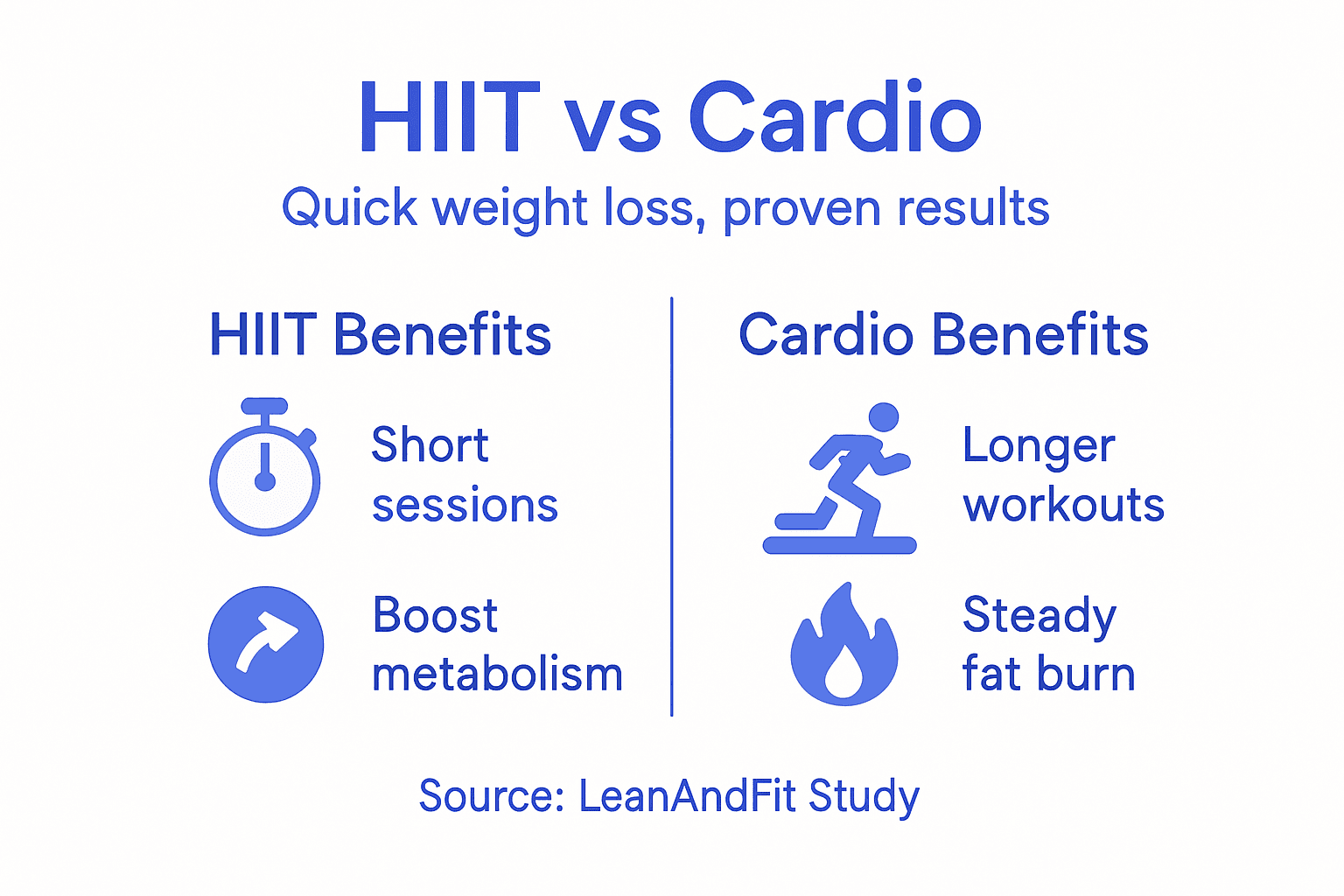
Compare the time efficiency and fitness impact of HIIT versus traditional cardio:
| Metric | Traditional Cardio | HIIT |
|---|---|---|
| Session Length | 45-60 minutes | 20-30 minutes |
| Intensity Level | Moderate | High, varies |
| Post-Workout Burn | Minimal | Extended increase |
| Progress Speed | Gradual | Rapid improvement |
Pro tip: Start with 10-minute HIIT sessions and progressively increase duration as your fitness level improves, ensuring consistent adaptation and minimizing injury risk.
Potential Risks and How to Stay Safe
HIIT is a type of training that requires caution, as it can cause a variety of injuries that need to be taken into account.
Musculoskeletal injury prevention is an essential component of any high-intensity interval training program. The main risks associated with this type of training include the following:
The main risks associated with this type of training include the following:
@ Physical Risks
@ Muscle sprains, strains
@ Joint overuse
@ Tendon and ligament stress
@ Heart stress for people with low endurance
@ Performance Risks
@ Overtraining
@ Extreme fatigue
@ Weakened immune system
@ Metabolic imbalance
Appropriate HIIT requires a set of safety measures. Gradual increase in intensity and observation of the body’s response to avoid potential injury during training are essential for such procedures.
In addition, it is important to note that people with health conditions should consult a doctor before attempting to perform any high-intensity interval training.
Warm-up and recovery are essential components of HIIT, and their neglect can lead to injury.
A useful strategy for preventing injuries during high-intensity interval training is to start with a low level of intensity, maintain proper technique, and take enough rest between high-intensity exercises.
Unlock Rapid Weight Loss with Expert HIIT Guidance
Struggling to get the most out of your high-intensity interval training or unsure how to burn fat and improve heart health most effectively?
The good news is that it can be much easier if you know what to do.
This article explores HIIT myths and the best ways to improve your health using this time-saving workout approach.

Get to Know the Full Potential of High-Intensity Interval Training with our LeanAndFit HIIT Sessions
Take a look at our selection of specially crafted HIIT routines and valuable recommendations on how to increase fat burning and improve cardiovascular health with High-Intensity Interval Training right now.
Would you like to gain more energy doing workouts while challenging yourself? Then consider trying our Outdoor Workouts – LeanAndFit and getting inspired by the beauty of nature every day.
If you want to increase your muscle mass while doing aerobic activities, you are welcome to the Resistance Workouts – LeanAndFit section comprising resistance training routines that help build muscles and burn fats.
So why are you waiting for? Let leanandfit.info show you the way to effective and fun weight loss!
Frequently Asked Questions:
- How to Use High-Intensity Interval Training (HIIT) for Fat Loss? – LeanAndFit
- HIIT Training: Rapid Weight Loss and Fitness Boost – LeanAndFit
- Is HIIT the Secret to Getting Lean and Fit or Just Overhyped? – LeanAndFit
- Why Tabata HIIT Workout Beats All for Getting Lean and Fit? – LeanAndFit
- Why trust leanandfit.info?
- For educational purpose only