

Over one third of American adults are diagnosed with obesity-related health problems that affect their day-to-day life.
With weight issues being the main cause of chronic disease in America, it is important that you understand how Body Mass Index works to help you fight this problem.
First you need to undertand body mass index meaning.
This article by leanandfit.info will explain what BMI is, how you can calculate it, what categories you fit into depending on your BMI, as well as go over some of the most important information regarding this vital health indicator.
Table of Contents
- What Body Mass Index Means and Measures
How BMI Is Calculated and Used
BMI Categories and Health Implications
Limitations and Misconceptions of BMI
Alternatives for Assessing Body Fat
Key Takeaways
| Point | Details |
|---|---|
| Body Mass Index (BMI) Calculation | BMI is calculated by dividing weight in kilograms by height in meters squared, or using a formula adapted for pounds and inches in the U.S. |
| BMI Categories | The standard BMI categories include Underweight, Normal weight, Overweight, and Obese, each associated with different health implications. |
| Limitations of BMI | BMI does not differentiate between muscle and fat mass, which can lead to misleading assessments for athletes or muscular individuals. |
| Alternative Assessment Methods | Consider advanced body composition analysis methods like DXA and BIA for a more accurate assessment of health beyond traditional BMI metrics. |
What Body Mass Index Means and Measures?
Body Mass Index (BMI) is a ratio between a person’s body weight and height that roughly estimates whether a person is at risk for weight-related conditions.
It was created as a statistical tool meant for populations, so normal weight range for adults is defined statistically, and there are other categories that can help evaluate weight status.
Use a calculator to print or email your results. Or, print this page for instructions.
The formula for BMI is weight [kg] divided by height [m] squared.
Based on the number, one can determine whether they are underweight, normal weight, overweight, or obese.
According to the World Health Organization (WHO) classification and the Centers for Disease Control (CDC), the following BMI categories are generally used:
- Underweight: below 18.5
- Healthy weight: 18.5 – 24.9
- Overweight: 25 – 29.9
- Obese: 30 and above
BMI should be used as a general indicator. One cannot tell if someone has too much muscle or fat mass based on their BMI. It is not recommended to categorize a person solely based on their BMI, since it does not consider variations in body composition.
Doctors usually consider a person’s BMI along with other factors, such as waist size and body fat.
PRO TIP: You may want to get an in-depth body scan to understand your body composition better than a standard BMI test.
How BMI Is Calculated and Used?
Body Mass Index can be calculated using a simple mathematical formula. It provides a fast estimation of the weight status of a person.
A healthcare professional determines one’s body mass index to screen for possible health risks. As such, it plays a vital role in assessing general wellness and detecting health problems affecting the body weight.
There are two primary methods for calculating the body mass index. The first calculation involves dividing weight in kilograms by the square of height in meters to obtain kg/m 2 .
An alternative is to use the number of pounds and inches before dividing by the square of height in inches. The CDC offers calculation guidelines in metric and US units for easier weight screenings. Below are the steps involved in calculating body mass index.
Here’s a quick reference to BMI formulas for different measurement systems:
| Unit System | Formula | Common Use |
|---|---|---|
| Metric | weight (kg) / [height (m)]² | Worldwide/Scientific |
| Imperial | (weight (lb) / [height (in)]²) × 703 | United States/General Public |
| Digital Tools | Online calculators and apps | Consumer/Easy calculation |
- Calculate your weight in kilograms or pounds
Calculate your height in meters or inches
Square the height and divide the weight by the resulting number
The result is your BMI
Though BMI can help determine whether a person is overweight or underweight, the index is not a reliable indicator of health.
BMI can be misleading since the same number can represent very different levels of body fat depending on a person’s muscularity.
Health professionals usually consider BMI in conjunction with other factors such as waist size, body fat, and other health indicators to assess an individual’s overall health and fitness.

Pro Tip: Request a comprehensive health screening that goes beyond BMI to get a more accurate understanding of your overall physical condition and potential health risks.
BMI Categories and Health Implications
Body Mass Index (BMI) is a classification that sorts people according to their weight category. The classification helps the doctor interpret patients’ health status regarding potential risks associated with the excessive accumulation of body fat.
The latest studies prove that the index helps determine death and chronic disease risks.
For the adult population, the CDC (Center for Disease Prevention and Control) classifies weight categories into four classes.
Underweight – BMI below 18.5
Potential risks:
- Poorly nourished
- Low immunity
- Osteoporosis
- Muscle loss
Normal weight – BMI between 18.5 and 24.9
Potential risks:
- No increased chronic disease risks
- Normal metabolic functions
- Lower mortality rates
Overweight – BMI between 25 and 29.9
Potential risks:
- Heart disease risks
- Diabetes risks
- Muscle and joint problems
Obesity – BMI 30 and above (1st, 2nd, 3rd degree depending on severity)
Potential risks:
- High chronic disease risks
- Cardiovascular disease risks
- Increased cancer risks
- Metabolic syndrome
It is essential to remember that the body mass index is a screening tool. Several factors are considered when determining the potential health risks associated with high BMI, including body structure, muscular structure, sex, and age. The index helps determine the general health state of the population; however, it is not a solid indicator of personal health status.
Health care providers generally use body mass index in combination with other screening methods for better accuracy in determining potential health risks.
Pro tip: Ask the doctor to determine and explain your BMI to understand what it means for your health.
Limitations and Misconceptions of BMI
Though it is frequently used, Body Mass Index (BMI) is not a particularly accurate tool for assessing health.
There are some serious restrictions and dangers in relying on this numerical value as the primary indicator of health, which current medical professionals are just beginning to acknowledge.
Several of the most dangerous flaws of BMI as a tool for assessing the health of individuals are listed and explained below:
- •Muscle mass can be mistaken for unhealthy weight
- •The formula is prejudiced towards Caucasians
- •It does not account for age
- •And it does not account for healthy weight distribution.
These flaws in the diagnostic tool prompt to more scrutiny as to why BMI is not as useful as we have been led to believe. BMI is a tool that was designed to approximate the health of a population, rather than individuals, due to some well-documented shortcomings in its ability to indicate health.
Its formula is shockingly simplistic: weight divided by height squared. This calculation produces wildly inaccurate results when it comes to muscular individuals, the elderly, and people of different races.
BMI also fails to account for differences in body types, such as muscular versus fatty weight gain. As a result of these known flaws, doctors and medical professionals across the country are beginning to push away from BMI as a reliable health indicator.
They are advocating for more comprehensive tests to be used in addition to, or in place of, BMI as a way of getting a better idea of a person’s health based on their weight.
Pro Tip: When visiting your doctor, request a full health assessment, as opposed to a BMI test, in order to get a better idea of your health.
Alternatives for Assessing Body Fat
Body Composition Analysis provides more thorough information about the state of health of the human body than the traditional calculation of BMI.
State-of-the-art methods allow for the accurate assessment of the distribution of fats in the body, as well as other features that are helpful in determining body composition.
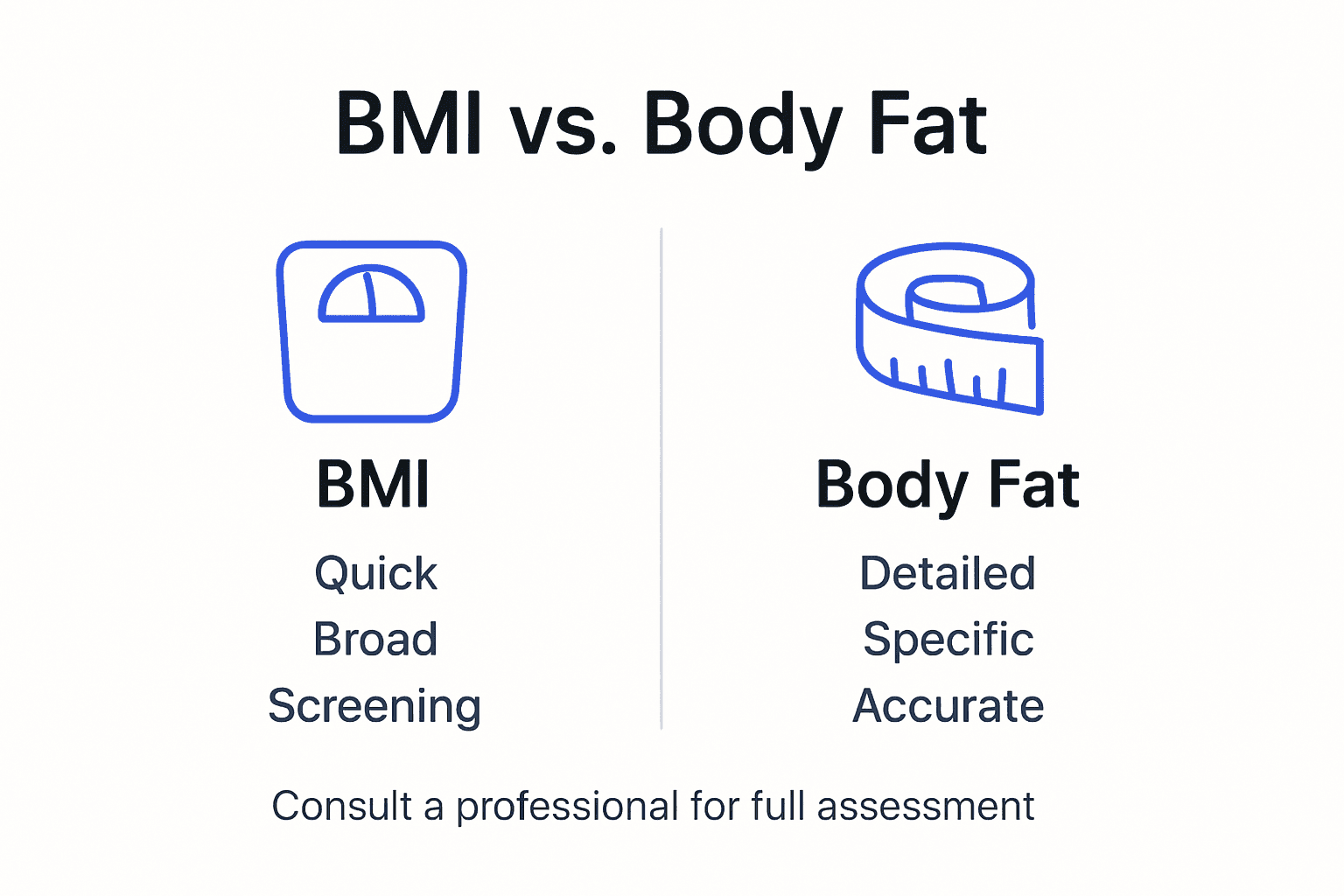
Key alternatives for assessing body fat include:
The table below summarizes advanced body composition assessment tools:
| Method | Accuracy Level | Practical Considerations |
|---|---|---|
| DXA | Very High | Clinic setting, minimal radiation |
| BIA | Moderate | Home use, sensitive to hydration |
| 3D Scanning | Variable | Tracks shape changes, requires specialized gear |
| Hydrostatic | High | Requires water tank, most accurate for fat percentage |
Dual-Energy X-ray Absorptiometry (DXA)
- Gold standard in body composition testing
- Offers comprehensive analysis of bone, muscle, and fat
- Exceptionally precise with low radiation exposure
Bioelectrical Impedance Analysis (BIA)
- Portable and cost-effective device
- Uses electrical impulses to calculate body fat percentage
- Simple and quick screening option
3D Body Scanning
- Generates 3D body image database
- Tracks body composition evolution
- Effective tool for fitness/health monitoring
Hydrostatic Weighing
- Underwater body density measurement
- Very precise percentage of body fat estimation
- Requires specialized equipment
The described techniques provide the ability to understand and evaluate the state and changes in the body’s composition in different ways that are often combined in practice. The variability of the procedures and their differences in efficacy motivate the choice of one device or another.
Professionals in the field, amateurs in bodybuilding, people interested in medicine, and those who want to monitor their health should consult healthcare professionals to find out what method of assessing body composition is most appropriate for what is needed and what is available in a particular case.
Take Control of Your Weight Health Beyond BMI
Calculating the body mass index is an essential step in determining the health-related risks associated with overweight or extreme underweight. However, it is also crucial to understand the importance of other factors that are relevant to the equation.
When it comes to exercising and eating healthy to reach fitness and wellness goals, information from LeanAndFit.info will assist you in finding the right path.
Whether it’s dieting and exercising regularly or making adjustments to be healthier and happier, you can take advantage of the valuable resources provided by the website.
It provides the clients with the required tools that can help them get to know themselves better in terms of their weight category and related issues.
Moreover, they receive information on the most useful diets and exercises. They have a variety of dieting options to choose from, including recipes for scrumptious weight loss smoothies and relevant articles to read.
By visiting LeanAndFit.info , you are going to find many helpful ideas and guides to help you make the best decisions for your life now or in the future.
Frequently Asked Questions:
Q1: What does your BMI say about your weight health that your bathroom scale cant show by itself?
A1: BMI adds height as a variable to the weight, creating a standard screening tool that can categorize an adult as either underweight, healthy weight, overweight, or obese. But it does not measure body fat, muscle, fat distribution, or overall health.
Q2: Can two adults have the same BMI figures but completely different weight-health issues?
A2: They can. One may have more muscles, or a higher or lower body fat or waist circumference, and a different level of fitness and age than the other. BMI should be considered in the context of other health indicators.
Q3: When can a healthy range BMI not be healthy?
A3: Someone with healthy BMI can still have a higher risk of developing weight-related health problems due to several additional factors like abnormal waist size, high blood pressure, or abnormal blood-glucose levels.
Q4: Why can BMI be misleading when someone has more muscles than average?
A4: BMI is calculated on the total weight and height without factoring out the muscle tissue. So someone with higher muscles may have an overweight or obese BMI due to their increased weight even when the body fat is low.
Q5: Can a slight BMI change be significant?
A5: Yes, if a person manages to make their health better by lowering weight or raising fitness level. As a result, BMI improves too. But it may still stay within the same category. A slight change can also be as significant as a major change depending on the situation.
Q6: What BMI doesnt say about your weight health?
A6: Where the extra weight is distributed. BMI cant tell if you are gaining weight in the waist area which means that this person may have a higher cardiometabolic risk. This information can be attained through measuring the waist circumference.
Q7: Why can be the same BMI figure healthy for one adult but not for another?
A7: Because BMI categories are applicable to everyone regardless of their age, sex, ethnicity, muscular build, pregnancy, or other factors. People of the same sex and race can have normal BMI and experience different health risks depending on their fitness level, nutrition, and other variables. A physician will appropriately evaluate the BMI in context to your personal health.
Q8: Can a person improve their weight health without drastically changing their BMI?
A8: Yes. Several components contribute to the overall weight health besides BMI. These include fitness, body fat, waist size, blood pressure, blood-sugar levels, nutrition, and many other variables. So as long as there is room for improvement in any of these areas, your weight health can be improved.
Q9: What is the hidden danger of viewing BMI as a personal health score instead of a screening measurement?
A9: BMI can serve as a helpful indicator that there may be a personal health issue. But it should not be considered as the ultimate authority on judging health since this would lead to unwarranted optimism or pessimism in personal health.
Q10: If BMI is simply one tool for evaluating weight health, what other measurements are worth considering?
A10: Some of the valuable tools that can help you assess your weight health independently include waist circumference, blood pressure, blood tests, and an examination of a person’s physical activity, nutrition, and physical health history.
Recommended:
- Understanding the Healthy Weight Range for Better Health – LeanAndFit
- Body Composition Explained: What Shapes Your Health – LeanAndFit
- Basal Metabolic Rate – How It Impacts Weight Loss – LeanAndFit
- Gut Health and Weight: Complete Guide for 2025 – LeanAndFit
- Why Trust LeanAndFit.info?
- For educational purposes only