Over one third of American adults face obesity-related health challenges that impact everyday life.
As weight issues remain the leading risk factor for chronic illness across the United States, understanding how Body Mass Index works is crucial for those striving to improve their health.
This guide demystifies BMI, its calculation methods, key categories, and what its numbers really mean for weight management and overall wellness.
Table of Contents
- What Body Mass Index Means and Measures
- How BMI Is Calculated and Used
- BMI Categories and Health Implications
- Limitations and Misconceptions of BMI
- Alternatives for Assessing Body Fat
Key Takeaways
| Point | Details |
|---|---|
| Body Mass Index (BMI) Calculation | BMI is calculated by dividing weight in kilograms by height in meters squared, or using a formula adapted for pounds and inches in the U.S. |
| BMI Categories | The standard BMI categories include Underweight, Normal weight, Overweight, and Obese, each associated with different health implications. |
| Limitations of BMI | BMI does not differentiate between muscle and fat mass, which can lead to misleading assessments for athletes or muscular individuals. |
| Alternative Assessment Methods | Consider advanced body composition analysis methods like DXA and BIA for a more accurate assessment of health beyond traditional BMI metrics. |
What Body Mass Index Means and Measures?
Body Mass Index (BMI) represents a standardized measurement that calculates an individual’s body weight relative to their height, providing a quick snapshot of potential health risks associated with weight.
Developed as a statistical tool to assess population-level adiposity, BMI helps healthcare professionals screen for potential weight-related health conditions quickly and efficiently.
The calculation itself is straightforward: BMI divides a person’s weight in kilograms by their height in meters squared, resulting in a numerical value that falls into specific categories.
According to the Centers for Disease Control, these categories help screen for potential weight status ranging from underweight to obese. The standard BMI categories include:
- Underweight: Below 18.5
- Normal weight: 18.5 to 24.9
- Overweight: 25 to 29.9
- Obese: 30 or greater
While BMI provides a valuable initial assessment, it’s crucial to understand its limitations. The index cannot distinguish between muscle mass and fat mass, meaning athletes or individuals with high muscle density might register as overweight despite being metabolically healthy.
Healthcare professionals typically use BMI as one of several diagnostic tools, combining it with additional measurements like waist circumference, body fat percentage, and comprehensive health screenings.
Pro Tip: Request a comprehensive body composition analysis alongside your BMI measurement to get a more nuanced understanding of your overall health status.
How BMI Is Calculated and Used?
Body Mass Index (BMI) is calculated through a straightforward mathematical formula that provides a quick assessment of an individual’s weight status.
Healthcare providers use this screening tool to estimate body fat and potential health risks, making it a crucial measurement in preventive healthcare.
The calculation process involves two primary methods. In the metric system, BMI is determined by dividing weight in kilograms by height in meters squared (kg/m²). For American users, the formula adapts to pounds and inches.
The Centers for Disease Control provides specific guidelines for calculating BMI across different measurement systems, ensuring consistent and accurate measurements. Here’s a breakdown of the calculation steps:
Here’s a quick reference to BMI formulas for different measurement systems:
| Unit System | Formula | Common Use |
|---|---|---|
| Metric | weight (kg) / [height (m)]² | Worldwide/Scientific |
| Imperial | (weight (lb) / [height (in)]²) × 703 | United States/General Public |
| Digital Tools | Online calculators and apps | Consumer/Easy calculation |
- Measure your weight in kilograms (or pounds)
- Measure your height in meters (or inches)
- Square your height measurement
- Divide your weight by the squared height value
- The resulting number represents your BMI
While BMI is a valuable screening tool, it’s not a definitive measure of health.
The index cannot distinguish between muscle mass and fat mass, which means athletes or individuals with high muscle density might receive misleading results.
Healthcare professionals typically use BMI as part of a comprehensive health assessment, combining it with additional measurements like waist circumference, body fat percentage, and other diagnostic tests to create a more complete picture of an individual’s health status.

Pro Tip: Request a comprehensive health screening that goes beyond BMI to get a more accurate understanding of your overall physical condition and potential health risks.
BMI Categories and Health Implications
Body Mass Index (BMI) categorizes weight status into distinct groups that help healthcare professionals assess potential health risks.
Recent studies have shown that BMI categories provide crucial insights into mortality and chronic disease potential, making them an essential tool in preventive healthcare.
The Centers for Disease Control outlines four primary BMI categories for adults, each associated with different health implications:
- Underweight: BMI below 18.5
- Associated with potential nutritional deficiencies
- Possible weakened immune system
- Risk of osteoporosis and muscle weakness
- Normal Weight: BMI between 18.5 and 24.9
- Lowest risk for chronic health conditions
- Optimal metabolic functioning
- Better overall health outcomes
- Overweight: BMI between 25 and 29.9
- Increased risk of heart disease
- Higher likelihood of developing diabetes
- Potential joint stress and mobility issues
- Obesity: BMI 30 and above (divided into three classes)
- Significantly elevated health risks
- Increased chances of cardiovascular disease
- Higher probability of certain cancers
- Potential metabolic syndrome development
Understanding these categories is crucial, but it’s equally important to recognize that BMI is not a definitive measure of individual health. Factors like muscle mass, age, gender, and overall body composition play significant roles in determining true health status.
Healthcare professionals typically use BMI as one of many screening tools, combining it with additional health assessments to create a comprehensive health profile.
Pro Tip: Consult a healthcare professional who can provide a nuanced interpretation of your BMI within the context of your overall health and individual physiological characteristics.
Limitations and Misconceptions of BMI
Body Mass Index (BMI) is widely used, but it’s far from a perfect health measurement.
Current medical guidelines recognize significant limitations in using BMI as a standalone health indicator, revealing several critical misconceptions about this popular metric.
The most significant limitations of BMI include:
- Muscle Mass Confusion: Athletes and muscular individuals often register as “overweight” or “obese” despite being extremely fit
- Racial and Ethnic Bias: BMI calculations historically fail to account for body composition differences across diverse populations
- Age-Related Inaccuracies: The metric doesn’t effectively adjust for age-related body composition changes
- Body Shape Ignorance: BMI cannot distinguish between healthy muscle mass and unhealthy fat distribution
These limitations stem from BMI’s origins as a population-level statistical tool, not an individual health assessment. The calculation simply divides weight by height squared, completely ignoring crucial factors like muscle density, bone structure, age, gender, and genetic variations.
This means a professional athlete and a sedentary person with the same BMI could receive identical health risk assessments, despite dramatically different physical conditions.
Healthcare professionals now recommend using BMI as just one of multiple diagnostic tools.
Additional assessments like waist circumference, body fat percentage, metabolic screenings, and comprehensive physical examinations provide a more accurate picture of individual health status.
Pro Tip: Request a comprehensive health assessment that goes beyond BMI, including body composition analysis and metabolic screening for a truly personalized health evaluation.
Alternatives for Assessing Body Fat
Body Composition Analysis provides more comprehensive insights into health than traditional BMI measurements.
Modern techniques offer sophisticated methods for precisely measuring fat distribution and body metrics, giving individuals and healthcare professionals a more nuanced understanding of physical health.
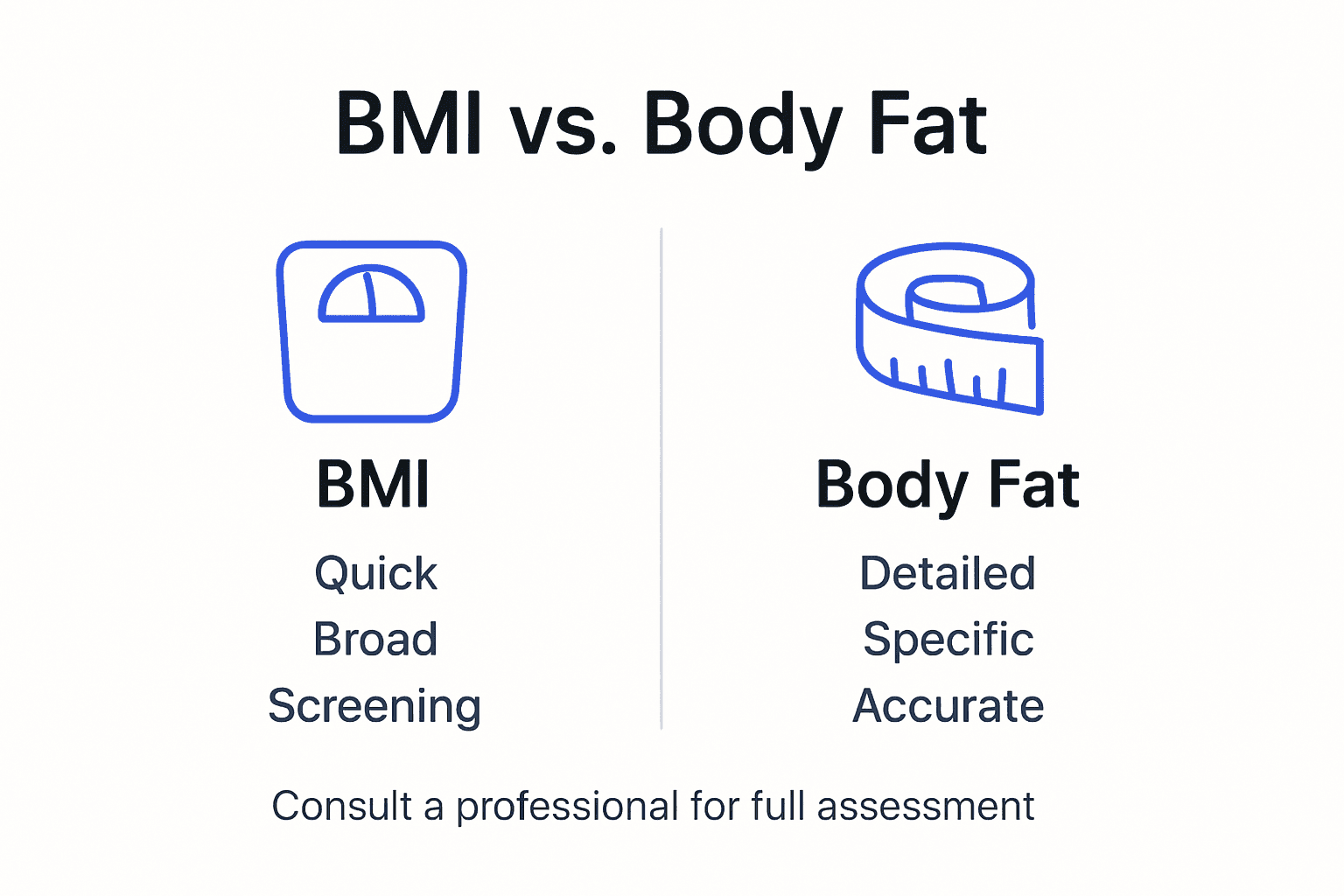
Key alternatives for assessing body fat include:
The table below summarizes advanced body composition assessment tools:
| Method | Accuracy Level | Practical Considerations |
|---|---|---|
| DXA | Very High | Clinic setting, minimal radiation |
| BIA | Moderate | Home use, sensitive to hydration |
| 3D Scanning | Variable | Tracks shape changes, requires specialized gear |
| Hydrostatic | High | Requires water tank, most accurate for fat percentage |
- Dual-Energy X-ray Absorptiometry (DXA)
- Gold standard for body composition measurement
- Provides detailed breakdown of bone, muscle, and fat
- High precision and radiation exposure is minimal
- Bioelectrical Impedance Analysis (BIA)
- Portable and relatively affordable
- Uses electrical currents to estimate body fat percentage
- Quick and non-invasive screening method
- 3D Body Scanning
- Creates comprehensive digital body model
- Tracks body shape and volume changes
- Useful for fitness and medical tracking
- Hydrostatic Weighing
- Measures body density underwater
- Highly accurate fat percentage calculation
- Requires specialized equipment
Each method offers unique advantages, with accuracy varying based on technology and implementation.
Professional athletes, medical researchers, and individuals seeking precise health insights often combine multiple assessment techniques to create a comprehensive understanding of body composition.
Pro Tip: Consult a healthcare professional to determine the most appropriate body composition assessment method for your specific health goals and individual physiology.
Take Control of Your Weight Health Beyond BMI
Understanding your Body Mass Index is an important first step in gauging your weight-related health risks but it does not tell the whole story.
If you struggle with confusing BMI results or want a more natural and effective approach to managing your weight and overall wellness, LeanAndFit.info offers practical guidance rooted in lifestyle changes.
From tailored dietary plans and exercise routines to behavioral strategies, this resource empowers you to build healthier habits that produce lasting results.

Discover personalized weight management solutions designed to address the limitations of BMI and give you real insight into your health journey.
Explore expert advice, recipe ideas like weight loss smoothies, and scientific updates that keep you informed and motivated. Take the first step today by visiting LeanAndFit.info and unlock tools that help you achieve a stronger, healthier you now.
Frequently Asked Questions
Q-1: What is Body Mass Index (BMI)?
A-1: Body Mass Index (BMI) is a standardized measurement that calculates an individual’s body weight relative to their height, assisting in assessing potential health risks related to weight.
Q-2: How is BMI calculated?
A-2: BMI is calculated by dividing a person’s weight in kilograms by their height in meters squared (kg/m²) or using weight in pounds and height in inches with a specific formula that converts the result.
Q-3: What do the BMI categories mean?
A-3: BMI categories include Underweight (below 18.5), Normal weight (18.5 to 24.9), Overweight (25 to 29.9), and Obese (30 or greater), each associated with different health risks.
Q-4: What are the limitations of using BMI as a health measure?
A-4: BMI does not distinguish between muscle mass and fat mass, may overlook racial and ethnic differences, does not adjust for age-related body composition changes, and fails to account for body shape variations.
Recommended:
- Understanding the Healthy Weight Range for Better Health – LeanAndFit
- Body Composition Explained: What Shapes Your Health – LeanAndFit
- Basal Metabolic Rate – How It Impacts Weight Loss – LeanAndFit
- Gut Health and Weight: Complete Guide for 2025 – LeanAndFit
- Why Trust LeanAndFit.info?
- For educational purposes only