
Over half of American adults do not get the recommended amount of physical activity throughout the week
Creating a strength training program in the comfort of your home is an easy way to close that gap and begin seeing results.
Whether it be more energy, confidence, or overall improvement in life, these are all things you will gain through the right methods and mindset.
See how you can improve your own health and fitness by making some changes in your home and habits. Learn beginner strength training step by step!
Table of Contents
- Step 1: Prepare Your Strength Training Space and Equipment
- Step 2: Choose Foundational Beginner Strength Training Exercises
- Step 3: Establish a Simple and Effective Training Schedule
- Step 4: Perform Key Movements With Proper Form
- Step 5: Track Progress and Adjust Your Plan
Quick Summary
| Essential Insight | Detailed Explanation |
|---|---|
| 1. Create a Dedicated Workout Space | Establish a clutter-free area with proper lighting and safety for effective strength training. Include essential equipment for efficient workouts. |
| 2. Focus on Fundamental Exercises | Select key exercises like squats, push-ups, and lunges to engage multiple muscle groups while minimizing injury risk. |
| 3. Develop a Consistent Training Schedule | Aim for 3-4 sessions per week, allowing rest days and targeting different muscle groups for balanced strength development. |
| 4. Master Proper Technique | Prioritize correct form to prevent injuries and maximize effectiveness. Practice movements slowly before adding weight or repetitions. |
| 5. Track Progress Regularly | Keep a detailed workout log to monitor performance, adjust your plan, and recognize improvements over time. |
Step 1: Prepare Your Strength Training Space and Equipment
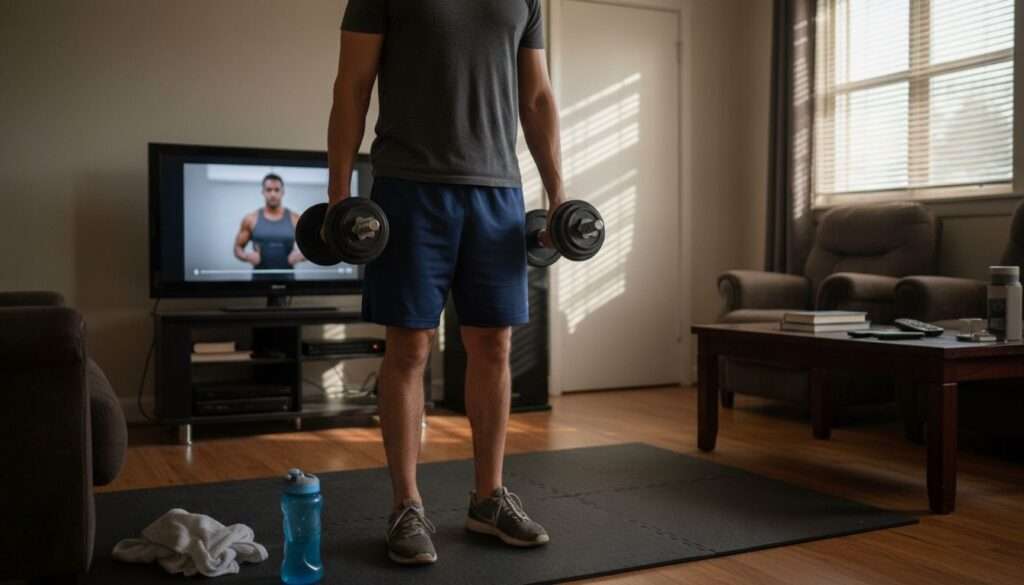
Setting up a good place for strength training is essential. It will help to achieve positive results in the shortest possible time. Strength training experts recommend creating the perfect environment for a successful workout.
The home gym should be equipped with machines and accessories that will allow you to increase the weight of dumbbells or barbells. According to Harvard Health Publishing, one should start with a few adjustable dumbbells, a nonslip exercise mat, and a chair.
They will allow you to do more exercises and give you variety. In addition, one should choose as small a place as possible for the gym so that the equipment can be stored there. Besides, the area should be suitable for doing exercises with large weights.
The location should be as safe as possible for performing various exercises. A solid, smooth floor without any protrusions is suitable for such a place.
It is necessary to equip the room or corner with proper lighting and ventilation. It is vital to leave enough space so that during training, you do not have to avoid moving around due to a lack of space.
One should also have a water bottle during strength training to drink more often. Having a towel and a tracker at hand will help achieve the best results during a workout by monitoring the pulse and keeping track of the number of repetitions.

Step 2: Choose Foundational Beginner Strength Training Exercises
Selecting the right set of activities is essential to building muscle effectively and safely, so the beginner-friendly options are a great place to start
When picking the ones that will be beneficial and help achieve the goals, it is important to make sure they work multiple muscles and reduce the risks of injury.
The basic strength training options that Pine Eagle Clinic suggests for beginners are perfect for gaining fitness and building muscle power.
Those are squats, push-ups, lunges, dumbbell rows, and planks, which can target several muscles at once.
By using the bodyweight or light dumbbells at the start of the journey, one can adequately prepare the muscles for the increased intensity and eventually gain the required muscle mass.
Strength training for beginners should be focused on perfecting the technique and using a lighter weight to avoid injuries.
Each movement should be performed two or three times per day, and the number of repetitions should be from ten to fifteen.
Moreover, the core-strengthening exercises like planks or glute bridges will help to increase stability and reduce the risks of injury.
Step 3: Establish a Simple and Effective Training Schedule
Developing a strong schedule is essential to any strength training program. A well-planned program will include periodic workouts that allow the muscles to recover and repair.
Motivational factors to increase adherence to your new fitness program can help one maintain their fitness plans.
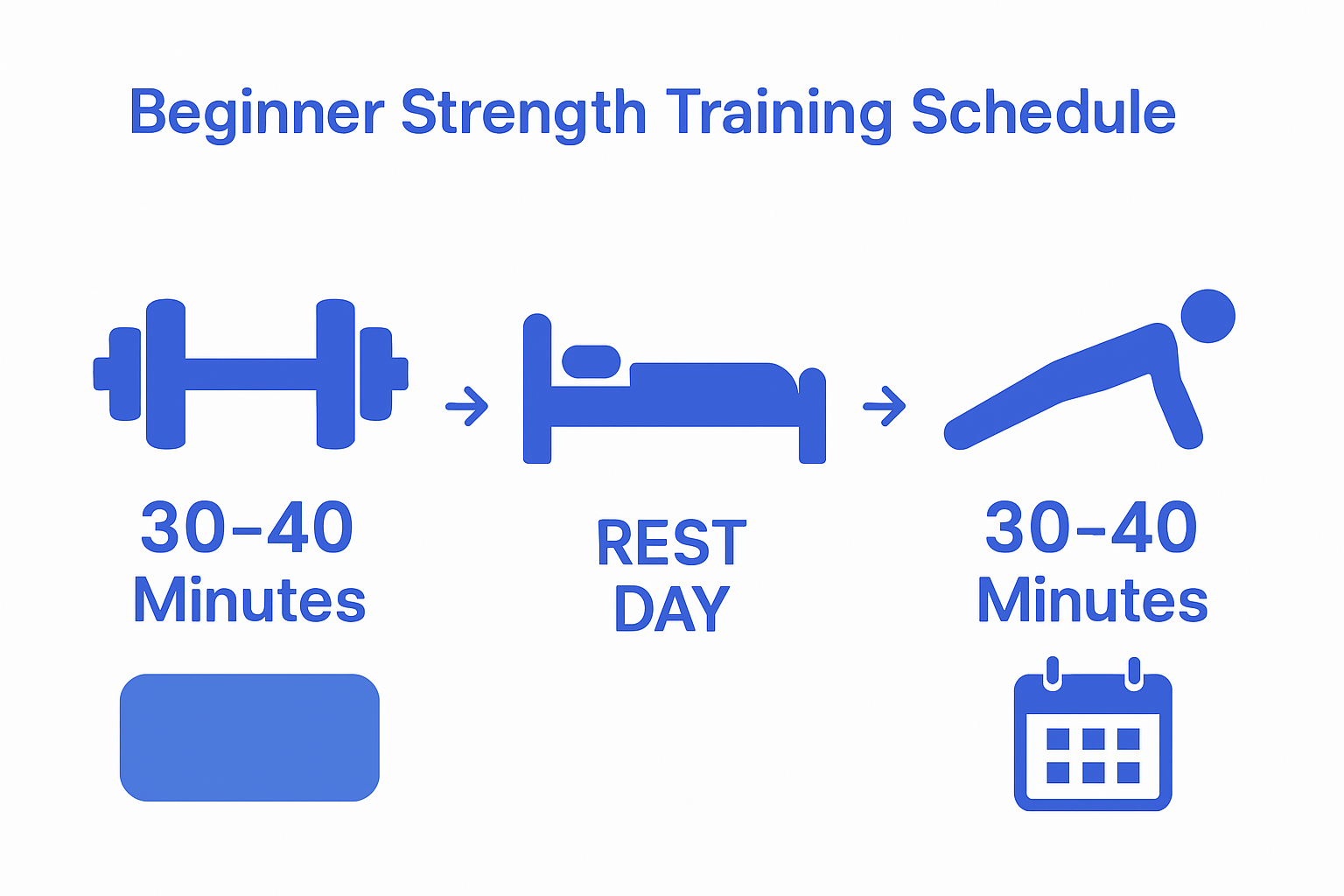
Lifelong Wellness recommends a beginner friendly approach that focuses on progressive strength building. An ideal starting schedule involves 3 4 strength training sessions per week, allowing at least one rest day between workouts.
Target your entire body when you go strength training and work out different muscle groups so that they grow. You may want to do full body exercises on Mondays, Wednesdays, and Fridays and do some light activities such as a cardio or stretching on the other days.
It is important to start slow when you are new to strength training because it is always better to stay consistent rather than to push yourself too hard and hurt. Try to start with 30-45 minutes of working out and then move on to more challenging exercises as your fitness level increases.
Overall, the tips discussed above will help you get in shape without hurting yourself. When doing strength training, it is essential to focus on the right form, work out your whole body, and challenge yourself consistently. Keeping a log of your progress will help you stay motivated throughout your fitness journey.
Step 4: Perform Key Movements With Proper Form
Mastering proper form is essential to avoid injuries and maximize the benefits of any workout.
Proper technique allows you to focus on the target muscles and achieve the desired outcome. Building a solid foundation in strength training is essential, and it is necessary to focus on each movement and pay attention to details.
The Pine Eagle Clinic offers to learn the main strength training techniques and introduces clients to such exercises as squats, push-ups, lunges, and rows. When doing squats, it is necessary to keep the back straight, chest out, and knees over toes.
During push-ups, the body should be in a straight line from head to heels. The same goes for lunges, but the front knee should face directly forward. One should perform the movement gently and controlled in front of a mirror until they can do it correctly.
In addition, it may be helpful to consult a personal trainer at the Pine Eagle Clinic, who will explain the details of the techniques and show how to achieve perfect form by comparing one’s movements to those demonstrated in videos.
Perfect form allows one to accomplish more during their workout. To maximize results, it is necessary to remember that quality is more important than quantity.
Step 5: Track Progress and Adjust Your Plan
For effective strength training, it is essential to measure and adjust progress.
Tracking fitness progress will help achieve motivation throughout the training process.
Harvard Health Publishing recommends recording the details of workouts to observe progress. They suggest writing down the type of exercises, the number of sets performed, the number of repetitions, and weights used.
The user should note the first results they have achieved and then update the log depending on the results of training.
It is vital to observe the body’s response to working out and adjust the training plan as needed. It is essential to note changes in the number of repetitions, the ability to perform more challenging exercises, and the weight lifted with good form.
Sometimes, progress might be noticeable faster, while sometimes people might feel that they are not as motivated as before.
According to Overload Fitness, when the body starts adapting to the given load, it is time to increase it. It can be done by adding 5-10% to the current weight or 1-2 more repetitions for each set. On average, one should reassess the results every four to six weeks.
Start Your Strength Training Journey with Confidence
Getting started with the strength training exercises are not easy, especially if an individual does not know how to design a suitable plan, what exercises to perform, and how to do them correctly.
This article will address the most common problems related to finding a suitable training program, learning new exercises like squats or push-ups, and keeping track of progress.
Therefore, if one wants to overcome these challenges and begin their journey to developing lean muscles, referring to the solutions gathered by the professionals at Strength Training would be the best choice.
The mentioned website offers a variety of valuable suggestions and guidelines about exercises for beginners, which would allow them to get high-quality knowledge about the process and achieve their goals.
A person interested in building their own workout plan should navigate to the Strength Training – LeanAndFit website and utilize the offered insights and resources to gain access to the necessary information and develop their own plan.
Once you’ve learned the fundamentals, it’s also useful to understand how close to failure you should train when performing resistance exercises.
Frequently Asked Questions:
Q-1: What are the most common mistakes that a beginner makes when starting to do strength training exercises?
A-1: A novice trainee usually has a distorted perception of the initial period of training. The vast majority of beginners try to maximize their efforts right away, believing that this will yield the best results. This is a common mistake because strength training is an adaptive process at first; therefore, gradual overload is needed for training.
The human body is a highly complex structure, and all its elements need proper training. The central nervous system adapts to the loads slowly, and the muscle tissue’s functional capacity has a certain reserve. Therefore, it is essential not to overload the body at the beginning of the training.
Q-2: How can one determine whether they have strengthened their muscles or simply worked out?
A-2: This is a tricky question, and not many people ask themselves. Sometimes, the results of working out can be confusing and misleading. These changes are usually most evident in how a person moves. If they begin to do daily activities with less effort, then they can consider their strength training successful.
It is also essential to monitor the success and progression of strength training. This can be done in various ways, such as working with a higher weight or increased repetitions. Moreover, a person should feel more comfortable in their movements and be able to maintain correct posture.
Q-3: It seems that it can be challenging for a beginner to understand what exercises they can do. Is this a common occurrence?
A-3: This phenomenon is common for every novice trainer since the list of all strength training exercises is very extensive. Moreover, for a beginner, it is necessary to start with fundamental exercises to develop a basic understanding of how their body works. Therefore, if a novice trainer does not confuse themselves with the variety of exercises, it will be helpful for them. They are not needed to complicate their training; a few basic, effective exercises will bring the best result.
Q-4: I often hear that training with sore muscles is more effective. Does it mean that I should work out with sore muscles?
A-4: When a beginner trains, the soreness and pain they feel after a workout are normal. This is the body’s reaction to increased loads. However, one should not confuse this with healthy pain syndrome.
Delayed onset muscle soreness is not a sign or an indicator of a productive and effective workout. After the workout, the muscles need the body’s resources to repair them. Therefore, a person should not overload the muscles so that they have less time to recover. For these reasons, such training is not suitable for the beginner.
Q-5: How significant is the role of rest days in a beginner’s strength training program?
A-5: Rest days are essential for the body to recover and repair damaged tissues. Although strength training is a therapeutic activity, it still requires rest days for recovery. After a workout, microtrauma occurs in the muscle fibers. The healing occurs due to the synthesis of new cells. Therefore, overloading during the workouts should not be done. Novice trainers should plan two or three days of rest per week.
Q-6: Is it possible for a beginner to strengthen their muscles without a gym membership and special equipment?
A-6: This depends on the definition of a gym. There are many exercises that are performed without any special equipment and are ideal for beginners. Moreover, if these exercises are done correctly, then they will be very effective. For example, push-ups with additional weight are an excellent exercise for strengthening the upper body. Therefore, as long as one knows what exercises are available, they can achieve good results with little effort.
Q-7: How long does it take to start seeing the results of strength training?
A-7: It is challenging to answer this question, since many factors need to be considered. The most crucial elements include the individual’s characteristics and the quality of their diet. A beginner can feel changes in their body after 2-3 weeks of consistent and correct training.
However, it is important not to confuse this with actual and visible results. Although individual characteristics of each person and their experience level differ, one can expect obvious results in 4-8 weeks or more.
Recommended
- How to Incorporate Strength Training for Lean Muscle Development? – LeanAndFit
- 7 Key Reasons to Understand the Importance of Strength Training – LeanAndFit
- Full Body Home Workout for Effective Weight Loss Results – LeanAndFit
- How Progressive Overload Boosts Muscle Growth? – LeanAndFit
- Effective Pre-Workout Routine for Women: Boost Your Performance – Interval
- Benefits of Dead Hang for Shoulders
- Why Trust LeanAndFit.info?
- For educational purposes only