
Over half of American adults say they do not get enough physical activity each week.
Setting up a strength training routine at home can bridge that gap and offer a flexible path to better health.
Whether you want to boost energy, feel stronger, or improve daily function, the right approach makes all the difference.
Learn how simple changes to your space, mindset, and habits can help you safely build strength and reach your fitness goals.
Table of Contents
- Step 1: Prepare Your Strength Training Space and Equipment
- Step 2: Choose Foundational Beginner Strength Training Exercises
- Step 3: Establish a Simple and Effective Training Schedule
- Step 4: Perform Key Movements With Proper Form
- Step 5: Track Progress and Adjust Your Plan
Quick Summary
| Essential Insight | Detailed Explanation |
|---|---|
| 1. Create a Dedicated Workout Space | Establish a clutter-free area with proper lighting and safety for effective strength training. Include essential equipment for efficient workouts. |
| 2. Focus on Fundamental Exercises | Select key exercises like squats, push-ups, and lunges to engage multiple muscle groups while minimizing injury risk. |
| 3. Develop a Consistent Training Schedule | Aim for 3-4 sessions per week, allowing rest days and targeting different muscle groups for balanced strength development. |
| 4. Master Proper Technique | Prioritize correct form to prevent injuries and maximize effectiveness. Practice movements slowly before adding weight or repetitions. |
| 5. Track Progress Regularly | Keep a detailed workout log to monitor performance, adjust your plan, and recognize improvements over time. |
Step 1: Prepare Your Strength Training Space and Equipment
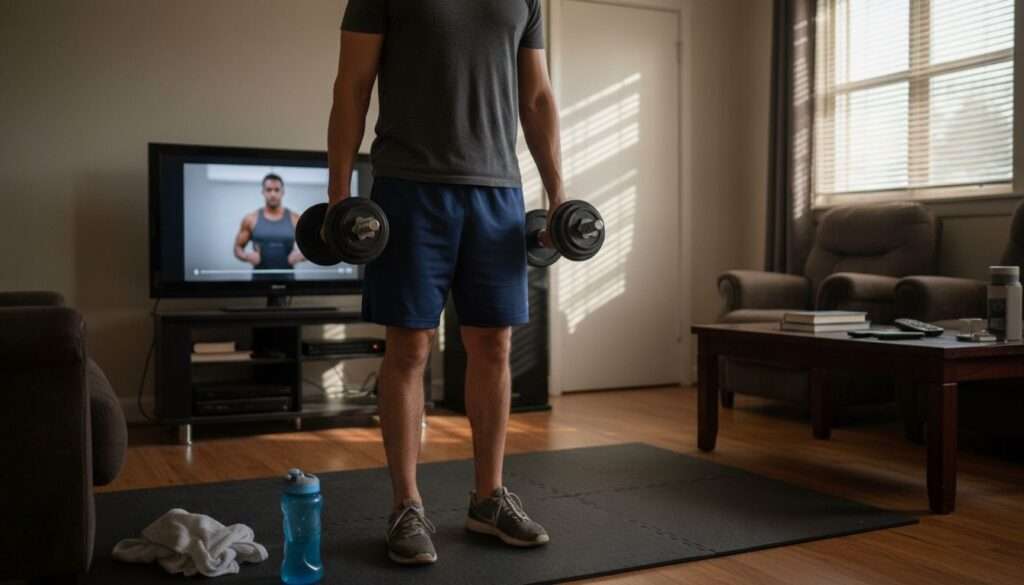
Setting up an effective strength training space requires strategic planning and smart equipment selection. Creating a dedicated workout area will help you stay motivated and maximize your training potential.
Strength training experts recommend establishing a space that supports safe and efficient workouts.
Your home workout zone should include essential equipment that allows progressive resistance training. Harvard Health recommends starting with adjustable dumbbells, a nonslip exercise mat, and a sturdy chair.
These foundational pieces provide versatility without overwhelming beginners. Choose compact equipment that can be easily stored and allows movement between exercises.
When selecting your training area, prioritize space and safety. Aim for a zone with smooth flooring clear of obstacles like furniture or breakable items. Good lighting and ventilation will enhance your workout experience.
Always ensure enough room to perform exercises with proper form without feeling cramped. Keep a water bottle nearby and consider having a towel and workout tracker to monitor your progress and stay hydrated during strength training sessions.

Step 2: Choose Foundational Beginner Strength Training Exercises
Selecting the right exercises is crucial for building strength effectively and safely as a beginner. Your goal is to develop a balanced workout routine that targets multiple muscle groups while minimizing injury risk.
Foundational strength training exercises will help you establish a solid fitness base and progressively build muscle strength.
Pine Eagle Clinic recommends several key exercises for beginners that provide comprehensive muscle engagement. These essential movements include squats for lower body strength, push-ups for upper body development, lunges for balance and leg power, dumbbell rows for back muscles, and planks for core stability.
Each exercise works multiple muscle groups simultaneously, making them efficient choices for new strength training participants.
When starting out, focus on proper form over lifting heavy weights. Begin with bodyweight versions of exercises and gradually introduce light dumbbells or resistance bands as you build confidence.
Aim for 2 3 sets of 10 15 repetitions for each exercise, listening to your body and avoiding overexertion.
Core strengthening movements like planks and glute bridges will provide additional stability and help prevent potential injuries during your fitness journey.
Step 3: Establish a Simple and Effective Training Schedule
Developing a structured strength training schedule is critical for consistent progress and preventing burnout. Your workout plan should balance exercise frequency, muscle group targeting, and adequate recovery time.
Exercise motivation strategies can help you stay committed to your new fitness routine and build sustainable habits.
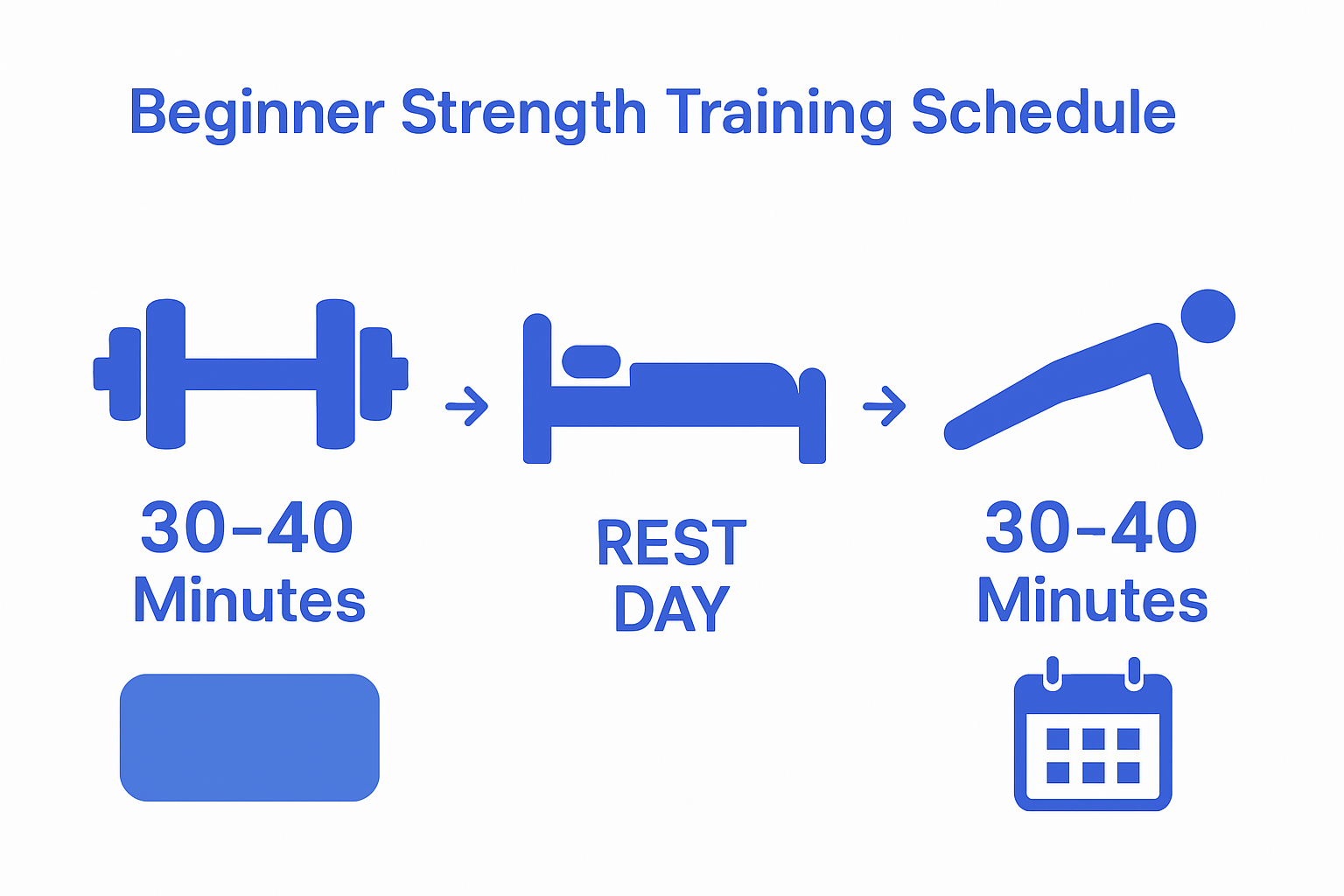
Lifelong Wellness recommends a beginner friendly approach that focuses on progressive strength building. An ideal starting schedule involves 3 4 strength training sessions per week, allowing at least one rest day between workouts.
Target different muscle groups in each session to ensure comprehensive development and prevent overtraining. A sample weekly schedule might include full body workouts on Monday, Wednesday, and Friday, with light cardio or stretching on alternate days.
Remember that consistency trumps intensity when you are beginning your strength training journey. Start with shorter 30 45 minute sessions and gradually increase duration and complexity as your fitness improves.
Strength training strategies emphasize listening to your body, maintaining proper form, and progressively challenging yourself without risking injury. Tracking your workouts in a journal or fitness app can help you monitor progress and stay motivated throughout your fitness transformation.
Step 4: Perform Key Movements With Proper Form
Mastering proper exercise technique is fundamental to preventing injuries and maximizing your strength training results.
Learning correct form will help you engage the right muscle groups, reduce strain, and build a solid foundation for your fitness journey. Foundational strength training techniques require careful attention to body positioning and movement patterns.
Pine Eagle Clinic emphasizes the critical importance of precise technique during key exercises like squats, push-ups, lunges, and rows. When performing squats, maintain a straight back, keep your chest up, and ensure your knees track in line with your toes.
For push-ups, keep your body in a straight line from head to heels, engage your core, and lower yourself with controlled movement. During lunges, step forward with your front knee staying directly above your ankle while maintaining an upright torso.
Practice each movement slowly and deliberately before adding weights or increasing repetitions. Use mirrors or record yourself to check your form, and consider working with a fitness professional who can provide personalized feedback.
Watching tutorial videos and comparing your technique can also help refine your movements. Remember that quality always trumps quantity in strength training progress.
Step 5: Track Progress and Adjust Your Plan
Effective strength training requires consistent monitoring and strategic adjustments to ensure continuous improvement.
How to track fitness progress will help you stay motivated and understand your body’s changing capabilities. Tracking allows you to recognize patterns, celebrate achievements, and make informed decisions about your workout routine.
Harvard Health recommends keeping a detailed workout log that records exercises, sets, repetitions, and weights used. Start by documenting your initial performance baseline and update your log after each workout.
Pay attention to how your body responds to different exercises and adjust your plan accordingly. Look for signs of progression such as increased repetitions, improved form, or the ability to lift heavier weights with proper technique.
Remember that progress is not always linear. Some weeks you might feel stronger, while others might feel more challenging. Overload Fitness suggests listening carefully to your body and making incremental changes to prevent burnout or injury.
Typically, you can increase weight by 5 10% or add 1 2 repetitions when an exercise becomes consistently manageable. Regular assessment every 4 6 weeks will help you maintain momentum and continue challenging your muscles effectively.
Start Your Strength Training Journey with Confidence
Embarking on beginner strength training can be challenging when you are unsure how to build a balanced routine, choose the right exercises, and maintain proper form.
This article highlights common concerns like establishing a training schedule, selecting foundational exercises such as squats and push-ups, and tracking progress safely.
If you want to overcome those hurdles and stay motivated on your journey toward lean muscle development, exploring expert advice and well-structured plans can make all the difference.

Discover practical strategies, workout guides, and motivation tips at Strength Training – LeanAndFit. Our resources cover core concepts including progressive resistance workouts and effective exercise regimens designed especially for beginners.
Take control of your health today by visiting LeanAndFit and unlock your full fitness potential with step-by-step support. Begin your transformation now and experience the confidence that comes with a sustainable strength training lifestyle.
Frequently Asked Questions:
Q-1: What’s the biggest mistake beginners make when starting strength training, even before lifting their first weight?
A-1: Most beginners jump in with the mindset of “more is better.” They either try to copy advanced workouts or push too hard too soon.
The truth? Strength training is more about consistency than intensity at the beginning.
Your body needs time to adapt—your muscles, joints, and even your nervous system are learning something new. Starting slow with proper form builds a solid foundation. Think of it like learning to drive—you wouldn’t hit the highway on day one.
Ease in, learn control, and progress step by step.
Q-2: How do I know if I’m actually getting stronger or just going through the motions?
A-2: Great question—and surprisingly, not asked enough. Strength gains aren’t always dramatic in the beginning. Look for small wins: lifting slightly heavier weights, doing one or two extra reps, or feeling more stable during exercises.
Even better posture and improved balance are signs of progress. Strength isn’t just about muscles growing—it is about your body becoming more efficient. If things feel a little easier week by week, you’re on the right track.
Q-3: Is it normal to feel confused about which exercises to start with?
A-3: Absolutely. Walking into strength training as a beginner can feel like entering a new world. The trick is to keep it simple. Focus on basic compound movements like squats, push-ups, rows, and lunges.
These exercises train multiple muscles at once and give you the best results early on. You don’t need 20 different exercises—you need a few effective ones done correctly. Simplicity beats complexity every single time.
Q-4: Why do I feel sore after workouts, and does it mean I did things right?
A-4: That soreness—often called delayed onset muscle soreness (DOMS)—is your body adapting to new stress. It is common when you start, but it’s not the ultimate measure of a good workout.
You can have an effective session without feeling sore the next day. What matters more is progression and consistency. If soreness is extreme, it might mean you pushed too hard. The goal is to challenge your body, not punish it.
Q-5: How important is rest in a beginner strength training routine?
A-5: Rest is not optional—it is essential. When you lift weights, you’re actually creating tiny tears in your muscles. They rebuild stronger during rest, not during the workout itself.
Skipping rest days can slow progress and increase injury risk. For beginners, 2–3 rest days per week works well. Think of rest as part of the training plan, not a break from it.
Q-6: Can I see results without going to the gym or using heavy equipment?
A-6: Yes, 100%. Bodyweight exercises can be incredibly effective for beginners. Push-ups, squats, planks, and resistance band workouts can build strength when done consistently.
The key is progression—making exercises slightly harder over time. You don’t need fancy equipment to get started. Your body is already a powerful tool.
Q-7: How long does it take to see visible changes from strength training?
A-7: This is where patience comes in. Some people notice strength improvements within 2–3 weeks, but visible changes usually take 4–8 weeks or more. It depends on factors like diet, consistency, sleep, and genetics.
The important thing is not to quit early. Results are happening beneath the surface before you see them in the mirror. Stick with it, and your efforts will show.
Q-8: What mindset should I have to stay consistent as a beginner?
A-8: Focus on progress, not perfection. Some days you’ll feel strong, other days not so much—and that’s completely normal. Instead of chasing quick results, aim to build a habit.
Show up, do your best, and keep moving forward. Treat strength training as a long-term investment in your health, not a short-term fix. The real transformation happens when it becomes part of your lifestyle.
Recommended
- How to Incorporate Strength Training for Lean Muscle Development? – LeanAndFit
- 7 Key Reasons to Understand the Importance of Strength Training – LeanAndFit
- Full Body Home Workout for Effective Weight Loss Results – LeanAndFit
- How Progressive Overload Boosts Muscle Growth? – LeanAndFit
- Effective Pre-Workout Routine for Women: Boost Your Performance – Interval
- Benefits of Dead Hang for Shoulders
- Why Trust LeanAndFit.info?
- For educational purposes only