Almost 42 percent of American adults are obese, which means that many families in the United States have a serious issue dealing with overweight.
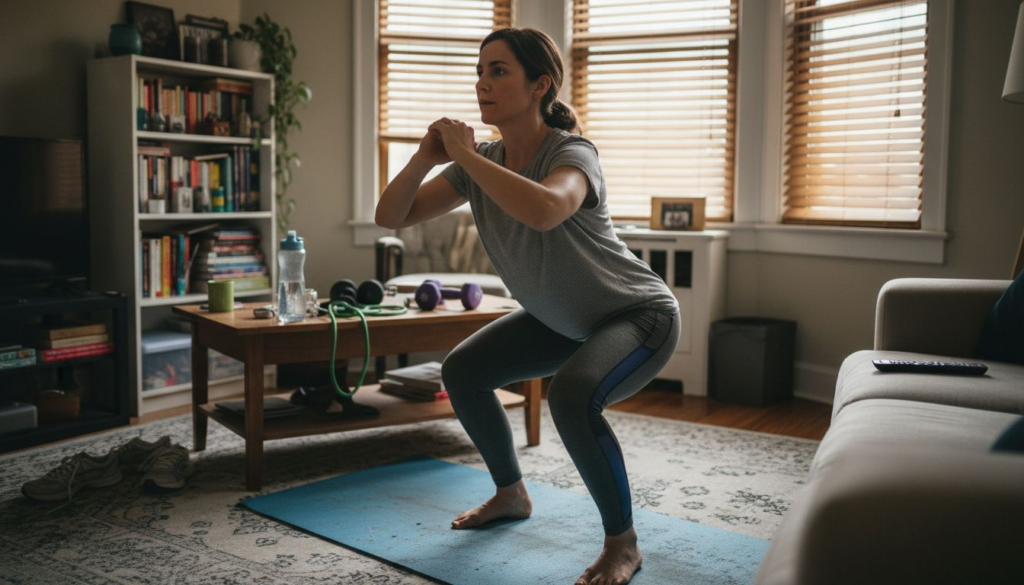
Though it can be hard to find a chance to lose weight, do an exercise or simply go to a gym, a small and convenient home workout space will bring great motivation on the way to a healthier lifestyle.
Especially for American adults who are constantly busy with jobs and raising children, having a fitness area in the living room will provide an opportunity to work out even in the busiest schedules.
The idea behind this article is to learn easy home workouts for effective weight loss.
Table of Contents
- Step 1: Prepare Your Space and Gather Essential Equipment
- Step 2: Select Simple, Beginner-Friendly Exercise Routines
- Step 3: Establish a Weekly Workout Schedule for Consistency
- Step 4: Perform Workouts With Proper Form and Safety Tips
- Step 5: Track Progress and Adjust Your Routine for Better Results
Quick Summary
| Key Message | Explanation |
|---|---|
| 1. Create a dedicated workout zone | Establish at least a 6×6 feet area, free from obstacles, that motivates consistent exercise. |
| 2. Use versatile and portable equipment | Incorporate items like resistance bands and adjustable dumbbells that are space-efficient and effective. |
| 3. Follow a balanced weekly schedule | Include strength, cardio, and flexibility workouts while ensuring at least one rest day to allow recovery. |
| 4. Prioritize proper form and safety | Maintain correct alignment and warm-up to prevent injuries and enhance workout effectiveness. |
| 5. Track progress and adjust regularly | Document metrics and modify your routine every four to six weeks to maximize results and avoid plateaus. |
Step 1: Prepare Your Space and Gather Essential Equipment
Creating a smart home gym layout tips can help you get the most out of your hard-earned money. It is critical to design a functional space that meets your fitness needs.
You can design your work-out space in whatever manner suits you best.
If you have a large house, it may be wise to consider getting an entire floor to work out and store your equipment. On the contrary, if you have a tiny apartment, you may need to be more creative with the limited space available. Make sure to reserve a space that is at least six by six feet with nothing in it that can cause a hazard when working out.
According to the American Heart Association, you may want to put a piece of multi-use equipment that can occupy small space.
Resistance bands and dumbbells are a good start for strength training, and you can easily improvise by using a bag of rice or water bottle as weights. Lightweight dumbbells are also a safe option, especially for a beginner.
It is essential to keep your space tidy and store your equipment away neatly to ensure you have enough working area. It may be wise to purchase large equipment such as a yoga mat, resistance bands, and adjustable dumbbells that can provide multiple benefits.
For instance, a yoga mat will offer a comfortable working surface and outline your work-out area. Resistance bands are also highly relevant because they can help you achieve a broad range of motion and are easy to store. Dumbbells allow you to store weights as you need them with no need for a huge set.
Moreover, you can place the equipment against a wall or use a chair for stability during exercises, especially if you are new to working out.
Here’s a quick guide to essential home workout equipment and their main benefits:
| Equipment | Space Required | Key Benefit |
|---|---|---|
| Yoga Mat | Minimal (rollable) | Comfort and injury prevention |
| Resistance Bands | Compact | Versatile strength training |
| Adjustable Dumbbells | Small footprint | Progressive resistance options |
| Sturdy Chair/Wall | Already present | Balance and stability support |
| Household Items | None | Cost savings and convenience |
Pro Tip: Create a motivational workout playlist and place a small bluetooth speaker in your exercise area to keep energy levels high and make your home workouts more enjoyable.
Step 2: Select Simple, Beginner-Friendly Exercise Routines
The right workout routines can make all the difference for a beginner so they do not get discouraged.
As the University of New Mexico’s home workout guide suggests, one should focus on simple exercises that will challenge them but not overwhelm their bodies.
One should aim at developing a routine that will work different groups of muscles and be fun at the same time.
The best way to start is to focus on full-body exercises that require little equipment and allow one to build endurance and strength. Push-ups, lunges, squats, and sit-ups are a good way to start.
Moreover, these types of exercises can be modified for different levels of experience and skill.
A good rule of thumb to build muscle is to do two to three sets of eight to 12 repetitions for each exercise with enough rest in between for the muscles to recover their strength.
As you go, you can begin to add variety to your workouts in order to continue challenging yourself.
For instance, you can move from regular bodyweight squats to jump squats, or from knee push-ups to full push-ups, or from basic lunges to lunges with arm raises or weights.
The idea is to listen to your body and only advance as far as you feel comfortable with.
The aim is to have a balanced fitness regime that works out your whole body, and includes elements of strength training, light cardio and flexibility in order to lose weight.
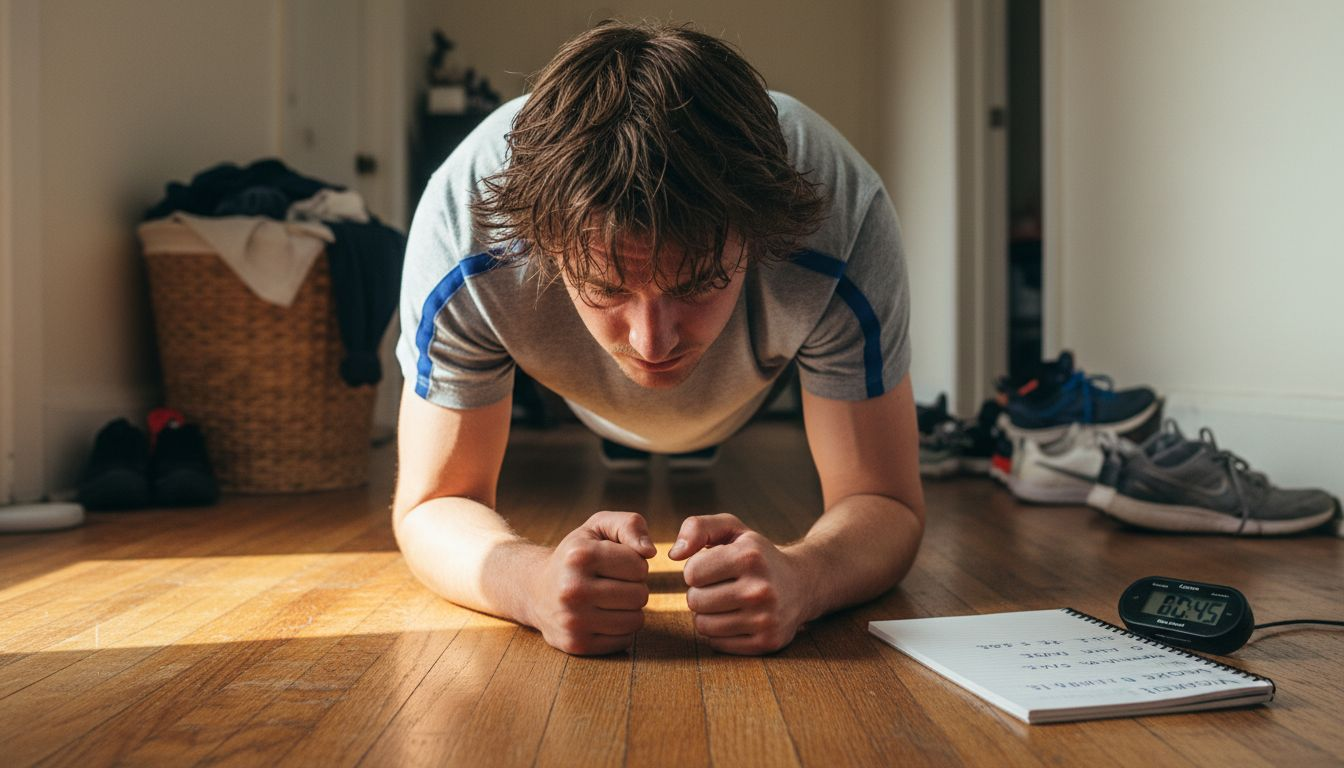
Pro Tip: It’s also a good idea to keep track of your workouts, either in a notebook or in an online fitness app, so as to have a sense of accomplishment and motivation to keep going by seeing how far you’ve come.
Step 3: Establish a Weekly Workout Schedule for Consistency
Creating a sustainable workout routine involves designing a plan that fits your lifestyle and motivates you towards achieving fitness objectives.
It is important to formulate a realistic schedule that fits in well with your desires and needs. A proper weekly schedule should be balanced and include a variety of activities or types of the same activity.
According to the Mayo Clinic, an individual needs approximately 150 minutes of moderate aerobic activity or 75 minutes of vigorous activity each week, along with two-plus days of muscle-strengthening exercises.
A balanced fitness plan should consist of aerobic exercises, strength-training, and stretching.
One should note that a properly structured fitness schedule allows for recovery and sufficient rest between different types of exercises. A beginner should plan to have no more than two intense workouts per day with a break for stretching in between.
In addition, it is advisable to alternate between muscle-building, strenuous, and recovery days in a week.
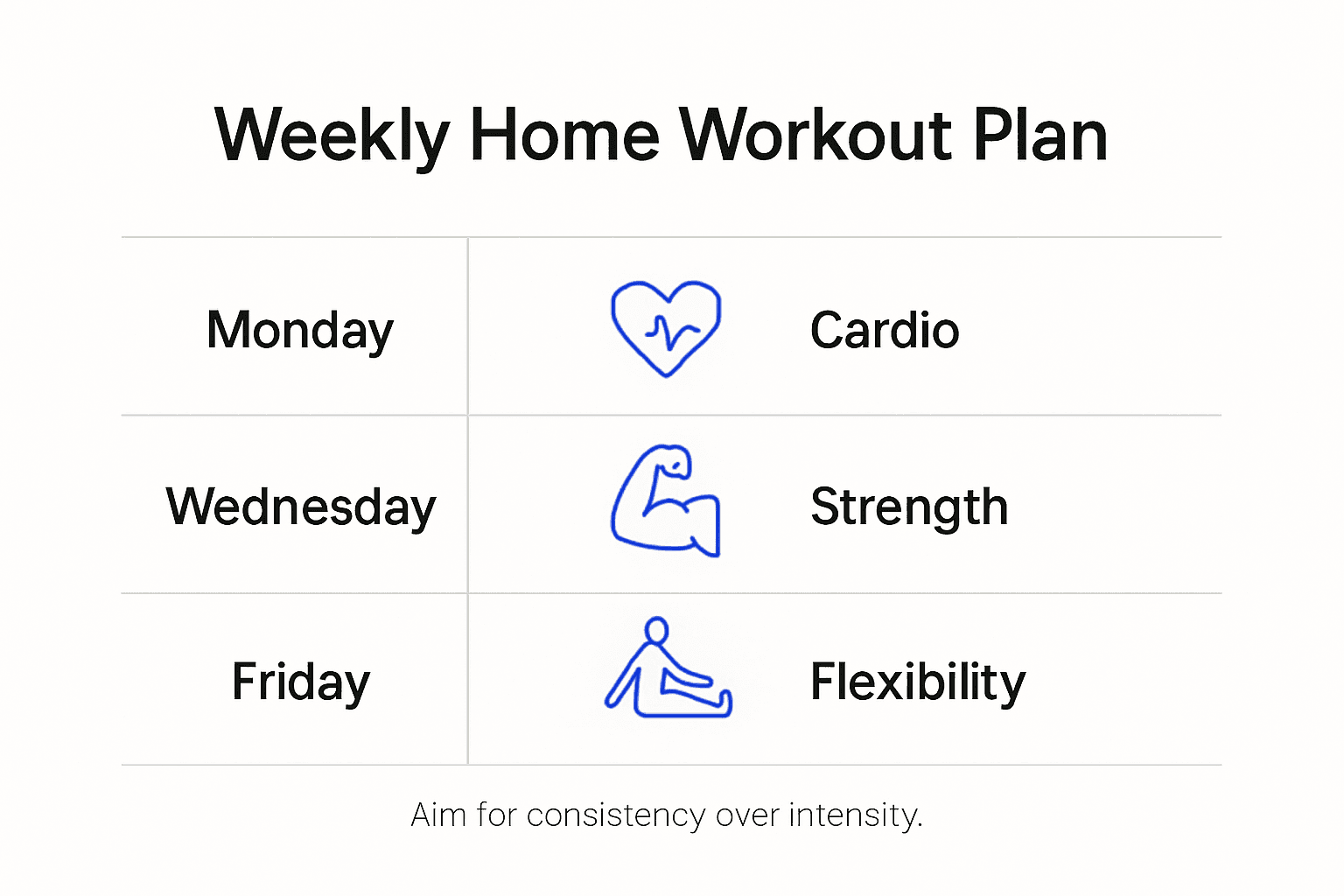
For instance, one could have a full-body workout on Mondays and Thursdays and a moderate-intensity cardio workout on Tuesday and stretch on Wednesday or Friday.
Some people might find it easier to exercise in the evenings while others might have more energy throughout the day, so it is important to set the most appropriate time for workouts.
The most optimal schedule is the one that fits in with the needs and desires of the individual. Therefore, it is important to choose the most appropriate time and type of exercise.
Finally, it is important to note that the best fitness plan is the one that one will actually stick to, so it is important to plan the schedule according to personal needs. Keeping a fitness journal or a calendar and marking all the workouts will help measure the progress and encourage towards achieving the goal.
Below is an example of a balanced weekly beginner workout schedule:
| Day | Focus Area | Example Activity |
|---|---|---|
| Monday | Strength | Full-body resistance workout |
| Tuesday | Cardio | Brisk walk or jump rope |
| Wednesday | Flexibility | Yoga or dynamic stretching |
| Thursday | Strength | Bodyweight circuit training |
| Friday | Active Rest | Gentle stretching or walk |
| Weekend | Recovery | Full rest or light yoga |
Pro Tip: Prepare your workout clothes and equipment the night before to reduce morning friction and increase the likelihood of sticking to your exercise routine.
Step 4: Perform Workouts With Proper Form and Safety Tips
Safe exercise practices are crucial to avoid injuries and gain the most benefits from workouts. It is essential to learn proper exercise techniques to ensure that the activities are safe for the body.
Correct form during training is necessary to prevent injuries and achieve better results during workouts.
It is vital to keep the core tight and use proper movement patterns during physical activities. Moreover, when doing strength training, it is vital to focus on the movement of the spine and joints.
According to Harvard Health experts, to reduce the risk of injuries during strength training, it is vital to begin each workout with a lighter weight and more reps and then move to heavier weights and fewer repetitions.
This recommendation helps avoid overexertion from the beginning, leading to serious injuries. Moreover, during the workouts, it is vital not to hold one’s breath.
Holding the breath leads to an increase in blood pressure and can cause serious injuries. It is also vital to do a proper warm-up and cool-down when exercising. A warm-up helps the muscles become more pliable, reducing the risk of injuries.
Cooling down after the workout helps the body recover and prevents additional injuries. A cool-down also helps lower the heart rate back to a resting state. Furthermore, it is critical to listen to one’s body during the workout and never overtrain.
If during an exercise session, there occurs a sharp pain or discomfort, it is necessary to stop and revisit the activity. Spasms and discomfort in the muscles are normal after a workout, but if a person feels pain, the workout is too strenuous for the body, and it must be discontinued.
Pro tip: Using a mirror or recording oneself during a workout, and checking the movement for proper form is a helpful tool.
Step 5: Track Progress and Adjust Your Routine for Better Results
Creating a baseline fitness assessment is essential if you want to witness progress and set goals.
By tracking your fitness progress, you will be able to see the fruits of your hard work and stay motivated throughout your weight loss journey.
Monitoring your progress will provide you with valuable insights into determining what works best for you and what should be changed in your fitness regimen.
According to Cleveland Clinic, you can use a journal or a digital platform to track your progress.
Once your baseline fitness assessment is set you should begin tracking your progress. You can track your progress by taking your body measurements, weight, and other vital signs such as your resting heart rate, and performance indicators like the number of reps or time.
Take progress photos every two to four weeks and rate how you feel after each workout. It is essential to note both quantitative and qualitative changes in your body to help you get the most out of your fitness journey.
To ensure that you are constantly challenging your body, you may have to change your workout regimen every four to six weeks. This is important because your body adapts to the same stimulus at an extremely fast rate.
You may begin to see a sudden drop in results if you continue to do the same workout in the same way. To overcome a sudden drop in results, you can try changing the order of your exercises, increasing the weights or time for your exercises, and trying new activities.
It is important to remain patient and not get discouraged if you don’t see drastic results right away. Your body will respond at its own pace and time, even if you are not seeing drastic results, you should keep working out and make changes to your workout plan.
Pro Tip: You can use progress photos and measurements as a motivational tool and a visual representation of your non-scale victories.
Ready to Transform Your Home Workouts Into Real Weight Loss Progress
Having trouble finding effective and easy workouts for your home and busy schedule?
This article will help you identify the problems one may encounter while attempting to create the perfect routine for home workouts using beginner-friendly moves, the importance of form and consistency, and how one can continue to improve their skills.
If you are looking to further educate yourself on bodyweight routines or need instructions on resistance workouts, we are here to help!
Our detailed guides on Bodyweight Exercises – LeanAndFit and Resistance Workouts – LeanAndFit were created just for you!
Take control of your home workouts by using our guides and transforming your everyday routines into effective and fun workouts that will keep you coming back for more!
Get insider knowledge on how to keep your motivation up and results coming in by visiting us at LeanAndFit.info
Don’t miss your chance to transform your home into your personal gym and help you reach your goals of losing weight with our guides! We can’t wait to see you there!
Frequently Asked Questions:
This FAQ section is designed to target high-intent search queries while delivering practical, data-backed insights for users looking to achieve weight loss through easy home workouts:
Q-1. Can making your home workout easier to start make it more effective for long term weight loss?
A-1. Yes. The value of a workout isn’t based on how challenging or difficult it is, but on how much you can stick with it. A home workout that is simple to prepare and participate in may help you stick with it. Going slow and easy at first is a good idea for people who aren’t used to being physically active.
Q-2. Could you build up a sweat using the furnishings in your home to make your workout less predictable?
A-2. Yes. Using a sturdy chair, wall, stairs, and floor to perform a chair squat, wall push up, step ups, march, and stretches can be effective. Working out with your own body weight can be beneficial too. The goal is to use home items in ways that safely make you work different muscles.
Q-3. Why could breaking up one 30 minute home workout into three 10-minute movement sessions be a good way to start for a beginner?
A-3. It can be much easier to find time for three 10-minute physical activity breaks during your day than to find time for one 30-minute workout. The National Institute of Diabetes and Digestive and Kidney Diseases (NIDDK) recommends breaking up physical activity during the day. They also note that 10 or more minutes of physical activity can count towards your weekly activity goals. If you are just starting out, 3 easy 10 minute workouts could be much easier on both your body and mind than one 30 minute workout.
Q-4. Can a beginner boost his/her/your weight-loss fitness at home without feeling wrung out after each workout?
A-4. Yes. You don’t have to feel like you’ve been in a serious car crash after each workout. Aerobic activities like walking, dancing, marching, or other light exercises can get your heart and lungs working without completely maxing you out. NIDDK recommends trying the “talk test.” During physical activity, you should be able to talk in sentences but shouldn’t be able to sing a song comfortably.
Q-5. What if the most valuable benefit of your home workout is it keeps you off the couch for another hour?
A-5. It really can still be valuable. Breaking up your sitting time during the day by getting up and moving is important. Cleaning, vacuuming, yard work, walking around your home, taking walks can all be part of a good fitness plan.
Q-6. Could doing a smaller set of home exercises more consistently beat trying to always find something new to work on?
A-6. It absolutely could. Constantly trying to come up with new workouts or buying new equipment is not necessary. All you need is an easy workout you enjoy so you’ll keep doing it. You can eventually move on to something more challenging. NIDDK recommends finding an activity you enjoy because being active should be enjoyable.
Q-7. Why does increasing the length of your home-workout usually outweigh dramatically increasing your exercise intensity?
A-7. Going slower and farther usually has more benefits than going faster and shorter. NIDDK recommends gradually increasing the amount or time you’re active most days. You can do that by adding minutes or days before really cranking up the intensity. Once you get used to one level, you can move on to the next.
Q-8. Can strength exercises at home help your weight-loss fitness, even if they don’t burn as many calories as a longer aerobic workout?
A-8. Yes. When it comes to weight loss, you can’t focus on how many calories you burn during a workout. Strength or muscle-building activity has its own value. It helps your muscles and bones and keeps you healthier. Adults should aim to do muscle strengthening activity at least 2 days a week.
Q-9. Could counting your workout consistency be a more effective way to track early progress than weighing yourself each morning?
A-9. Yes, It most definitely could. Your weight can vary from day to day. Workout consistency can be measured in how many days you worked out, how long you worked out, and how many reps or steps you took. It can be a good way to see if you’re being active enough. People tend to notice improvements in their activity consistency or endurance.
Q-10. What is the most overlooked question to ask yourself before trying to step up your home-workout to make weight loss happen faster?
A-10. “Can I really do this again next week, next month, and 6 months from now?” Having a good fitness plan takes into account how much and how often you can be active given your life situation, your physical limitations, and how you feel. Trying too hard right away could cause you to give up or get injured. It’s much healthier to slowly move up to longer aerobic activity and more strength-building exercise.
Recommended
- Full Body Home Workout for Effective Weight Loss Results – LeanAndFit
- 7 Home Workout Ideas for Weight Loss and Fitness Success – LeanAndFit
- Effective Workout at Home Tips for Safe Weight Loss – LeanAndFit
- Beginner Yoga for Weight Loss: Achieve Results Naturally – LeanAndFit
- Why Trust LeanAndFit.info?
- For educational purposes only