Pilates is often associated with flexibility, controlled movements, and a toned appearance. One of its most important benefits is the way it challenges and strengthens the muscles that support and stabilize the body.
Pilates builds core strength by using controlled movements to engage the muscles in your abdomen, back, hips and other parts of your body to create stability in your trunk. It helps you to engage your muscles correctly, use controlled breathing and correct technique.
This applies to both mat-based Pilates and reformer Pilates. Both ways will challenge your core if done with control.
Having a stronger core may help improve balance, movement control, and physical function. Pilates can also complement a broader fitness routine that includes walking, resistance training, and other forms of physical activity.
Within this guide we will explain which muscles are part of your core, how Pilates can build those muscles, some exercises you can try and how mat Pilates compares to reformer Pilates. We will also look at how realistic Pilates is for improving your posture and getting a leaner body.
Article Index
- What Is Core Strength in Pilates?
- Which Muscles Make Up the Core?
- How Pilates Builds Core Strength and Stability
- The Role of Deep Core Muscles in Pilates
- Best Pilates Exercises for Core Strength
- Mat Pilates vs. Reformer Pilates for Core Training
- How Core Strength Supports Posture, Balance, and Daily Movement
- Can Pilates Help You Achieve a Leaner Physique?
- How Often Should You Practice Pilates?
- Common Pilates Core Training Mistakes
- Safety Considerations and Beginner Modifications
- Frequently Asked Questions
- Final Takeaway
What Is Core Strength in Pilates?
Core strength relates to the strength of the muscles around your trunk and pelvis.
When discussing core training in Pilates, we often refer to the body’s powerhouse. This describes the central area of the body, including the abdominal muscles, lower back, hips, and pelvic floor.
Core training in Pilates aims to improve coordination between muscles, breathing, and trunk and pelvic alignment rather than simply tightening the abdominal muscles or performing repeated crunches.
During controlled movements, the abdominal and other core muscles help stabilize the trunk. If sufficient control is lacking, the lower back may arch excessively or the pelvis may move unintentionally.
Throughout Pilates exercises we work on increasing our control within various positions, movement patterns and resistance.
This means that core strength in Pilates can be used to help you with your everyday movements such as bending, stretching, lifting and balancing.

Which Muscles Make Up the Core?
The core is made up of several muscles that work together. It is not limited to the six-pack muscles at the front of the abdomen.
The main muscle groups include:
Transverse Abdominis
The transverse abdominis is a deep abdominal muscle that wraps around the trunk. It contributes to abdominal wall tension and trunk stability.
This muscle can be challenged when breathing is controlled and arm and leg movements are performed in Pilates.
Rectus Abdominis
The rectus abdominis runs vertically along the front of the abdomen. It helps flex the trunk, such as during a controlled curl-up or Pilates roll-up.
This muscle is often linked with having defined abs but also has many functions.
Internal and External Obliques
Obliques are muscles on the side of your abdomen.
They assist with twisting, side flexion and stability. These muscles can be challenged with exercises such as side planks and controlled twisting.
Multifidus and Other Back Muscles
The multifidus is a group of small muscles located along the spine. Together with other back muscles, it contributes to spinal control and stability.
These muscles can be used when doing controlled trunk positioning movements in Pilates.
Diaphragm and Pelvic Floor Muscles
The diaphragm is the primary muscle involved in breathing. The pelvic floor muscles support the pelvic organs and contribute to pressure regulation and trunk function.
These muscles work with your core (abdominal and back muscles) to help with breathing and movement.
This works together to create stability in your body whilst doing various activities.
How Pilates Builds Core Strength and Stability
Pilates develops core strength through controlled movements that require the trunk to remain stable while other parts of the body move.
Several training principles contribute to this process.
Controlled Movement
Pilates exercises are generally performed with attention to movement quality rather than speed.
For instance, when you are lowering your legs you want to ensure you do not lose control of your pelvis and lower back.
This can be tricky for your abdominal muscles and other supporting musculature.
Breathing Coordination
Breathing is extremely important in Pilates.
In general, Pilates practitioners should try to breathe steadily throughout difficult movement.
By syncing your breathing to your movements you will keep a good level of control and make exercises easier to perform.
Gradual Resistance and Progression
The exercises can be adapted.
Beginners will often start with flexed knees and shorter ranges of movement. As control develops they can move onto more challenging exercises with extended legs, longer levers and added resistance.
Reformer apparatus uses springs to give variable resistance.
Repeated Practice
Consistent training and gradual progression can help develop core strength. As control improves, individuals may be able to perform more repetitions or progress to more challenging exercise variations.
There is research to support that Pilates can help improve core muscle strength. However, results can vary.
A systematic review was carried out in 2023 looking at 8 randomised controlled trials. It looked at Pilates and core muscle activation in those with chronic low back pain. The authors stated that there is growing evidence that Pilates can improve core muscle strength and could be an effective exercise intervention for this population.
The Role of Deep Core Muscles in Pilates
Deep core muscles are important for trunk control.
The transverse abdominis and multifidus are often discussed in relation to spinal stability. However, these muscles do not work independently. They coordinate with other abdominal, back, breathing, and pelvic muscles.
Pilates exercises can challenge this coordination.
During a tabletop leg movement the participant needs to move their legs while keeping their pelvis stable. This will require the abdominal muscles and stabilising muscles to work together.
A study was carried out in 2025 looking at the effects of core stabilisation training based on Pilates. The experimental group (n=57) performed the training three times per week for 6 weeks. Researchers found there were improvements in measurements relating to the transverse abdominis and internal oblique muscles when compared to an aerobic exercise control group.
This provides useful evidence about how the deep abdominal muscles work. However, this does not mean that all Pilates programs will have the same results.

Best Pilates Exercises for Core Strength
There are a number of Pilates exercises that can help develop core strength, stability and control.
Start with modifications that are easy to do and ensure you are using the correct form.
| Pilates Exercise | Main Training Emphasis |
|---|---|
| The Hundred | Abdominal endurance and breathing coordination |
| Pilates Toe Taps | Abdominal control and pelvic stability |
| Single-Leg Stretch | Trunk control during leg movement |
| Pilates Roll-Up | Controlled trunk flexion |
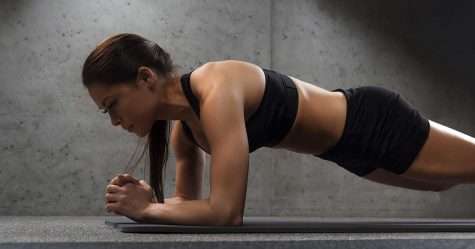
| Side Plank | Lateral trunk stability |
| Swimming | Posterior trunk endurance |
| Pilates Bridge | Hip extension and trunk-pelvic control |
The Hundred
The Hundred is a traditional Pilates exercise that combines controlled breathing with sustained abdominal engagement.
How to perform it:
- Lie on your back with your knees bent and feet resting on the floor.
- Lift your head and shoulders slightly if you can do so comfortably.
- Extend your arms alongside your body.
- Move your arms up and down in small controlled pulses.
- Coordinate your breathing with the movement.
- Continue for a manageable number of breathing cycles.
Beginners can keep their feet on the floor rather than extending their legs.
The exercise challenges abdominal endurance and breathing coordination.
Pilates Toe Taps
Toe taps are a useful beginner exercise for practicing pelvic control.
How to perform them:
- Lie on your back with your knees bent.
- Lift one leg and then the other until your hips and knees are approximately at right angles.
- Keep your pelvis steady.
- Slowly lower one foot toward the floor.
- Return it to the starting position.
- Repeat with the opposite leg.
Avoid allowing your lower back to arch excessively as your leg moves.
The goal is to maintain controlled movement rather than lower the foot as far as possible.
Single-Leg Stretch
This exercise challenges abdominal control while the legs move alternately.
How to perform it:
- Lie on your back with your knees bent.
- Bring one knee toward your chest.
- Extend the opposite leg to a comfortable angle.
- Return the extended leg and switch sides.
- Continue alternating while maintaining steady breathing.
Keep your head supported on the floor if lifting it creates discomfort.
Pilates Roll-Up
The roll-up involves controlled trunk flexion and movement through the spine.
How to perform it:
- Lie on your back with your legs extended and arms reaching overhead.
- Slowly raise your arms toward the ceiling.
- Begin lifting your head and upper body.
- Continue rolling forward only as far as you can control comfortably.
- Slowly return to the starting position.
Do not pull forcefully with your arms or use momentum to complete the movement.
Beginners who find the full roll-up difficult can practice a smaller curl-up instead.
Side Plank
Side planks challenge the muscles along the sides of the trunk.
How to perform them:
- Lie on your side with your elbow positioned under your shoulder.
- Bend your knees for an easier variation.
- Lift your hips from the floor.
- Keep your shoulders, hips, and knees aligned.
- Hold the position while breathing normally.
- Lower your hips and repeat on the other side.
As strength improves, you can progress to a version with straight legs.
Swimming
The Pilates swimming exercise challenges the muscles along the back of the body.
How to perform it:
- Lie face down with your arms extended overhead.
- Keep your neck in a comfortable neutral position.
- Gently lift one arm and the opposite leg.
- Lower them and alternate sides.
- Continue with slow, controlled movements.
Avoid lifting your limbs excessively or forcing your lower back into an uncomfortable position.
Pilates Bridge
The bridge works the gluteal muscles and challenges coordination between the hips, pelvis, and trunk.
How to perform it:
- Lie on your back with your knees bent and feet flat on the floor.
- Keep your arms alongside your body.
- Gently engage your abdominal muscles.
- Lift your hips until your body forms a comfortable diagonal line from shoulders to knees.
- Pause briefly.
- Slowly lower your hips to the floor.
Avoid arching your lower back to lift your hips higher.
The bridge is useful for developing hip extension strength alongside trunk control.
Mat Pilates vs. Reformer Pilates for Core Training
Mat Pilates and reformer Pilates use similar movement principles, but they provide different training experiences.
Mat Pilates
Usually body weight, gravity and sometimes light apparatus such as bands or balls are used.
Exercises can be adapted to increase difficulty based on body position, range of movement and leverage.
Potential benefits include:
- Easy to do at home or in a class setting.
- Minimal equipment required.
- Opportunities to build core strength and trunk control.
- Easier for beginners.
Reformer Pilates
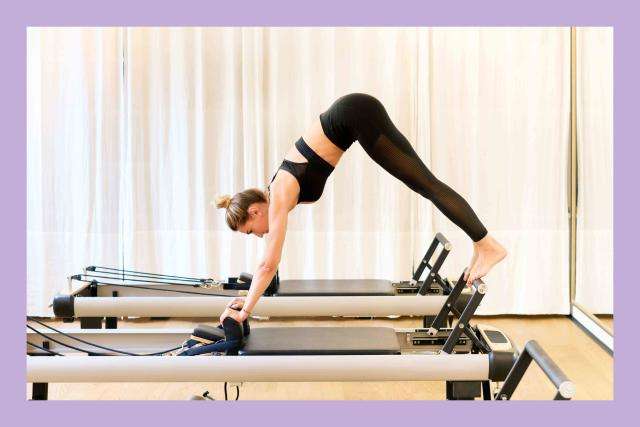
A reformer contains a sliding carriage, springs, straps and adjustable resistance.
The springs can offer resistance or assistance depending on the exercise and how the machine is set up.
Potential benefits include:
- Resistance can be adjusted.
- A wide range of supported and challenging positions.
- Opportunities to work the trunk with arm and leg movements.
- Variety of exercises which may be difficult to complete on Mat Pilates.
However, just because you’re using a reformer it doesn’t mean it will be more effective. It will depend on the exercise, resistance, technique, progression of training and individual ability.
| Feature | Mat Pilates | Reformer Pilates |
|---|---|---|
| Equipment | Mat and optional small props | Reformer machine and accessories |
| Resistance | Mainly body weight and gravity | Body weight and adjustable springs |
| Exercise Variations | Bodyweight-based movements | Machine-assisted and resisted movements |
| Core Challenge | Depends on body position and movement control | Depends on spring settings, movement, and machine position |
| Accessibility | Can be practiced at home | Usually requires access to a reformer |
| Supervision | Group classes or individual instruction | Often taught in a supervised studio setting |
Both approaches can contribute to Pilates core strength when performed consistently and with appropriate technique.
How Core Strength Supports Posture, Balance, and Daily Movement
Core muscles help control the position of the trunk and pelvis during movement.
Better trunk control may help with activities that require balance, coordination, and changes in body position.
Posture and Trunk Control
The abdominal and back muscles are involved in controlling the spine and pelvis.
Pilates encourages awareness of body position and controlled movement. Practicing these skills may help some people improve aspects of their posture.
A systematic review was conducted in 2024 looking at 13 studies involving 783 participants to look at the effects of Pilates on body posture. It was found there is some evidence to suggest Pilates may help improve certain postural issues however the quality of the studies and results varied.
However, it does not mean Pilates will fully correct all postural conditions.
Research reference: Li et al. (2024) – Effects of Pilates on Body Posture: A Systematic Review
Balance and Stability
Many Pilates exercises involve controlling your arms or legs.
This can be challenging to your balance and co-ordination especially when in kneeling, standing or side lying positions.
Improved control of your movements may assist you to perform exercises more effectively and in everyday activities.
Everyday Functional Movements
Having good core strength can help with many everyday activities such as:
- Bending over to lift items.
- Reaching items up high.
- Lifting shopping bags.
- Standing up from a seated position.
- Keeping stable when walking.
- Resistance training exercises.
Although having more core strength will not prevent injury it can improve overall physical function by improving strength and control.
Can Pilates Help You Achieve a Leaner Physique?
Pilates can be used to help improve your fitness and build a stronger and more active body. However, it is important to know how Pilates can work for you.
Muscle Strength and Endurance
The Pilates exercises will work multiple muscle groups due to the controlled movements and repetitive contractions.
Regular practice may increase muscle endurance and control. Certain exercises can also create resistance in the abdominal, hip and back muscles.
This can create a stronger look and better physical performance.
Body Composition and Fat Loss
Pilates on its own won’t necessarily help you lose body fat.
Fat loss overall is about creating an energy deficit over time. This depends on many factors such as your overall energy balance, diet, activity levels, sleep and more.
Pilates can be used to contribute to your overall physical activity but shouldn’t be shown as a way to specifically lose belly fat.
Although exercises can help strengthen your abdominal muscles, you won’t be able to control where fat is lost from your body.
Combining Pilates With Resistance Training
Pilates can be a great addition to an exercise routine if you are looking to become stronger and more toned.
For example, a balanced routine may include:
- Core control, mobility and muscular endurance using Pilates.
- Muscle building using resistance training.
- More movement through walking/other aerobic activities.
- Eating well to aid training.
Our guide on strength training for lean muscle development explains how resistance exercise can support muscle development.
The most suitable combination depends on individual goals, training experience, health, and recovery.
How Often Should You Practice Pilates for Core Strength?
There is no single training frequency that is ideal for everyone.
How much you train depends on your current fitness, how challenging the exercises are, your recovery and other physical activities.
For someone new to Pilates, beginning with two sessions per week may be a manageable approach. As technique and exercise tolerance improve, training frequency can be adjusted.
A practical routine might include:
- Training two or three times per week.
- Have active recovery or rest days between intense sessions.
- Progressing your difficulty gradually.
- Having other physical activities to get your fitness up.
A 2025 study looked at using Pilates for core stability and trained 3 times per week for 6 weeks.
You should also consider your technique and recovery. If you are continually feeling uncomfortable, too tired or your symptoms are worsening then you should alter your training and seek appropriate advice.
Common Pilates Core Training Mistakes
Good technique is more important than simply completing a large number of repetitions.
Some common mistakes can reduce exercise quality or make movements unnecessarily uncomfortable.
-
Holding your breath
Holding your breath during challenging movements can make it harder to coordinate breathing and movement.
Try to breathe steadily through all your exercises.
-
Using momentum
By swinging your legs or moving your trunk too quickly you will reduce control.
Move more slowly so you can maintain good movement patterns through your repetitions.
-
Arching your Lower Back
Some abdominal exercises become more difficult if your legs are straight.
Try to keep your knees bent or reduce how far you move if you are arching too much through your lower back.
-
Concentrating on the abdominals only
Training your core is not just about working your front stomach muscles.
Incorporate exercises that work your sides and back of the trunk.
-
Progressing too quickly
More advanced exercises are not necessarily better for beginners.
Start using simpler variations to build your control before adding resistance, reps and complexity.
-
Ignoring recovery
Your muscles need time to adapt to training.
Avoid doing tough core workouts regularly without allowing yourself to recover especially if you are also doing resistance training or other exercise.
Safety Considerations and Beginner Modifications
Exercises can be modified to suit different fitness levels however, not all exercises will be suitable for everyone.
Begin with basic exercises if you’re new to exercising.
Useful modifications may include:
- Bending knees during core exercises
- Head and neck support
- Reducing the range of movement
- Reducing the number of repetitions
- Stable surface
- Work with a qualified Pilates instructor to learn the correct techniques.
People with persistent back pain, recent surgery, significant joint problems, pregnancy-related concerns, or other medical conditions should seek appropriate professional advice before beginning or modifying an exercise program.
Stop an exercise if it causes sharp pain, unusual symptoms, or significant discomfort.

Frequently Asked Questions
Does Pilates improve core strength?
Pilates can help improve core strength. Research suggests that performing Pilates can enhance core muscle strength, depending on the programme and individual.
What Pilates exercises will improve core strength?
Useful exercises include toe taps, single-leg stretches, side planks, the Hundred, bridges, and swimming. The best starting exercises depend on your fitness level and ability to maintain good technique.
Will mat Pilates or reformer Pilates help core strength?
Both methods can challenge the core. Mat Pilates mainly uses body weight and gravity, while reformer Pilates uses adjustable spring resistance and a moving carriage. The most suitable option depends on the individual.
Will Pilates improve deep abdominal muscles?
Pilates can help challenge deep abdominal muscles such as the transverse abdominis. With controlled movements focusing on keeping the pelvis and trunk stable, this can help develop coordination and muscle function.
Can Pilates help reduce belly fat?
Pilates can help strengthen the abdominal muscles. However, you cannot specifically target belly fat. Body fat changes will depend on many factors, including your overall energy balance, diet and physical activity levels.
Does Pilates improve postural alignment?
Pilates may help improve aspects of posture by developing trunk control, body awareness, and muscular endurance. However, it does not guarantee correction of every postural problem.
How often should I be doing Pilates to improve core strength?
This will depend on your level of experience, how quickly you recover and the amount of other physical activity you are doing. To begin with you could aim for 2 sessions per week, as your form and tolerance to the exercises improve you can gradually increase.
Can beginners do Pilates core exercises?
Yes. Beginners can do modified versions of core exercises including bent knee toe taps, basic bridges and supported side planks. Controlling your movements correctly is more important than doing more advanced exercises.
Does reformer Pilates give more core strength than mat Pilates exercises?
There is not enough evidence to state that reformer Pilates will always give a better core workout than mat Pilates. If exercises are chosen appropriately, both can provide effective core challenging workouts.
Can Pilates be used instead of strength training?
Pilates can contribute to muscular strength and endurance, but it may not provide the progressive loading needed for all muscle-building goals. Combining Pilates with resistance training can provide a well-rounded programme.
Final Takeaway
Pilates core strength develops through controlled movements, breathing coordination, and exercises that challenge the abdominal, back, hip, and pelvic muscles.
Both mat Pilates and reformer Pilates can help develop core stability, muscular endurance, and movement control.
Exercises such as toe taps, side planks, bridges and modified roll-ups can help improve these skills.
Improved core control can help improve your balance, posture and physical activities in daily life. However, Pilates should not be seen as a guaranteed way to lose belly fat or achieve a certain body shape.
Pilates can be combined with progressive resistance training, regular activity, good nutrition and adequate recovery to help build a stronger and leaner body.
The most important thing is to be consistent with your Pilates, ensure you are using the right technique and progressing at a steady pace. Choose exercises that suit your personal ability and goals.
References and Further Reading
- Franks J, Thwaites C, Morris ME. (2023). Pilates to Improve Core Muscle Activation in Chronic Low Back Pain: A Systematic Review.
https://pmc.ncbi.nlm.nih.gov/articles/PMC10218154/ - Lee K. (2025). Effects of Core Stability Training on Deep Stabilizing Muscle Function and Neuromuscular Control.
https://pmc.ncbi.nlm.nih.gov/articles/PMC11944116/ - Li F, Dev Omar Dev R, Soh KG, Wang C, Yuan Y. (2024). Effects of Pilates on Body Posture: A Systematic Review. Archives of Rehabilitation Research and Clinical Translation.
https://pmc.ncbi.nlm.nih.gov/articles/PMC11447755/ - Roque GC, de Oliveira RG, Sorzi MV, de Oliveira LC. (2024). Are Pilates Exercises Effective in Improving Postural Misalignment? Systematic Review and Meta-analysis. Musculoskeletal Care.
https://pubmed.ncbi.nlm.nih.gov/39562728/