Starting to work out can be stressful, especially when the goal is to lose weight and get healthier.
Most American adults are hesitant to get into exercising due to the complex nature of the concept.
By observing the fitness level and working with achievable goals in mind, anyone can create a suitable regime that would allow them to reach their objectives, remain injury-free, and increase their chances of success.
Learn how to measure basic indicators and test accessible activities to identify the image of the desired outcome and remain motivated throughout the process.
Table of Contents
- Step 1: Assess Your Current Fitness Level
- Step 2: Set Realistic Workout Goals
- Step 3: Choose Appropriate Beginner Exercises
- Step 4: Plan Your Weekly Workout Schedule
- Step 5: Track Results and Adjust Routinely
Quick Summary
| Main Insight | Explanation |
|---|---|
| 1. Assess Your Fitness Level | Evaluate heart rate, strength, flexibility, and body composition to create personalized workout plans. |
| 2. Set Attainable Goals | Define specific, small, and time-bound objectives to enhance motivation and monitor progress. |
| 3. Choose Suitable Exercises | Select beginner-friendly workouts that match your current fitness level to encourage consistency. |
| 4. Create a Weekly Schedule | Plan well-structured workouts that balance activity, rest, and recovery for sustained fitness. |
| 5. Track and Adjust Regularly | Consistently monitor your progress and make necessary adjustments to your fitness routine for optimal results. |
Step 1: Assess Your Current Fitness Level
Before starting an exercise program, it is essential to determine a person’s baseline fitness status to set realistic expectations for a weight loss or fitness improvement plan.
Several factors should be considered when determining one’s fitness.
Some of these are indicated below.
- It is necessary to measure the heart rate: while sitting down, count the number of beats per minute.
- Test muscular strength by doing a certain number of push-ups or holding a plank position.
- Assess flexibility by performing a reach test.
- Take measurements of body composition, such as body mass index (BMI) and waist circumference.
A person can begin by testing some of the simplest components without any special equipment, such as measuring BMI. Using a stopwatch, a measuring tape, and a scale, they will be able to determine their baseline fitness data to develop a fitness plan and track their progress.
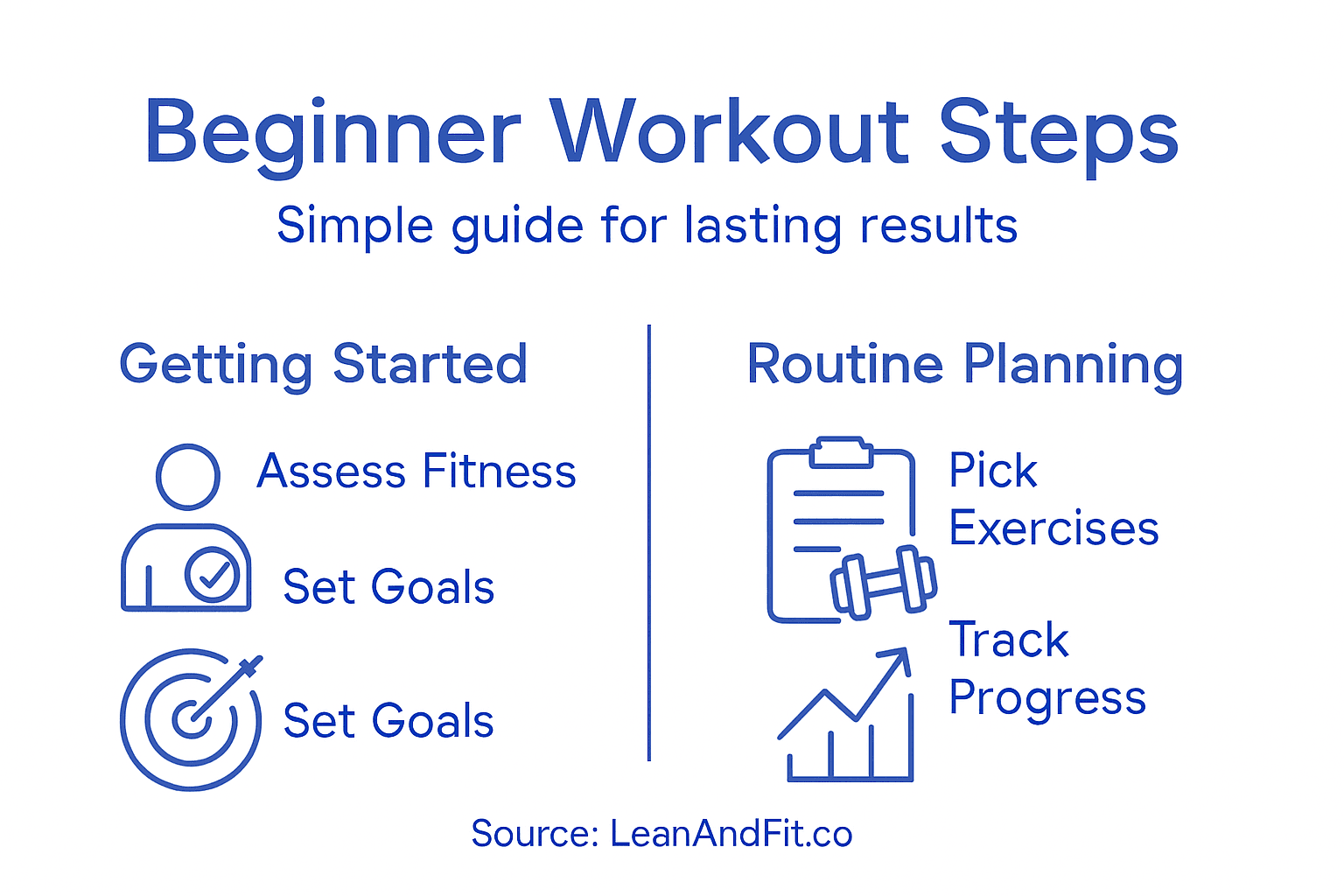
Here’s how different fitness metrics help tailor your workout strategy:
| Fitness Metric | What It Reveals | How It Guides Planning |
|---|---|---|
| Resting Heart Rate | Cardiovascular health | Sets baseline for endurance work |
| Strength Assessment | Current muscle power | Informs choice of starter exercises |
| Flexibility | Joint range of motion | Determines stretching needs |
| Body Composition | Fat and muscle levels | Personalizes weight loss targets |
Knowing your starting point isn’t about judgment – it’s about creating a personalized pathway to success.
Pro tip: Record your initial measurements in a dedicated fitness journal to visually track your transformation and stay motivated.
Step 2: Set Realistic Workout Goals
Establishing attainable fitness goals is a crucial step towards successful weight loss. Understanding how to set realistic weight loss goals will enable you to achieve your fitness objectives.
Therefore, when setting fitness goals it is essential to make them small and attainable, specific, have time frames, think about how to track progress.
Smaller and attainable goals should be set in order to achieve larger ones
Therefore, breaking larger goals into smaller, more easily achievable ones is essential. For instance, instead of setting a goal of losing fifty pounds, set a goal of losing five or ten pounds.
If the larger, more difficult to achieve goals are set right away, you may feel as if you can never reach them and give up trying. Furthermore, fitness requires a long-term commitment; therefore, it is important to have smaller goals that are easily attainable.
Next, make specific goals.
Specific goals could include a target weight or how many times a week you want to work out. In addition, try to set up a time frame for meeting your goals.
Finally, think about ways to gauge your progress.
For example, make a chart to monitor how much weight you are losing. Having a visual representation of your fitness progress can be very helpful and motivating. Furthermore, writing down your goals makes them more tangible and less like ideas.
Remember, having attainable fitness goals is the secret to successful weight loss and leading a fit and healthy life.
Step 3: Choose Appropriate Beginner Exercises
Starting your fitness journey requires choosing the type of exercises and their difficulty level.
Exercises that can be done at home for a beginner are a great way to start and determine what sport activities you enjoy and what keeps you motivated.
- You may design your own comprehensive fitness plan that includes aerobic, strengthening, flexibility exercises, and low-impact activities.
- Aerobic physical activities can include walking, swimming, and jogging.
- Strength training involves bodybuilding exercises like squats, lunges, and push-ups.
- Meanwhile, flexibility training requires stretching, toe touches, and yoga.
- Low-impact sports are perfect for people with bad knees, and they include stationary bicycling and elliptical training.
The most critical aspect of designing the fitness plan is to start with easier exercises and lower intensity and increase the time spent exercising and the load. This will allow the body to adapt to new loads gradually.
It is essential to pay attention to form to reduce the risk of injury during workout sessions and have a positive experience in exercising. If you determine that something is too hard for you, do not be afraid to ask for advice or assistance.
Working out is a process, and you should be patient with yourself and your achievements.
Step 4: Plan Your Weekly Workout Schedule
Building a proper workout plan makes it possible to achieve the desired result. A well-drafted workout plan should be highly precise and set realistic goals that are aligned with a person’s lifestyle.
The following features should be included in the weekly workout plan:
- At least 150 minutes of cardio workouts
- Two separate days for strength training
- At least one day of a rest or other activities
- One-day training for stretching
It is vital to create a schedule that would allow a person to meet all the requirements above. It can be done by allocating weekly days to particular exercises or by alternating between them as per the following example: cardio and strength training can be combined on some days as a warm-up and a stretch can replace the strength training exercises on others.

Review this weekly schedule blueprint for balanced weight loss progress:
| Day of Week | Primary Activity | Recovery Strategy |
|---|---|---|
| Monday | Cardio (Brisk walk) | Light stretching after workout |
| Tuesday | Strength training | Focus on hydration |
| Wednesday | Cardio/light yoga | Gentle mobility movements |
| Thursday | Rest or full yoga | Extra sleep or meditation |
| Friday | Strength training | Foam rolling, healthy snack |
| Saturday | Cardio (swimming) | Leisure walk for recovery |
| Sunday | Rest and reset | Plan and reflect for coming week |
Consistency matters more than perfection – build a schedule you can actually maintain.
Pro tip: Schedule your workouts like important meetings and set phone reminders to increase your commitment and follow-through.
Step 5: Track Results and Adjust Routinely
Making changes to your fitness routine in order to keep losing weight is important. By tracking your fitness it will keep you motivated and updated on where you’re body is at. Set up a system for tracking your fitness somewhere you’re able to see it.
Some examples might be:
- your body measurements such as weight, waist size, and body fat,
- reps and sets of any exercises you’re doing,
- having a picture of your body each month to track changes,
- using fitness apps or journals to keep track.
Once you’ve set up your system and have been tracking your progress for 4-6 weeks, look and see how your fitness is doing. If you’re not seeing the progress you want to see, change up your routine and try something new.
If you have hit a plateau and aren’t progressing, don’t worry that’s completely normal. Now would be a great time to change things up! Your body is always changing, so don’t be scared to change things up in your fitness journey too.
Pro tip: Take your measurements and pictures of your body at the same time each day wearing the same clothes
Take Control of Your Fitness Journey with Proven Beginner Strategies
Starting a new diet can be tricky if you’re looking to make real, lasting changes that will transform your weight loss journey.
That’s why this article focuses on getting to know your own fitness levels, setting achievable targets, and finding the motivation to make the best lifestyle choices.
If you’re looking for a series of easy to use and straightforward workouts, made specifically for beginners, you’re in the right place!
Bodyweight Exercises – LeanAndFit has developed a series of clever and effective exercises, perfect for newcomers to fitness.
In addition to these workouts, be sure to check out our Exercise Regimens – LeanAndFit, where we share expert insight into the most useful activities for building your fitness levels in any kind of weight loss journey.
Finally, be sure to try some of our Cardio Intervals – LeanAndFit , the perfect way to gently build your stamina and endurance!
Visit us at leanandfit.info to access expert advice, detailed plans, and ongoing support. Your lasting weight loss success begins with the right first step—take it now.
Frequently Asked Questions:
Q-1: Why do many beginners’ workout regimes break in the first weeks?
A-1: It is normal for a novice to overestimate their capabilities. Such people often try to do too many exercises at once and achieve the opposite result than desired. They feel enthusiastic about starting, but this enthusiasm quickly fades, and training is abandoned. The most practical way to lose weight is to remove the overload and start training lighter. Only by stimulating the body is it possible to achieve a regular, full-fledged workout.
Q-2: How can one determine that their workout regime is properly developed?
A-2: When the body starts to resist, the weight loss process begins. It is crucial not to measure the results on the scales at first but to notice changes in performance. Having more energy and being calmer, so a person will feel that training is beneficial for him in all areas of life. This state will also help to accelerate the results and carry out the workout regularly.
Q-3: Does it make sense for a beginner to focus more on cardio or weightlifting?
A-3: It is necessary to choose a balanced workout regime in which there will be a balance between different types of activities. For example, cardio is helpful for burning fat, and strength training is intended to build muscle tissue. These two types of training are complementary. In addition, a beginner should not try to do complex exercises: it is enough to start with sports activities that are most comfortable with a person.
Q-4: Is it better for a beginner to have a short and intense workout or a longer one?
A-4: The intensity of the workout and the time spent on it are directly related. The shorter the workout, the more intense it should be. With a prolonged presence in training, the attention of the novice may wander, and the results of the workout will be insignificant. Therefore, if a person has a choice and can, for example, do two-hour training, but decides to spend an hour and half on exercise – the latter will be more productive.
Q-5: How significant is the rest day for a beginner in the context of workout regimes?
A-5: The rest day is as necessary for the body as the days of training. Muscle tissues, which are actively developed during workout sessions, need rest and time to recover. Without breaks, the results will be less noticeable and fleeting. The novice should also include one or two days of rest in their regimen so as not to overload the body.
Q-6: What is the best way for a beginner to stay motivated to work out?
A-6: Most often, the motivation to work out is subjective and varies from person to person. Sometimes it is given by a personal trainer, and sometimes it is a desire right out of one’s head. This is not that important, but in order not to try to pull yourself together for a long and strenuous workout, it is enough to find a comfortable form that is suitable for the body.
Q-7: Can a person lose weight without a gym membership in the beginning?
A-7: Of course, a person can lose weight without a gym membership at the beginning. There are many ways to do workouts outside the gym. For example, one can run or walk outdoors, do sports activities in the house, and attend fitness clubs. The main thing is to find a type of activity and a trainer who will not give overestimated results because the beginner will not have such an opportunity.
Q-8: Why might a beginner find themselves in a progressive weight loss plateau?
A-8: Sometimes the cause of this is the unsuitable environment. To lose weight, a newbie needs to do sports, but a regular workout, balanced nutrition, and an increased focus on the process are also desirable. Lack of sleep, drinking, and irregular food habits can be an obstacle to weight loss. Besides, many novices, trying to achieve greater results, do the same workouts as before but only for a longer period of time.
Q-9: What psychological changes do you usually have to make for weight loss to be successful in the long term?
A-9: Weight loss is never urgent; therefore, it is necessary to change the attitude towards it and treat it as a process that extends over a long period of time. If a person looks at the situation with the prospect of at least several months, then such an approach will be much more efficient. In addition, for weight loss to be successful, it should be not only an active trainer but also a generally good mood for some time.
Recommended
- Home Exercises for Beginners: Start Weight Loss Today – LeanAndFit
- Complete Guide to Weight Loss for Beginners – LeanAndFit
- Easy Home Workouts for Effective Weight Loss Results – LeanAndFit
- Effective Workout at Home Tips for Safe Weight Loss – LeanAndFit
- How water can help you lose weight? – EQUA – Sustainable Water Bottles
- Why Trust Us?
- For educational purposes only