More than forty percent of American adults are obese. This is why the need for easy fitness regimens to do at home is so important.
For those new to exercising, working out at home can help you break through barriers and start feeling strong again in the comfort of your own home.
You will be given advice on how to set up and start your own fitness area and be on your way to shedding unwanted weight and getting real results, all without having to leave your home.
Table of Contents
- Step 1: Set Up A Safe Exercise Space
- Step 2: Select Easy Beginner-Friendly Moves
- Step 3: Create A Simple Workout Routine
- Step 4: Perform Exercises With Proper Form
- Step 5: Track Progress And Adjust Routine
Quick Summary
| Key Insight | Explanation |
|---|---|
| 1. Create a Safe Workout Area | Designate a clear, comfortable space with suitable flooring and lighting for effective exercise. |
| 2. Start with Simple Exercises | Choose easy, beginner-friendly movements like squats and walking to build confidence and avoid burnout. |
| 3. Plan a Consistent Routine | Schedule workouts 3-4 times a week, incorporating proper warmups and cooldowns for balanced fitness. |
| 4. Focus on Proper Form | Practice exercises slowly with attention to technique to prevent injuries and maximize effectiveness. |
| 5. Track Your Progress | Keep a log of your workouts and measurements to monitor changes and stay motivated in your weight loss journey. |
Step 1: Set Up a Safe Exercise Space
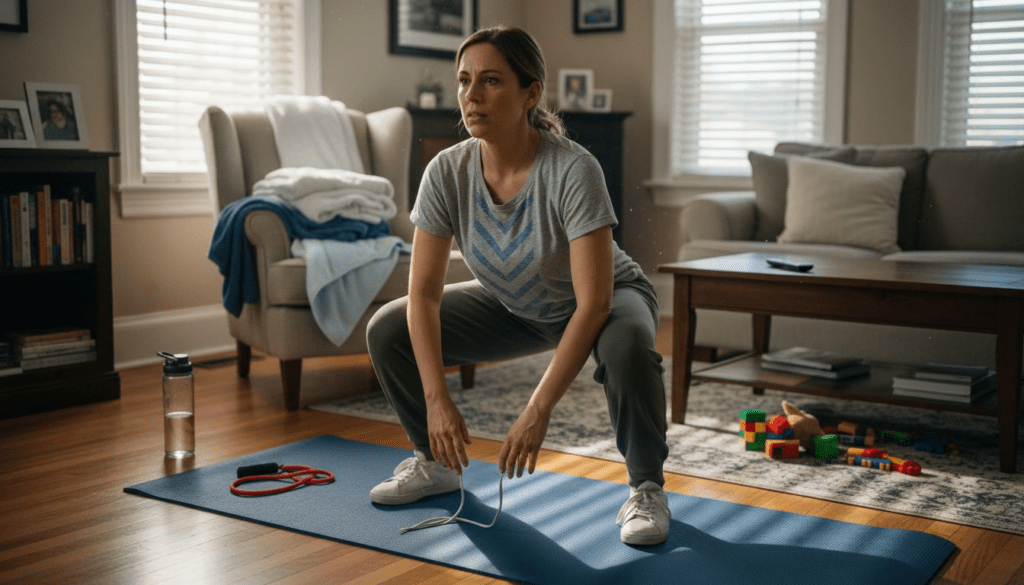
Creating a dedicated workout area in your house is crucial to your success.
It does not have to be something huge, just something that gives you enough room to move around and get your workout in.
See what areas in your house you can utilize for your workout.
When picking your area you should think about the floor, lighting, and airflow in that area.
It is best to avoid tile or thick carpets for your workout area. You want something with a little give in it. You should aim for 6×6 for your square footage so you have plenty of room to move around. It is also vital you pick an area that has ample natural lighting and airflow in it.
To make your own home workout space you will need to do a few things: Make sure you have enough square footage, have a good, comfortable, non-slip mat in the space, have some resistance bands for exercise, and have comfortable clothes to work out in.
If you have space, you can also buy some small free weights to add to your exercise area. It is also important that the space you have is kept tidy and free of things that might trip you or cause you harm during your workout.
Free Tip: A great tip for creating your own workout space is to hang a small mirror in there. This will help keep your posture and form straight and correct during your workouts.
Step 2: Select Easy Beginner-Friendly Moves
As a beginner working on your weight loss plan, it is essential to pick the most appropriate and effective exercises.
Exercises should be relatively simple, not require advanced skills, and most importantly, be beneficial for multiple muscle groups.
Your first set of workouts should be something easy to help you gain experience and avoid overexertion.
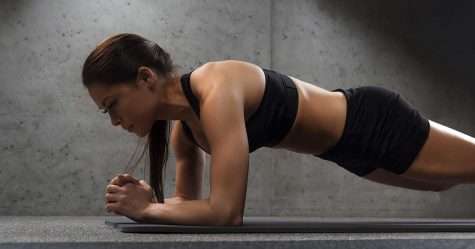
Some of the best bodyweight exercises for beginners include bodyweight squats, glute bridges, and modified pushups, as well as knee tucks. Another great addition is walking, which is a perfect low-impact activity for cardiovascular fitness.
Perform 10-15 repetitions of each exercise and try to increase this number every time you do these workouts.
Free Tip: Focus on the technique and controlled movements rather than the number of reps or how fast you perform the movements.
As you progress, you can combine these basic moves into simple circuits that keep your workouts interesting and challenging. Listen to your body and take breaks when needed. Consistency is far more important than intensity when you are just starting out.
Here’s a quick comparison of basic bodyweight exercises for beginners:
| Exercise | Main Muscles Worked | Ideal Repetitions | Common Mistake to Avoid |
|---|---|---|---|
| Bodyweight Squat | Quadriceps, glutes, core | 10-15 per set | Knees caving inward |
| Glute Bridge | Glutes, hamstrings, core | 10-15 per set | Overarching lower back |
| Modified Pushup | Chest, arms, core | 10-15 per set | Hips sagging or back arched |
| Walking | Legs, cardiovascular | 10-20 minutes | Slouching posture |
Pro Tip: Take short videos of yourself performing these exercises to track your form and monitor your progress over time.
Step 3: Create a Simple Workout Routine
Designing your first workout does not need to be hard.
The idea is to think of a plan that will keep you motivated and help you achieve your goals. You can find home workout ideas online that can help you come up with your own schedule and plan.
First, think about how many days a week you will be able to work out. It is good to start slow and stick to it. Try to work out three to four times a week. Each time you work out plan to spend five to ten minutes warming up and another five to ten minutes cooling down.
Warm up with a light walk or some mild stretching and then do twenty minutes of bodyweight exercises. Do ten to fifteen repetitions of each exercise with breaks in between. As you get stronger you can try to do more repetitions or add weights.
Remember it is better to go slower and be consistent rather than working out hard for a couple of days and then stop. Write down what you did for a workout in a journal or fitness app so that you can see how far you have come. Listen to your body and give yourself rest when you need to take a break.
Do not get discouraged if you miss a day, just go back to your workout the following day.
Pro Tip: It is important to schedule your workouts like you would any other important event and lay out your workout clothes the night before so you are more likely to do it. I hope this gives you some good ideas for your first ever workout!
Step 4: Perform Exercises With Proper Form
Mastering weight lifting technique for the weight loss newbie is the key to staying injury-free and getting the best possible results.
Bodyweight and Free Weights Exercises for Weight Loss Newbies Tips:
- Prioritize correct form by doing each exercise slowly and methodically in front of a mirror or with a phone camera at first.
- Hold dumbbells shoulder-width apart or place palms against your thighs while doing lunges in order to keep your upper body upright.
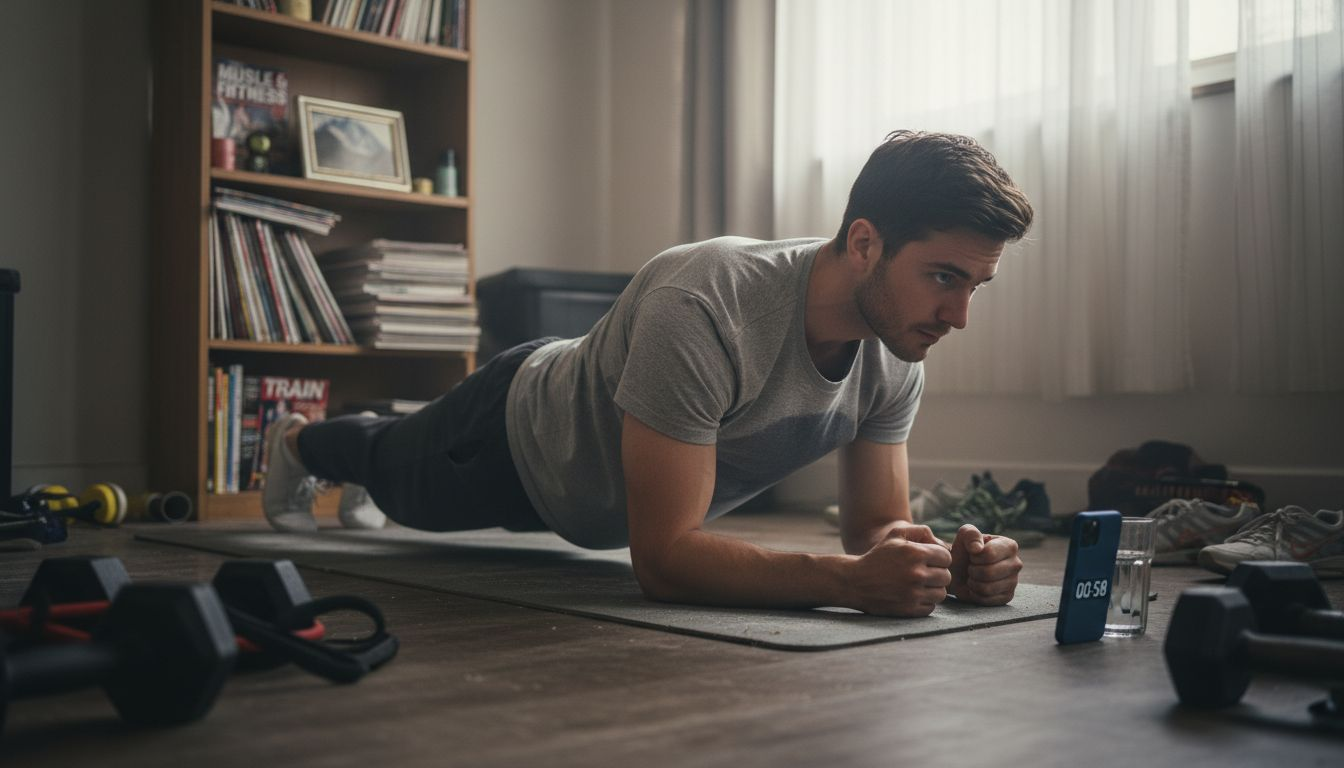
- Straighten your back while performing push-ups, so your body forms a straight line from your heels to your head.
- For lunges keep your knee pointing forward and do not extend it too far forward.
If you need assistance or have questions regarding proper form, you might want to consult online tutorials or ask a personal trainer for advice.
Do not rush the movement and make sure to prioritize form over quantity. It is better to do fewer reps with perfect technique than the recommended number of repetitions with poor form.
Pro Tip: Record your workout with a phone from different angles to examine the form and analyze it against the example performed by fitness experts.
Step 5: Track Progress and Adjust Routine
Tracking your fitness journey may involve more than stepping on a scale.
Workout tracking strategies for beginners can help you learn about your progress and make better choices in your fitness regimen. Knowing how to properly track and adjust your workout can keep you on track with your fitness goals and weight loss journey.
Create a basic workout log that you can refer to for each workout. Make sure to note what exercises you are doing, sets and reps performed, how long the workout lasted and how you felt during and after the workout.
Keep track of other fitness measurements that are important to you besides your weight. Keeping track of body measurements, progress photos, and how your clothes fit can be a good indicator of progress. Take note of how you feel physically, emotionally and even how well you are sleeping.
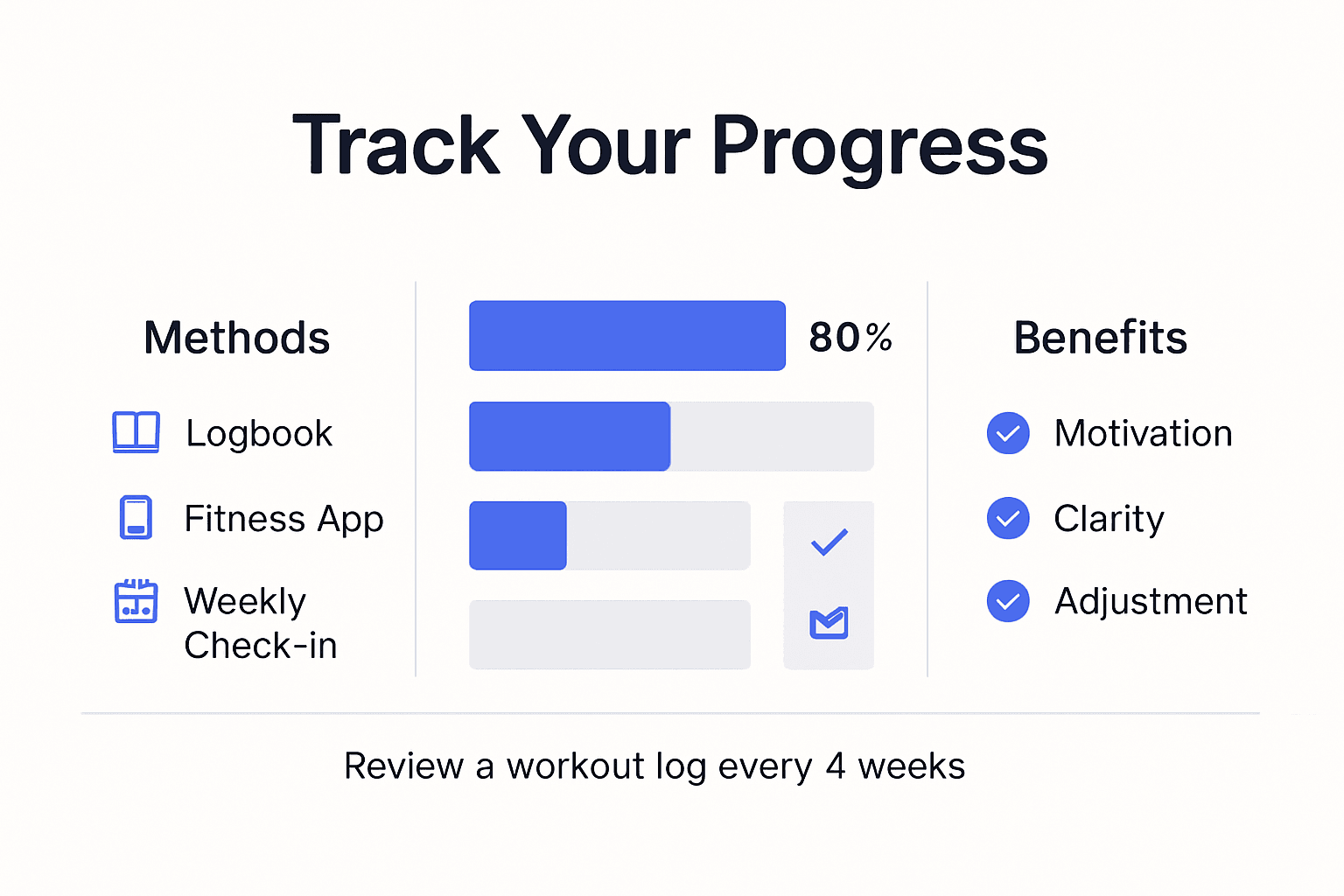
Every 4-6 weeks, one should look through their workout journal to monitor their progress. If they notice that certain activities have become easier or they have hit a plateau, it’s time for new exercises or to increase weights.
One should either increase the number of repetitions, try a more difficult variation, or increase the load.
It all depends on what works for the individual to stimulate their body into a new state of weight loss.
Use this summary to choose effective ways to track your fitness progress:
| Tracking Method | What It Measures | Benefit |
|---|---|---|
| Workout Log | Sets, reps, duration | Identifies consistency trends |
| Progress Photos | Physical appearance | Visualizes body composition over time |
| Body Circumference | Inches lost/gained | Shows muscle growth or fat loss |
| Fitness App | Comprehensive metrics | Automates and visualizes progress |
| Clothing Fit | Comfort in clothing | Detects subtle body changes |
Pro Tip: Use a dedicated fitness app or simple spreadsheet to make tracking automatic and visualize your progress over time.
Take Control of Your Weight Loss Journey with Expert Guidance
Starting your weight loss journey with home exercises can be confusing when it comes to developing a suitable routine.
The article discusses the issue of finding the right space to work out, learning basic movements, and preventing improper form during exercises.
If you are determined to begin your journey to permanent weight loss and do not know where to start, refer to the content provided by leanandfit.info .
Check out their comprehensive guides to Bodyweight Exercises and Resistance Workouts to learn how to level up your fitness at home.
Do not wait any longer to improve your health condition and develop healthy habits. Turn to LeanAndFit to get advice on exercise tracking and proper routine creation for a successful weight loss journey.
Frequently Asked Questions:
Q-1. Can the first home workout for weight loss be deliberately easier than I think I need?
A-1. Yes. For a beginner, the first objective is not to deplete yourself, but to create a repeatable workout . Starting with exercises that are within your limited capability (such as marching, chair squats, wall push-ups) and gradually raising time or intensity allows your body to adjust. Current recommendations specifically advise inactive adults to start small and progress.
Q-2. Why can a living-room workout become a better weight-loss starting point than a “perfect” gym program?
A-2. With convenience, the barriers between decision and action are eliminated. A beginner can do bodyweight exercises, walking, dancing, stair climbing, resistance exercises at home without a gym membership. The most ideal starting workout is the one you can do.
Q-3. Could five minutes of home exercise be a legitimate starting point for someone who has been inactive for years?
A-3. Yes. Five minutes can be a small start that can snowball into a bigger time commitment than an overzealous beginner might attempt right away. In fact, health professionals advise inactive people to start small and gradually increase time and frequency.
Q-4. What makes a beginner home exercise “weight-loss friendly” if it does not leave me completely exhausted?
A-4. The main requirement is that the exercise be challenging enough to not deter you from the next workout. Brisk walking around the house, marching, dancing, chair squats, wall push-ups, resistance exercises, etc. will help you accumulate a physically active lifestyle. Since weight loss is a matter of calories in and calories out, the workout will serve as an aid to healthy eating, rather than a means to judge yourself by how tired you are.
Q-5. Can household objects turn an ordinary home workout into strength training without buying exercise equipment?
A-5. Yes, except that you must prioritize safety first, then consider muscle-building potential. Your bodyweight already offers resistance, and household activities can provide a challenge. Muscular strength and endurance are officially recognized as being enhanced through bodyweight exercises such as push-ups and planks. Resistance bands and weights can be added if budget allows, but you can start without them.
Q-6. Why should a beginner combine slow strength exercises with faster movements instead of doing only cardio at home?
A-6. Different types of exercises offer different benefits. Aerobic exercises improve heart and lung health and are essential, but muscle-strengthening activities are also important for building and maintaining muscle mass, especially during weight loss. Adults are recommended to include muscle-strengthening exercises on at least 2 days a week.
Q-7. Could repeating the same beginner workout every day actually slow my progress toward a sustainable routine?
A-7. Yes, if you do the same tiring exercises every day, you might find it challenging to keep doing them. A beginner should aim for a balanced workout, alternating between aerobic, muscle strengthening, and lighter range-of-motion or mobility exercises on different days. This way, every day you look forward to a new activity, and your whole body gets equal attention.
Q-8. How can someone tell whether a home workout is challenging enough without owning a heart-rate monitor?
A-8. The talk test! If you can talk comfortably while exercising, it means that your heart rate is not elevated beyond your resting rate. You should be breathing somewhat heavily, but you shouldn’t feel uncomfortable saying a few words. If it feels too hard, you’re probably doing a vigorous workout, which might not be right for a beginner.
Q-9. Can turning everyday home movement into exercise help a beginner reach a weight-loss goal without adding another formal workout?
A-9. Yes. Formal workouts are not the only or necessarily the best way to get exercise. Climbing stairs, doing chores, dancing, walking around the house, gardening, etc. are all good ways to stay active. In recent years, health professionals have advocated a physically active lifestyle, which includes informal exercises and reducing the amount of time spent sitting.
Q-10. What should a beginner increase first-home workout time, exercise intensity, or number of workout days?
A-10. There is no right or wrong answer, but it’s usually better to ease into a new exercise routine. Once a solid, tolerable routine has been established, you can increase duration, intensity, or frequency. The long-term goal for adults is 150-300 minutes of moderate aerobic activity and at least 2 days of muscle-strengthening activity per week, but it’s a gradual progression.
Recommended
- 7 Home Workout Ideas for Weight Loss and Fitness Success – LeanAndFit
- Easy Home Workouts for Effective Weight Loss Results – LeanAndFit
- How to Start Exercise Naturally for Weight Loss Success – LeanAndFit
- Complete Guide to Weight Loss for Beginners – LeanAndFit
- 20-in-1 Push Up Board – Portable Foldable Strength Training Equipment – Voket
- Why Trust LeanAndFit.info?
- For educational purposes only