Beginning strength training can be pretty daunting when you’re new to exercising. You might be unsure of what exercises to do or how often to train or how much weight to use.
To start with though you don’t need to worry about spending a lot on a gym membership or having a complicated workout. Many great strength exercises can be done at home using just bodyweight, resistance bands and a few simple pieces of equipment.
When starting strength training as a beginner it’s more about learning the basics, getting into good form and slowly building up your strength. You won’t need to lift heavy weights straight away.
By starting with a simple routine and making a consistent effort, you can build strength, improve your physical fitness, and develop healthy habits.
This guide will show you how to get started, what exercises to do, how to plan your week and track your progress safely.
Table of Contents
- What Is Strength Training and Why Should Beginners Start?
- What Do You Need to Begin Strength Training?
- How Often Should Beginners Do Strength Training?
- Best Beginner Strength Training Exercises
- A Simple Full-Body Beginner Strength Training Workout
- How to Perform Strength Training Exercises With Proper Form
- How to Progress as Your Strength Improves
- How to Track Your Strength Training Progress
- Common Beginner Strength Training Mistakes
- Frequently Asked Questions
- Bottom Line
- References
What Is Strength Training and Why Should Beginners Start?
Strength training is a type of exercise in which your muscles work against resistance. This resistance can come from dumbbells, barbells, resistance bands, exercise machines, or your own body weight.
When you perform exercises such as squats, push-ups, rows, and lunges, your muscles produce force to control and complete each movement.
With regular training, your body can adapt by improving muscular strength, exercise performance, and, over time, muscle size.
There are many reasons why beginning strength training can be beneficial to beginners.
Improves muscular strength: Regular resistance training can improve your strength and make everyday activities easier, such as carrying shopping, climbing stairs, and lifting objects.
Promotes muscle growth: To promote muscle growth you need some sort of stimulus such as strength training and the right nutrition and recovery.
Supports bone health: Resistance training places mechanical stress on bones, which can help support bone health.
Improves physical function: Getting stronger muscles can help you move better in daily life.
Supports healthy aging: Maintaining muscle strength can help support mobility, independence, and physical function as you age.
The American College of Sports Medicine’s 2026 position stand supports resistance training for improving muscular strength, muscle size, and physical performance.
You don’t have to start doing all of these straight away. Start with a manageable routine and build up your consistency.
What Do You Need to Begin Strength Training?
One advantage of beginner strength training is that you can start with relatively little equipment.
Your first area to train in should be comfortable, clear and big enough to move around in.
Choose a suitable workout area
When exercising at home find a flat surface to work on.
Ensure there is enough stability on the floor. Also ensure there are no obstructions.
Having good lighting and air flow will help to make your working area more comfortable.
Start with basic equipment
You don’t need to buy everything.
Here are some items you may find useful:
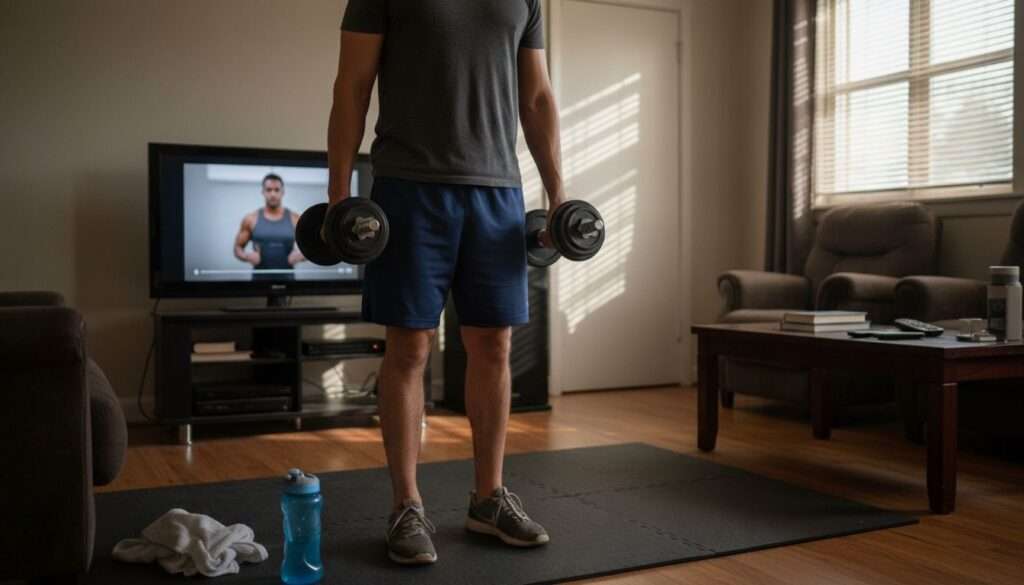
Exercise mat – for floor-based exercises.
Light dumbbells – for resistance exercises.
Resistance bands – for rowing exercises.
A stable chair or bench.
Water bottle and towel.
You can start doing body weight exercises to begin with and add equipment as your strength and confidence improves.
Wear comfortable clothing
Wear clothes that let you move easily. Wear secure shoes suitable for the exercises you are doing.
Make sure your area is tidy and your equipment won’t cause you to trip.

How Often Should Beginners Do Strength Training?
You don’t need to work out every day when you’re a beginner.
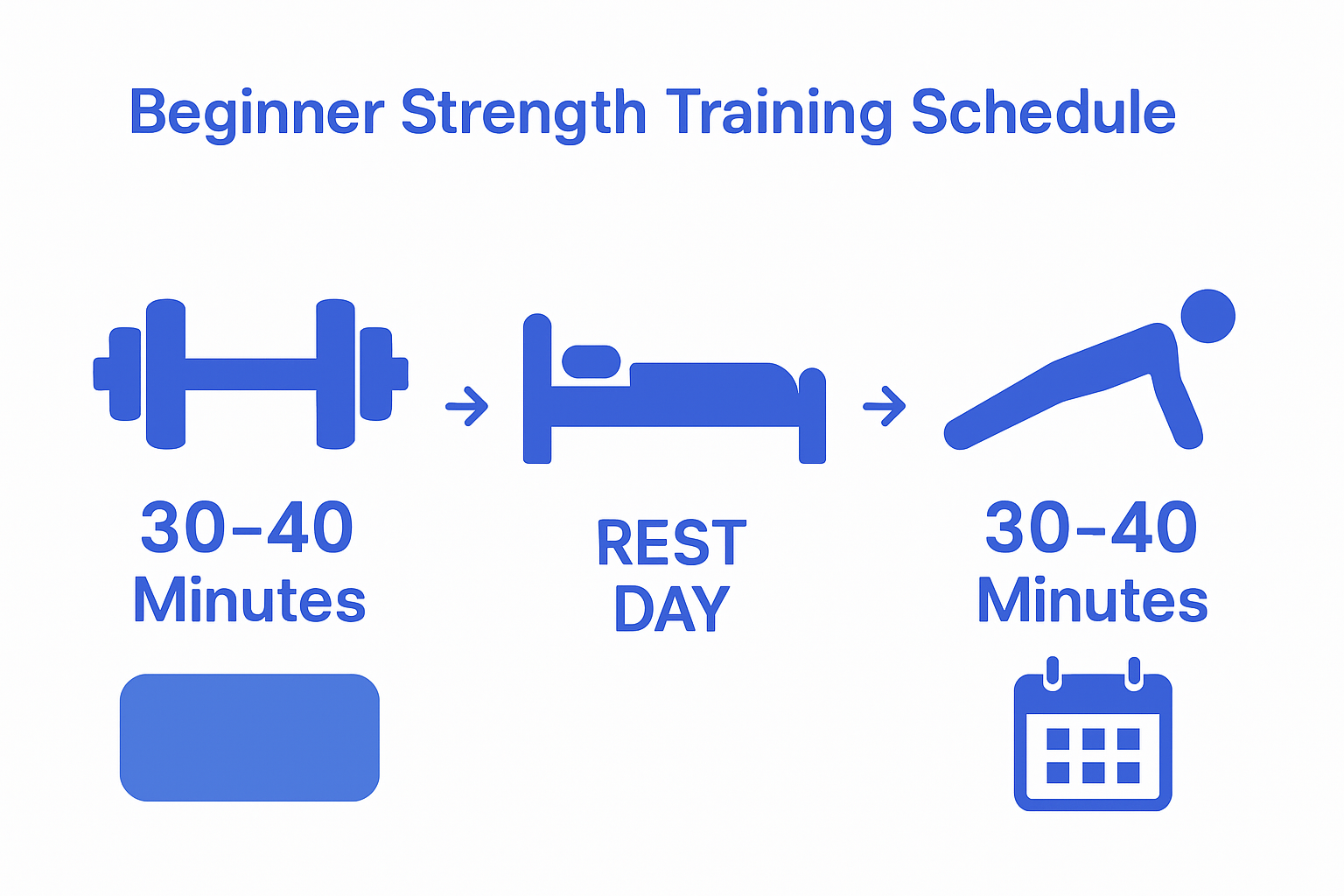
Start with two full body strength sessions a week, allowing recovery time between intense sessions.
For example, your sessions could be on a Monday & Thursday.
As you become fitter and more comfortable with the exercises, you may choose to increase the number of weekly sessions.
Example weekly beginner strength training schedule
| Day | Activity |
|---|---|
| Monday | Full-body strength training |
| Tuesday | Walking or light physical activity |
| Wednesday | Rest or gentle mobility exercises |
| Thursday | Full-body strength training |
| Friday | Walking or light physical activity |
| Saturday | Optional light activity |
| Sunday | Rest |
This is an example rather than a fixed requirement. You can adjust your schedule according to your availability, experience, and recovery.
The World Health Organization recommends that adults undertake muscle-strengthening activities involving all major muscle groups on at least two days per week.
Strength training is just one part of having an active lifestyle. You can also walk, cycle or do other forms of aerobic exercise.
Best Beginner Strength Training Exercises
A good beginner routine should include movements that train the major muscle groups.
You do not need dozens of exercises. A small selection of fundamental movements can provide a useful starting point.
Bodyweight Squats
Bodyweight squats work the lower-body muscles, including the quadriceps and glutes.
How to perform them:
- Stand with your feet approximately shoulder-width apart.
- Keep your chest comfortably lifted and your feet firmly on the floor.
- Bend your hips and knees to lower yourself into a comfortable squat.
- Keep your knees tracking in the direction of your toes.
- Push through your feet to return to the starting position.
Begin with a comfortable range of movement. If you need extra support then you can use a stable chair behind you.
Incline Push-Ups
Incline push-ups work your chest, shoulder, and triceps muscles.
They can be a good option for beginners because placing your hands on an elevated surface reduces the amount of body weight you need to push.
How to perform them:
- Place your hands on a stable elevated surface, such as a secure bench.
- Step your feet back and form a straight line from your head to your heels.
- Bend your elbows and lower your chest toward the surface.
- Push through your hands to return to the starting position.
Choose an incline that allows you to maintain control throughout the movement.
Glute Bridges
This exercise mainly targets the glutes but also works the hip muscles.
How to perform this exercise:
- Lie on your back with your knees bent.
- Place your feet flat on the floor, approximately hip-width apart.
- Gently tighten your abdominal muscles.
- Lift your hips until your body forms a comfortable line from your shoulders toward your knees.
- Lower your hips slowly then repeat.
- Don’t overarch your lower back when lifting.
Resistance-Band Rows
Resistance-band rows train the muscles of the upper back and arms.
How to perform them:
- Secure a suitable resistance band according to its manufacturer’s instructions.
- Hold the band with both hands.
- Sit or stand with your back comfortably upright.
- Pull your hands toward your torso while bringing your shoulder blades gently together.
- Return slowly to the starting position.
Always make sure the band and its anchor are secure before beginning.
Lunges
Lunges train the quadriceps, glutes, and other muscles involved in lower-body stability.
How to perform them:
- Stand upright with your feet comfortably apart.
- Step forward with one foot.
- Bend both knees while lowering your body under control.
- Keep your front knee aligned with your foot.
- Push through your front foot to return to the starting position.
If standard lunges feel difficult, begin with supported split squats while holding a stable surface.
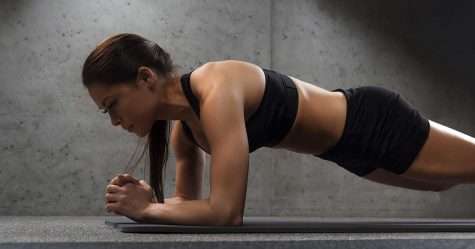
Planks
Planks train the abdominal muscles and other muscles that help stabilize the trunk.
How to perform them:
- Position your forearms on the floor.
- Extend your legs behind you.
- Keep your body aligned without allowing your hips to drop.
- Tighten your abdominal muscles gently.
- Hold the position for a manageable period while breathing normally.
Beginners can start with a knee plank if a full plank is too challenging.
A Simple Full-Body Beginner Strength Training Workout
You can put together a simple full-body workout using the exercises above.
As a starting point try the following circuit, changing the variations and number of repetitions to suit your current level of ability.
| Exercise | Sets | Repetitions or Duration |
|---|---|---|
| Bodyweight squats | 2 | 8–12 |
| Incline push-ups | 2 | 6–10 |
| Glute bridges | 2 | 10–15 |
| Resistance-band rows | 2 | 8–12 |
| Supported lunges | 2 | 6–8 per leg |
| Plank | 2 | 15–30 seconds |
How to complete the workout
Start with 5 minutes of light exercise. This could be marching on the spot and gentle joint movements.
Complete the recommended number of sets and reps for each exercise.
Take breaks between sets. This will help you to keep your form consistent. The length of your breaks will depend on the exercise and your fitness level.
You should be feeling that you could complete a few more controlled reps in most sets.
If you find an exercise too hard, choose an easier version. If you are always finding it too easy you can increase the difficulty gradually.
How to Perform Strength Training Exercises With Proper Form
Having good technique when exercising is important.
This will help you to move with control, use the correct range of movement and track progress more effectively.
Here are a few general tips.
Controlled Movement
Control your speed to ensure you are not rushing through the exercises. Ensure you are moving the resistance under control.
Controlled Range of Movement
Ensure your range of movement keeps you comfortable. Do not force a joint through any uncomfortable ranges.
Stable Positioning
Ensure you are not over rotating or swaying your body during the exercises.
Appropriate Resistance
If you are new to the exercise begin with body weight or low resistance.
Controlled Breathing
Avoid holding your breath. Exhale during the harder part of the movement and inhale as you return to the starting position.
Normal muscular effort is different from sharp or unusual pain. If an exercise causes pain, stop performing the movement. Seek appropriate professional guidance if the pain persists or you are unsure how to proceed.
Qualified Fitness Professionals
If you are unsure how to do an exercise a qualified fitness professional can assist you with the correct technique.
How to Progress as Your Strength Improves
As you become more comfortable with beginner-level exercises, you may notice that some movements start to feel easier. This is a normal part of adapting to regular training.
To continue improving, you can gradually increase the demands placed on your muscles. This approach is known as progressive overload.
This can be done in a few ways:
Increasing Repetitions
If you started doing 8 reps of an exercise, you can gradually increase it to doing 10-12 reps with good form.
Increasing Resistance
When you can comfortably do the top end of your intended rep range, you can increase the resistance slightly.
For example, you can swap to a slightly heavier dumbbell.
Increasing Sets
You can also increase your training volume by gradually adding another set to an exercise.
However, this may not always be needed so take into consideration your recovery, experience and overall workload.
Making the Exercise Harder
You can also increase the difficulty of exercises.
For example:
- Wall push-ups to incline push-ups.
- Incline push-ups to push-ups.
- Assisted squats to bodyweight squats.
- Supported lunges to unsupported lunges.
You don’t want to make every workout harder. You just want to make small improvements when you can manage your current training.
For a more detailed explanation, read our guide on progressive overload for muscle growth.
How to Track Your Strength Training Progress
Tracking your workouts can help you identify improvements and decide when to adjust your routine.
You don’t need a high tech fitness tracker or complex app, a simple notebook or spreadsheet will do.
Record the following information after each workout:
- Exercise performed.
- Weight or resistance used.
- Number of sets completed.
- Number of repetitions completed.
- Exercise variation.
- Any notes about technique or effort.
You might start off doing 2 sets of 8 incline push-ups. After a few sessions, you could be doing 2 sets of 10 using the same incline with good form.
This is a clear improvement.
Look at progress over several weeks
Your performance may vary depending on the day.
The amount of sleep you had, your stress levels, diet, daily activity and recovery can all have an effect on how well you feel.
Don’t worry if you have a tough workout.
You should see slow improvements over the course of a few weeks.
Common Beginner Strength Training Mistakes
Beginners sometimes make training more complicated than necessary. Avoiding a few common mistakes can make it easier to develop a consistent routine.
Too much resistance may be difficult to control
Using too much resistance can make it difficult to control an exercise and maintain proper technique.
Training too frequently
Allow your muscles time to recover.
When starting strength training, it isn’t necessary to exercise every day. Create a reasonable weekly plan and modify it as you gain experience.
Poor Exercise Technique
More reps does not necessarily mean you are improving.
If you’re using momentum, shortening your range of motion unnecessarily, or losing control of an exercise, it can become more difficult to assess your progress.
Too many variables
It can be hard to see how your body is responding if you’re increasing weight, reps, sets and how often you’re training.
Make small changes and track your performance.
Everyone is different
Not everyone has the same experience with training. People have different capabilities and recoveries.
You should measure your improvements against your previous performance rather than comparing yourself with someone else’s workout.
Not allowing recovery
Training is just one part of building strength.
Getting enough sleep, eating the right foods and allowing recovery between intense training can help you train consistently.
Frequently Asked Questions
How should a beginner start strength training?
Start with a few fundamental exercises that train the major muscle groups. Bodyweight squats, incline push-ups, glute bridges, resistance-band rows, and planks are useful options for beginners.
How many times per week should a beginner strength train?
Two full-body strength training sessions per week can provide a practical starting point.
As your fitness improves, you may adjust the frequency according to your goals, training experience, and recovery.
Can beginners do strength training at home?
Yes! Many strength exercises can be done at home. You can use body weight, resistance bands or dumbbells.
Start with simple movements such as squats, incline push-ups, glute bridges and planks.
How many repetitions should beginners perform?
A good place to start with many beginner exercises is around 8-12 repetitions per set.
Some exercises will have less repetitions and some will be for a set amount of time. Choose a range that allows you to maintain good form.
Should beginners lift heavy weights?
No, beginners do not need to use heavy weights.
Start with a weight that you can control during the exercise. As you become stronger and improve your form you can increase the weight.
Do I need to feel sore after strength training?
No, soreness is not an accurate indicator of how well you have trained.
You can improve your strength without experiencing significant soreness after every workout. If you experience severe or unusual pain, stop training and seek appropriate professional advice.
How long does it take to see results from strength training?
This will vary between individuals.
Some beginners may see improvements in their performance and strength before seeing any changes in their muscle size.
Your results will depend on how consistent you are with your training, what exercises you are doing, your diet, recovery and individual factors.
Instead of worrying about how long it will take to see results, keep track of your performance and improvements.
Can beginners build muscle without going to the gym?
Yes! Using body weight exercises and resistance bands can give you an effective stimulus.
As you improve your strength you can increase the number of repetitions, move onto harder variations and add extra resistance.
For more information, see our guide on bodyweight exercises without weights.
Should beginners train every muscle group in one workout?
A full body session can be a good option for beginners. This will allow you to work the major muscle groups in a small number of sessions per week.
It will also make it easier to create a consistent routine.
What should beginners do on rest days?
On rest days you can do regular activities, walk or do some light mobility exercises if comfortable.
You do not need to do another intense strength session. Give your body time to recover between intense sessions.
Bottom Line
You do not need complicated routines, expensive equipment, or heavy weights to begin strength training.
Start with basic movements to work your main muscles. Make sure you perform them correctly, plan a realistic weekly routine and ensure you are allowing enough time to recover between intense workouts.
Increase the number of reps, resistance or difficulty of the exercises as your strength improves. Keeping track of your progress will help you see where you are improving and make logical changes.
The most important thing to consider when starting strength training is how to stay consistent with your training.
With patience, appropriate training, and gradual progression, you can develop strength and build a foundation for long-term fitness.
References
- Currier BS, D’Souza AC, Fiatarone Singh MA, et al. Resistance Training Prescription for Muscle Function, Hypertrophy, and Physical Performance in Healthy Adults: An Overview of Reviews. Medicine & Science in Sports & Exercise. 2026. Read the full review on PubMed Central.
- World Health Organization. WHO Guidelines on Physical Activity and Sedentary Behaviour. 2020. Read the guidelines.
- National Health Service. Strength Exercises. View the exercise guidance.
- American College of Sports Medicine. Resistance Training Guidelines and Resources. Visit ACSM.
Why Trust LeanAndFit.info?
Learn about our editorial standards and approach to health and fitness information.